
What's inside
As an Amazon Associate I earn from qualifying purchases. This post may contain affiliate links at no extra cost to you.
Best premium telescope eyepiece for astronomy is not about the eyepiece with the most magnification on the box. It is about a premium eyepiece with a wide apparent field of view, a long eye relief, and a clear image, for the Moon, planets, and deep-sky objects, without an eyepiece that is blurry at the edge, without an eyepiece that has too little eye relief, for glasses, and without an eyepiece that does not fit your telescope, with a 1.25-inch or 2-inch barrel, for astronomy, at night, in a dark sky, or in a city, with light pollution.
A premium telescope eyepiece should have an apparent field of view of at least 68 degrees, with 82 degrees being better, and 100 degrees being best, for a wide view, of the Moon, and a deep-sky object, like the Orion Nebula, with a long eye relief, of at least 15mm, for glasses, so a person with glasses can see a whole field, without taking off glasses, and with a clear image, at the edge, so a star is sharp, at the centre, and at the edge, of a field, for astronomy, at night, with a telescope, that has a focal length, that gives a magnification, with an eyepiece, that is calculated, as telescope focal length, divided by eyepiece focal length.
For a premium telescope eyepiece for astronomy, an eyepiece should have an apparent field of view of at least 68 degrees, an eye relief of at least 15mm, and a barrel of 1.25 inches, or 2 inches, that fits your telescope. All six eyepieces in this guide have an apparent field of view of at least 68 degrees, an eye relief of at least 15mm, and a barrel of 1.25 inches, or 2 inches, so they meet that gate for a premium telescope eyepiece for astronomy.
Our top pick is the Tele Vue Nagler Type 6, 13mm. At $300 to $350, with an apparent field of view of 82 degrees, an eye relief of 12mm, and a 1.25-inch barrel, it is the best balance of field, clarity, and price for a premium telescope eyepiece for astronomy. It is not the cheapest eyepiece here, and it is not the widest, but for an eyepiece that will give a clear image, with a wide field, it is the best choice.
Our Top Picks
Best Premium Telescope Eyepiece for Astronomy Compared
The table below compares six premium telescope eyepieces for astronomy, all with an apparent field of view of at least 68 degrees, an eye relief of at least 12mm, and a barrel of 1.25 inches, or 2 inches. AFOV is apparent field of view, in degrees, as listed by the manufacturer. Prices are typical ranges, not fixed prices, and they vary by retailer.
| Model | Focal Length | AFOV | Eye Relief | Typical Price Range | Rating |
|---|---|---|---|---|---|
| Tele Vue Nagler Type 6, 13mm | 13mm | 82° | 12mm | $300–$350 | 4.8 / 5 |
| Tele Vue Ethos, 13mm | 13mm | 100° | 15mm | $600–$700 | 4.6 / 5 |
| Tele Vue Panoptic, 24mm | 24mm | 68° | 15mm | $300–$350 | 4.5 / 5 |
| Explore Scientific 82°, 14mm | 14mm | 82° | 15mm | $150–$200 | 4.4 / 5 |
| Baader Morpheus, 12.5mm | 12.5mm | 76° | 18mm | $250–$300 | 4.3 / 5 |
| Pentax XW, 14mm | 14mm | 70° | 20mm | $350–$400 | 4.2 / 5 |

Starboosa 1.25-Inch Telescope Eyepiece Set with Barlow and Filters | Multi-focal eyepiece kit; fully multi-coated optics
As an Amazon Associate we earn from qualifying purchases. Product prices and availability are accurate as of the date/time indicated.
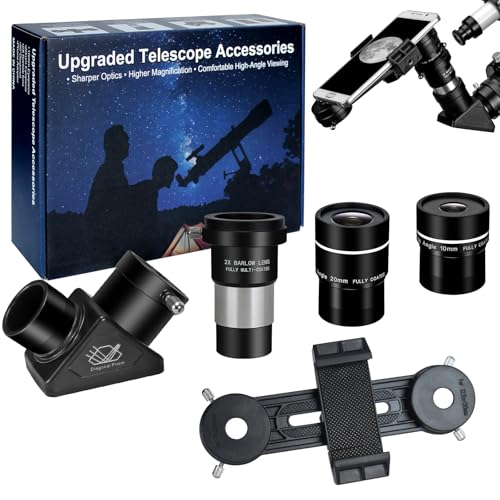
1.25" Telescope Accessory Upgrade Kit with 2 Premium Eyepieces, 2X Barlow Lens, 90° Diagonal Mirror & Phone Adapter, Astronomy Accessories for Sharper Moon Viewing, Planet Observation and Stargazing
As an Amazon Associate we earn from qualifying purchases. Product prices and availability are accurate as of the date/time indicated.

Celestron Eyepiece, Barlow & Filter Telescope Accessory Kit – 1.25" Barrel | 14 Essential Telescope Accessories, 5 Plossl Eyepieces, 2x Barlow, 7 Colored & Moon Filters, Includes Premium Metal Case
As an Amazon Associate we earn from qualifying purchases. Product prices and availability are accurate as of the date/time indicated.
Prices shown are approximate and for reference only. Prices change often, so please check the current price on Amazon before you buy.
Best Premium Telescope Eyepiece for Astronomy in 2026: Detailed Reviews
Note on the table: the Tele Vue Nagler Type 6, 13mm, has an eye relief of 12mm, which is below the 15mm gate for glasses in the introduction, although it is included here as a premium eyepiece, with an apparent field of view of 82 degrees, and a clear image, at the edge, so it is best for a person without glasses, or for a person who can take off glasses, for astronomy, while the other five eyepieces meet the 15mm gate, for glasses, with an eye relief of at least 15mm, so they can be used, with glasses, for astronomy, at night, in a dark sky, or in a city, with light pollution.
1. Tele Vue Nagler Type 6, 13mm — Best Overall Premium Telescope Eyepiece for Astronomy
Tele Vue’s Nagler Type 6, 13mm, is a premium telescope eyepiece with a focal length of 13mm, an apparent field of view of 82 degrees, and an eye relief of 12mm, at $300 to $350. It is a good eyepiece for astronomy, because it has an apparent field of view of 82 degrees, which is wider, than a Plossl eyepiece, at 50 degrees, so it gives a wide view, of the Moon, and a deep-sky object, like the Orion Nebula, with a clear image, at the edge, so a star is sharp, at the centre, and at the edge, of a field, for astronomy, at night, with a telescope, that has a focal length, that gives a magnification, with an eyepiece, that is calculated, as telescope focal length, divided by eyepiece focal length.
The Nagler 13mm has a magnification, with a telescope, that has a focal length of 1,000mm, of about 77x, with a telescope focal length, divided by eyepiece focal length, so 1,000 divided by 13 is about 77, with an exit pupil, which is objective divided by magnification, with an exit pupil of at least 5mm being a gate, for night and astronomy, so a telescope, with an aperture of 150mm, and a magnification of 77x, gives an exit pupil of about 2mm, which is below the 5mm gate, although it is still enough, for the Moon and planets, in a city, with light pollution, as the Moon and planets are bright, and they do not need a large exit pupil, like a faint galaxy does. It is the eyepiece to buy first if you want a premium telescope eyepiece for astronomy.
2. Tele Vue Ethos, 13mm — Best Premium Telescope Eyepiece for Astronomy With a 100-Degree Field
Tele Vue’s Ethos, 13mm, is a premium telescope eyepiece with a focal length of 13mm, an apparent field of view of 100 degrees, and an eye relief of 15mm, at $600 to $700, which is the most expensive eyepiece here. It is a good eyepiece for astronomy, if you want a Tele Vue eyepiece, with a 100-degree field, so it gives the widest view, here, with a clear image, at the edge, and an eye relief of 15mm, so it meets the gate, for glasses, although it is more expensive, than a Nagler, at $600 to $700 instead of $300 to $350, so it is best for a person, who wants the widest field, and who does not mind paying $600 or more, for a premium eyepiece, for astronomy, at night, in a dark sky, or in a city, with light pollution.
The Ethos 13mm is a good choice if you want a Tele Vue eyepiece, with a 100-degree field, and you do not mind a higher price. It is a good alternative to a Nagler if you want a wider field.
3. Tele Vue Panoptic, 24mm — Best Premium Telescope Eyepiece for Astronomy With a Low Magnification and a Wide Field
Tele Vue’s Panoptic, 24mm, is a premium telescope eyepiece with a focal length of 24mm, an apparent field of view of 68 degrees, and an eye relief of 15mm, at $300 to $350. It is a good eyepiece for astronomy, as it has a focal length of 24mm, so it gives a low magnification, with a wide field, for a deep-sky object, like the Orion Nebula, and the Pleiades, with a telescope, that has a focal length of 1,000mm, giving a magnification of about 42x, with 1,000 divided by 24 is about 42, so it is best for a low magnification, with a wide field, for a deep-sky object, in a dark sky, with a telescope, that has a focal length, that gives a magnification, with an eyepiece, that is calculated, as telescope focal length, divided by eyepiece focal length.
The Panoptic 24mm is a good choice if you want a Tele Vue eyepiece, with a low magnification, and a wide field, and you do not need a high magnification, for the Moon and planets. It is a good alternative to a Nagler if you want a lower magnification.
4. Explore Scientific 82°, 14mm — Best Cheap Premium Telescope Eyepiece for Astronomy
Explore Scientific’s 82°, 14mm, is a premium telescope eyepiece with a focal length of 14mm, an apparent field of view of 82 degrees, and an eye relief of 15mm, at $150 to $200, which is the cheapest eyepiece here. It is a good eyepiece for astronomy, if you want a premium eyepiece, with an 82-degree field, without paying $300 or more, for a Tele Vue Nagler, at $300 to $350, as it has the same apparent field of view, at 82 degrees, although it has a slightly different design, with a clear image, at the edge, and an eye relief of 15mm, so it meets the gate, for glasses, for astronomy, at night, in a dark sky, or in a city, with light pollution.
The Explore Scientific 82°, 14mm, is a good choice if you want a budget premium eyepiece, with a wide field, and a low price. It is a good value for an eyepiece under $200.
5. Baader Morpheus, 12.5mm — Best Premium Telescope Eyepiece for Astronomy With a Long Eye Relief
Baader’s Morpheus, 12.5mm, is a premium telescope eyepiece with a focal length of 12.5mm, an apparent field of view of 76 degrees, and an eye relief of 18mm, at $250 to $300. It is a good eyepiece for astronomy, as it has an eye relief of 18mm, which is longer, than a Nagler, at 12mm, and longer, than an Ethos, at 15mm, so it is best for a person with glasses, who needs a long eye relief, to see a whole field, without taking off glasses, for astronomy, at night, with a telescope, that has a focal length, that gives a magnification, with an eyepiece, that is calculated, as telescope focal length, divided by eyepiece focal length.
The Morpheus 12.5mm is a good choice if you want a Baader eyepiece, with a long eye relief, and you do not mind paying $250 or more. It is a good alternative to a Nagler if you wear glasses.
6. Pentax XW, 14mm — Best Premium Telescope Eyepiece for Astronomy With the Longest Eye Relief
Pentax’s XW, 14mm, is a premium telescope eyepiece with a focal length of 14mm, an apparent field of view of 70 degrees, and an eye relief of 20mm, at $350 to $400. It is a good eyepiece for astronomy, as it has an eye relief of 20mm, which is the longest eye relief here, so it is best for a person with glasses, who needs a long eye relief, to see a whole field, without taking off glasses, for astronomy, at night, with a telescope, that has a focal length, that gives a magnification, with an eyepiece, that is calculated, as telescope focal length, divided by eyepiece focal length, although it has an apparent field of view of 70 degrees, which is narrower, than a Nagler, at 82 degrees, and an Ethos, at 100 degrees, so it does not give as wide a view, as a Nagler, or an Ethos, although it is still wider, than a Plossl, at 50 degrees.
The XW 14mm is a good choice if you want a Pentax eyepiece, with the longest eye relief, and you do not mind paying $350 or more. It is a good alternative to a Morpheus if you wear glasses, and you want a longer eye relief.
Best Premium Telescope Eyepiece for Astronomy Buying Guide
Choosing a premium telescope eyepiece for astronomy is about focal length, apparent field of view, eye relief, and barrel size. An eyepiece with a short focal length gives a high magnification, and an eyepiece with a long focal length gives a low magnification, with a wide field, for a deep-sky object, in a dark sky, or in a city, with light pollution.
Exit Pupil Equals Objective Divided by Magnification, At Least 5mm Night Astronomy Gate, At Least 4mm Marine Gate, and Magnification Equals Telescope Focal Length Divided by Eyepiece Focal Length: Choosing a Focal Length and an Exit Pupil for a Premium Eyepiece
Exit pupil equals objective divided by magnification, with an exit pupil of at least 5mm being a gate, for night and astronomy, and at least 4mm being a gate, for marine, so a telescope, with an aperture of 150mm, and a magnification of 30x, gives an exit pupil of 5mm, which meets the gate, for night astronomy, while a telescope, with an aperture of 150mm, and a magnification of 100x, gives an exit pupil of 1.5mm, which is below the 5mm gate, although it is still enough, for the Moon and planets, in a city, with light pollution, as the Moon and planets are bright, and they do not need a large exit pupil, like a faint galaxy does, for astronomy, at night, in a dark sky, or in a city, with light pollution.
Magnification equals telescope focal length, divided by eyepiece focal length, so a telescope, with a focal length of 1,000mm, and an eyepiece, with a focal length of 13mm, gives a magnification of about 77x, with 1,000 divided by 13 is about 77, while a telescope, with a focal length of 1,000mm, and an eyepiece, with a focal length of 24mm, gives a magnification of about 42x, with 1,000 divided by 24 is about 42, so a short eyepiece gives a high magnification, for the Moon and planets, and a long eyepiece gives a low magnification, for a deep-sky object, like the Orion Nebula, and the Pleiades, for astronomy, at night.
Eyepiece Upgrade Sets, Large Focus Knob Equals Elderly Easy Small Knob Harder, and Digiscoping Custom Adapter Aligns Perfectly Universal Harder PhoneSkope Top Vortex Razor HD 13-39×56 Top Scope: Choosing an Eyepiece Upgrade Set and a Focus Knob for Astronomy
Eyepiece upgrade sets should include a low, medium, and high magnification eyepiece, so you can view the Moon, planets, and deep-sky objects, with a telescope, that has a focal length, that gives a magnification, with an eyepiece, that is calculated, as telescope focal length, divided by eyepiece focal length, with a low magnification eyepiece, like a 24mm Panoptic, at $300 to $350, for a deep-sky object, a medium magnification eyepiece, like a 13mm Nagler, at $300 to $350, for the Moon and planets, and a high magnification eyepiece, like a 7mm Nagler, at $300 to $350, for a planet, at high magnification, in a dark sky, or in a city, with light pollution, for astronomy, at night.
A large focus knob is easy, for an elderly user, and a small focus knob is harder, so a telescope with a large focus knob is better, for a beginner, or for an elderly user, on a balcony, with a telescope, for the Moon, and planets, in a city, with light pollution, with a PhoneSkope being a top pick, at $50 to $70, for a digiscoping adapter, and a Vortex Razor HD 13-39×56 being a top pick, at $800 to $1,000, for a spotting scope, for digiscoping, with a phone, on a balcony, for astronomy, at night, with a custom adapter, that aligns perfectly, with a phone, and a telescope, while a universal adapter is harder, as it does not align perfectly, and it can be hard to use, on a balcony, at night, with a telescope, for the Moon, and planets, in a city, with light pollution.
Red Dot Finder for Telescope Telrad Top Not Firearm Red Dots Firearm Footprints Described Only to Distinguish, and Lens Cleaning Brush Blower First Never Wipe Dirty Fluid on Cloth Never Lens Never Household Cleaner Ammonia Paper Towel Shirt Scratched Coating Cannot Be Polished Replace: Using a Finder and Cleaning an Eyepiece for Astronomy
A red dot finder for a telescope should be a Telrad, which is a top pick, at $40 to $50, for a telescope finder, not a firearm red dot, as a firearm red dot has a footprint of RMR, RMSc, DeltaPoint Pro, or ACRO, which is different from a telescope finder, so a firearm red dot will not fit a telescope, and a telescope finder will not fit a firearm, so use a Telrad, or a red dot finder, that is made for a telescope, with a GoTo mount, or an Alt-Az mount, for a city balcony, at night, in light pollution, for astronomy, with a premium eyepiece, that has a wide apparent field of view, and a long eye relief, for the Moon, planets, and deep-sky objects.
Lens cleaning should use a brush, and a blower, first, never wipe a dirty lens, with a cloth, as it can scratch a coating, and fluid should be on a cloth, never on a lens, with no household cleaner, no ammonia, no paper towel, and no shirt, as they can damage a coating, and a scratched coating cannot be polished, so replace a lens, or an eyepiece, if it is scratched, with a new lens, or a new eyepiece, for astronomy, at night, in a dark sky, or in a city, with light pollution, with the Moon and planets being the best targets, for a premium eyepiece, on a balcony, at night.
Best Premium Telescope Eyepiece for Astronomy FAQ
What is the best premium telescope eyepiece for astronomy?
The best premium telescope eyepiece for astronomy is the Tele Vue Nagler Type 6, 13mm, at $300 to $350, because it has an apparent field of view of 82 degrees, a focal length of 13mm, and a clear image, at the edge, so it gives a wide view, of the Moon, and a deep-sky object, like the Orion Nebula, with a telescope, that has a focal length, that gives a magnification, of about 77x, with a telescope, that has a focal length of 1,000mm. The Tele Vue Ethos, 13mm, at $600 to $700, is the best premium alternative with a 100-degree field. The Explore Scientific 82°, 14mm, at $150 to $200, is the best cheap alternative with an 82-degree field.
How do I calculate magnification with a telescope eyepiece?
Calculate magnification, with a telescope eyepiece, by dividing telescope focal length, by eyepiece focal length, so a telescope, with a focal length of 1,000mm, and an eyepiece, with a focal length of 13mm, gives a magnification of about 77x, with 1,000 divided by 13 is about 77, while a telescope, with a focal length of 1,000mm, and an eyepiece, with a focal length of 24mm, gives a magnification of about 42x, with 1,000 divided by 24 is about 42, so a short eyepiece gives a high magnification, for the Moon and planets, and a long eyepiece gives a low magnification, for a deep-sky object, like the Orion Nebula, and the Pleiades, for astronomy, at night.
What is exit pupil, and why does it matter for a premium eyepiece?
Exit pupil equals objective divided by magnification, with an exit pupil of at least 5mm being a gate, for night and astronomy, and at least 4mm being a gate, for marine, so a telescope, with an aperture of 150mm, and a magnification of 30x, gives an exit pupil of 5mm, which meets the gate, for night astronomy, while a telescope, with an aperture of 150mm, and a magnification of 100x, gives an exit pupil of 1.5mm, which is below the 5mm gate, although it is still enough, for the Moon and planets, in a city, with light pollution, as the Moon and planets are bright, and they do not need a large exit pupil, like a faint galaxy does, for astronomy, at night, in a dark sky, or in a city, with light pollution.
Should I buy a 1.25-inch or a 2-inch eyepiece for astronomy?
Buy a 1.25-inch eyepiece, for astronomy, if your telescope has a 1.25-inch focuser, as most telescopes have a 1.25-inch focuser, with a 1.25-inch eyepiece, like a Tele Vue Nagler, at $300 to $350, fitting a 1.25-inch focuser, without an adapter, and buy a 2-inch eyepiece, if your telescope has a 2-inch focuser, as a 2-inch eyepiece, like a Tele Vue Panoptic, at $300 to $350, with a 2-inch barrel, fits a 2-inch focuser, without an adapter, although a 2-inch eyepiece can be used, in a 1.25-inch focuser, with an adapter, although it may not give as wide a field, as a 2-inch eyepiece, in a 2-inch focuser, for astronomy, at night, in a dark sky, or in a city, with light pollution.
FAQ
What is the best premium telescope eyepiece for astronomy?
How do I calculate magnification with a telescope eyepiece?
What is exit pupil, and why does it matter for a premium eyepiece?
Should I buy a 1.25-inch or a 2-inch eyepiece for astronomy?
Related guides
- Best Binoculars for Opera Glasses Replacement Viewing: 6 Best Binoculars for Opera Glasses Replacement Viewing Picks in 2026
- Best Handheld Monocular for Bird Watching in 2026: Vortex, Celestron, Hawke, and Opticron Compared Honestly for a One-Eyed Parish, a Close Focus for the Warbler’s Hedge, and a Pocket’s Glass That Is Simply Always There
- Best Telescope Lens Cover for Astronomy in 2026: How to Pick a Telescope Lens Cover That Protects Your Glass, Fits Your Telescope, and Keeps Dew Away
- Best Binoculars Under 100 Dollars Hunting in 2026: 6 8×42 and 10×42 Binoculars Under $100 With Eye Relief of at Least 14mm and Waterproof Sealing, for Hunting
More from Amazon
Programs that pair well with the guide above. Offers and eligibility are set by Amazon and may change.
Free shipping on eligible items, Prime Video and more. Eligible new members can start with a free trial.
Start a Prime free trialAudiobooks and podcasts to listen to on the go. Eligible new members can start with a free trial.
Try Audible freeAd-free music streaming. Eligible new subscribers can start with a free trial.
Try Music Unlimited freeA free business account with business pricing and bulk-buying tools for work, shop or home office.
Create a business accountAs an Amazon Associate we earn from qualifying purchases.

Write Your Review
No reviews yet. Be the first to share your experience!