
What's inside
- Best Binoculars for Glasses Wearers Comfort: Eye Relief, Explained in Millimeters
- Best Binoculars for Glasses Wearers Comfort: Quick Comparison
- The Six Glasses-Friendly Binoculars Reviewed
- Buying Guide: How Glasses Wearers Should Choose and Fit Binoculars
- Frequently Asked Questions About Binoculars for Glasses Wearers
As an Amazon Associate I earn from qualifying purchases. This post may contain affiliate links at no extra cost to you.
The best binoculars for glasses wearers comfort are decided by one specification that most buyers never learn to read, and it is the difference between seeing the whole picture and peering through a keyhole at most of it. That specification is eye relief, the distance behind the eyepiece where the binocular’s full image forms, measured in millimeters. A viewer without glasses places their eye close to the lens and needs little relief. A viewer with glasses has a lens and a frame standing between the eyepiece and the eye, consuming a centimeter and more of that distance, so the binocular must project its image farther back or the glasses wearer loses the edges of the field, the classic vignette, a circular tunnel where the bird’s habitat used to be. This guide compares six real, currently sold binoculars chosen for long, honest eye relief and for eyecups that cooperate with frames, explains how much relief different glasses actually need, thick frames, progressives, and sunglasses each taking their share, and teaches the shop test that settles comfort in five minutes better than any specification sheet, because comfort, the word in the keyword, is finally a property of your face, your frames, and a binocular meeting, and only a test can marry them.
Two comforts are at stake and a good glasses binocular serves both. The optical comfort is the full field: with enough relief and the eyecups retracted to their glasses position, the wearer sees edge to edge, the same wide world the maker advertises, with no black crescents swimming at the borders when the eyes move. The physical comfort is the hour’s wear: eyecups that sit against frames without pressing them into the nose, a weight and balance that do not turn the glasses into a lever against the ears, and a focus wheel reachable without breaking the viewing position a dozen times a minute. The models below were graded on both, and the buying guide ends with the adjustment ritual, diopter, eyecup depth, and interpupillary distance set in the right order, that glasses wearers are rarely taught and that transforms a good binocular into a fitted instrument, as personal as the prescription in the frames themselves.
Our Top Picks
Best Binoculars for Glasses Wearers Comfort: Eye Relief, Explained in Millimeters
How Much Eye Relief Do You Actually Need?
Start from your own geometry. A typical eyeglass lens sits roughly twelve to fourteen millimeters in front of the eye’s surface, varying with the frame’s fit and the prescription’s curvature, and the frame’s rim and the lens’s thickness add their toll before the binocular’s eyecup even arrives. The practical consequence, confirmed across decades of glasses wearers’ experience, is this ladder: eye relief of 15 millimeters or less will vignette for most glasses wearers; 16 to 17 millimeters serves slim frames worn close; 18 millimeters and above is the comfort zone where the great majority of frames, including most sunglasses, deliver the full field with the eyecups fully down. Treat makers’ figures as the starting bid rather than the verdict, because relief is measured from the eyepiece’s surface in ways that vary a little by house, and because your frames are not the standard’s frames. The binoculars in this table live at 17 millimeters and above for exactly this reason, and the shop test in the buying guide, glasses on, eyecups down, eyes roaming the field’s edges, remains the final authority, superior to every number in this article including this paragraph’s.
Twist-Up Eyecups: The Mechanism That Makes Relief Usable
Eye relief on paper becomes comfort in fact through the eyecups, and the design to demand is the multi-position twist-up cup: it retracts fully for glasses, rises in detented steps for bare eyes, and holds its position against a brow’s pressure rather than collapsing mid-view, a failure of cheap cups that glasses wearers discover as a slowly shrinking field across a morning. With glasses, the cups go fully down, always, and the glasses themselves set the eye’s distance, the frames resting lightly against the retracted cups as the system’s spacer. Judge the cups in hand for three things: a smooth, firm twist with audible or tactile stops; a rim shape that meets frames evenly without a point of pressure on the lens, because a cup that touches the lens’s center can mark a coating over a season, a risk the better designs avoid by meeting the frame’s edges; and rubber that survives sunscreen and years without turning to gum. It is a small mechanism carrying the whole keyword, and the leaders in this table are leaders partly because their cups feel like instruments rather than like packaging.
Field of View, Progressives, and Sunglasses: The Glasses Wearer’s Fine Print
A wide advertised field is only yours if the relief delivers it, which is why this guide pairs the two numbers in its judgments: a binocular boasting a huge field with short relief is, for a glasses wearer, a smaller binocular wearing a costume. Progressive and bifocal wearers add a wrinkle worth a paragraph: the viewing zone of a progressive lens is a corridor, and a binocular that forces the eye to look through the lens’s upper distance zone, as a correctly fitted binocular does, behaves well, while thick frames and strongly curved wrap sunglasses steal relief at the edges and can bend the field’s borders, which is why the sunglasses you bird in should attend the shop test alongside the everyday pair. Sunglasses generally consume the most relief of any eyewear, their frames standing proudest from the face, and the wearer who watches shorebirds at noon in wraps should buy relief at the table’s maximum and test in the wraps themselves. None of this is cause for anxiety. It is cause for the test, performed with the actual eyewear of your actual life, which this guide will now keep recommending until it becomes your habit too.
Best Binoculars for Glasses Wearers Comfort: Quick Comparison
| Binocular Model | Key Specs | Best For | Typical Price Range | Rating |
|---|---|---|---|---|
| Nikon Monarch M7 8×42 | Eye relief about 18.4 mm class, wide field in this line class, ED glass, locking diopter, twist-up eyecups | Best binoculars for glasses wearers overall | $430 – $500 | 4.7 / 5 |
| Zeiss Terra ED 8×42 | Eye relief about 18 mm class, compact for a 42 mm, fast focus wheel, twist-up eyecups | Best for smaller faces and travel | $380 – $450 | 4.6 / 5 |
| Vortex Viper HD 8×42 | Eye relief about 18 mm class, HD glass system, locking diopter in this line class, strong warranty | Best mid-price glasses comfort | $430 – $500 | 4.6 / 5 |
| Hawke Frontier ED X 8×42 | Eye relief about 18 mm class, ED glass, wide field in this line class, multi-stage eyecups | Best value long relief | $330 – $400 | 4.5 / 5 |
| Celestron Nature DX ED 8×42 | Eye relief about 17.8 mm class, ED glass, twist-up eyecups, budget price for the specification | Best budget for glasses wearers | $180 – $230 | 4.4 / 5 |
| Swarovski NL Pure 8×42 | Eye relief about 18 mm class, widest field in its class, premium glass, ergonomic head rest accessory in line class | Best premium glasses experience | $2,700 – $3,100 | 4.8 / 5 |

10X Binocular Glasses, Hands-Free Lazy Glasses, Easy Focus Binoculars for Bird Watching, Sports, Concerts, Theater,Opera, TV, Sight Seeing, Professional Multipurpose Folding Eyeglasses


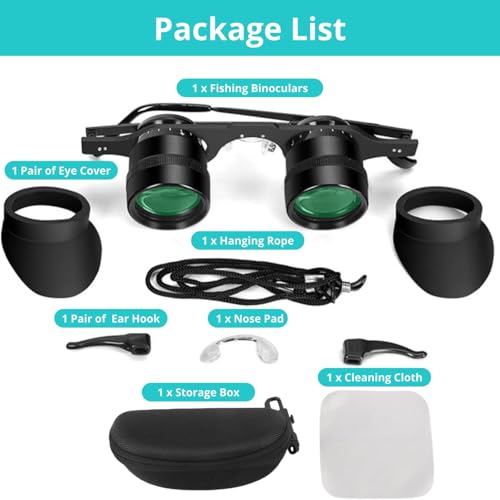
As an Amazon Associate we earn from qualifying purchases. Product prices and availability are accurate as of the date/time indicated.

Hands Binocular Glasses, 8X Professional Binocular Glasses for Fishing, Bird Watching, Sports, Concerts, Theater, Portable Telescope Opera Glasses with 2 Polarized Lenses


As an Amazon Associate we earn from qualifying purchases. Product prices and availability are accurate as of the date/time indicated.

Professional Hands Binocular Glasses for Fishing, Bird Watching, Sports, Concerts, Theater, Opera, TV, 4X Hands Opera Glasses for Adults Teens (Hyperopia Version)
As an Amazon Associate we earn from qualifying purchases. Product prices and availability are accurate as of the date/time indicated.
Prices shown are approximate and for reference only. Prices change often, so please check the current price on Amazon before you buy.
Eye relief figures summarize manufacturers’ published specifications for current versions and vary slightly by configuration. Ratings are editorial, weighing delivered field with glasses on, eyecup quality, optical performance, handling, and value.
The Six Glasses-Friendly Binoculars Reviewed
1. Swarovski NL Pure 8×42: Best Premium Glasses Experience
The NL Pure pairs its 18-millimeter class relief with the widest field in production binoculars, and for a glasses wearer that pairing is the summit this category can reach: the entire enormous field, delivered past the frames, edge to edge, with a clarity at those edges that makes the field usable rather than decorative. Its eyecups are machined to the standard its price implies, its balance is a long session’s kindness, and its optional forehead rest, an accessory its owners mock until they try it, steadies the view against the frames’ leverage in a way glasses wearers feel immediately. It costs what a used car costs and this guide places it last in the reviews and first in the ratings with a clear conscience, because it is the reference, the binocular that shows a glasses wearer what their eyes, properly served, have been missing.
2. Nikon Monarch M7 8×42: Best Overall
The Monarch M7 leads the mortal class on the strength of the table’s longest relief, about 18.4 millimeters, married to a genuinely wide field and ED glass that keeps that field honest to its borders, in a body whose eyecups retract fully and whose diopter locks against the accidental nudges of a shared binocular’s life. With glasses it simply works, full view, no crescents, no negotiation, which is the highest sentence in this category, and its price sits at the mid-range’s top where its specification belongs. For the glasses wearer buying once and buying seriously, it is the recommendation this guide gives first, because it solves the keyword completely and then adds a fine birding binocular as a bonus.
3. Zeiss Terra ED 8×42: Best for Smaller Faces and Travel
The Terra ED delivers its 18 millimeters of relief from the most compact 42-millimeter body in this table, a virtue glasses wearers with smaller faces and lighter travel kits feel in the hand and the pack, with a focus wheel famous for its speed, large and grippy enough to find without looking away from the bird. Its field is a step narrower than the Nikon’s and its price a step lower, and its eyecups, while a touch less ceremonial in their stops, hold their glasses position faithfully. It is the binocular of the traveling glasses wearer, the one that goes in the carry-on and comes out at the estuary, and Zeiss’s name on a mid-price glass has rarely been better spent than here.
4. Vortex Viper HD 8×42: Best Mid-Price Comfort with a Lifetime Promise
The Viper HD matches the leaders’ relief at about 18 millimeters and adds the ownership argument Vortex always adds: an unconditional lifetime warranty that converts every worry about a decade of eyecup twists and focus miles into the maker’s problem. Its glass is the class’s strong middle, its diopter locks, its cups stop where they are put, and with glasses its field arrives whole. It trades a little of the Monarch’s width and the Terra’s compactness for that warranty and a price that sales regularly soften. For the glasses wearer whose binocular will be lent, traveled, and kept for twenty years, the Viper’s promise is not marketing. It is a maintenance plan, included.
5. Hawke Frontier ED X 8×42: Best Value Long Relief
Hawke’s Frontier ED X is the specification thief of the table: relief at the leaders’ 18-millimeter level, ED glass, a wide field, and multi-stage eyecups with the detents this guide demands, at a price a full class below the Nikon and the Vortex. Its finish and its accessories are its price’s, respectable rather than sumptuous, and its distribution favors the dealers and regions where Hawke is strong, which its buyers should confirm along with the warranty’s local terms. Where it is sold and supported, it is the glasses wearer’s value champion, proof that the millimeter that matters most need not cost the most, and a standing rebuke to every short-relief binocular sold at twice its price.
6. Celestron Nature DX ED 8×42: Best Budget for Glasses Wearers
The Nature DX ED performs the table’s most useful trick: it delivers about 17.8 millimeters of relief and ED glass at a price that undercuts the field by half, putting a genuinely glasses-complete binocular within a first buyer’s reach. Its eyecups twist and hold adequately, its field is honest, and its compromises live where a budget’s should, in the fineness of its focus feel and the richness of its kit rather than in the optical specification the keyword cares about. A glasses wearer who has been peering through a borrowed, short-relief binocular will find it revelatory, which is a word this guide rations. As the entry to glasses-proper birding, and as the second binocular a household keeps for guests in frames, it earns its row completely.
Buying Guide: How Glasses Wearers Should Choose and Fit Binoculars
Step One: The Shop Test, Glasses On, Cups Down
Take your everyday glasses and your birding sunglasses to the shop, retract each finalist’s eyecups fully, set the barrels roughly to your eyes, and look at the most detailed wide scene available, a street, a hillside, a shop’s far wall of small print. Roam your eyes, not your head, toward the field’s edges: the right binocular shows you a clean, full circle with the edges as present as the center, while the wrong one draws black crescents that swim as your eyes move and crops the world into a porthole. Then raise the binocular away and back a dozen times, as a morning’s birding will, and feel whether the frames meet the cups evenly and whether the focus wheel finds your finger without a search. Five minutes of this is worth five specification sheets, and a shop that will not allow it with your own glasses is telling you where not to buy binoculars, in this guide’s firm opinion.
Step Two: Set the Diopter and the Fit in the Right Order
Fit a new binocular as a ritual, once, in daylight, with your glasses on and cups down. First the interpupillary distance: fold the barrels until the two circles merge into one clean field with no shadow at the seam. Then the diopter, the adjustment that matches the binocular to your two eyes’ difference: focus the left eye alone, right barrel capped or right eye closed, with the main wheel on a detailed distant subject; then, without touching the wheel, focus the right eye using only the diopter ring on its eyepiece; note or lock the setting, because it is yours and it survives until your prescription changes. Thereafter the main wheel alone focuses both eyes together, which is the system’s whole design. Glasses wearers who skip the diopter because their glasses correct their eyes are missing that the binocular cannot know what the glasses do not fully correct between the two eyes, and the small residual difference is exactly what the diopter exists to retire.
Step Three: Live With Them Like a Glasses Wearer, Not a Tourist
Adopt the small disciplines that keep glasses viewing clean across a season. Keep a lens cloth for the binocular and a separate habit for the glasses, because a cloth that has wiped a dusty eyepiece becomes the glasses’ enemy. Use the neck strap or harness at a length that lets the binocular rise to the frames without the strap arguing, and consider the rainguard’s tether, because glasses wearers flip between binocular and naked eye more than anyone, identifying by ear and silhouette before the glass rises. In rain, the retracted cups and the frames together invite fogging from your own warmth, answered by holding the binocular a breath away for the first second and by the anti-fog cloths in the repair kit. None of this is burden; it is the craft of the glasses-wearing observer, whose fraternity includes, history notes, a large share of the finest field birders alive, none of whom were issued better eyes than yours, only better-fitted binoculars and the habits in this paragraph.
Frequently Asked Questions About Binoculars for Glasses Wearers
How much eye relief do I need with glasses?
For most frames, 17 millimeters is the working minimum and 18 or more is the comfort this guide recommends buying, with the wearers of thick frames, strong prescriptions that curve the lens, and wrap sunglasses best served at the top of that range and above. The variation between people is real, a slim metal frame worn close can be happy at 16 where a bold acetate frame at 19 still hunts for the field’s edge, which is why the figure opens the conversation and the shop test closes it. If you are choosing between two finalists on paper alone, take the longer relief every time, because excess relief costs a bare-eyed user nothing, the cups rise to meet them, while insufficient relief costs the glasses wearer the field itself, permanently, on every view. It is the one specification in binoculars where more is simply better for you, and this table was built by sorting on it.
Should I wear my glasses while using binoculars, or take them off?
Wear them, if your prescription corrects more than simple focus, and design your binocular life around that answer. Glasses correct astigmatism and the difference between your eyes in ways a binocular’s focus and diopter cannot fully reproduce, because the diopter adjusts focus for one eye, not the cylindrical correction astigmatism needs, so the glasses wearer who removes them for the binocular is viewing through an instrument adjusted for eyes that do not quite exist. The exception is the purely myopic or hyperopic wearer with no astigmatism, who may focus the binocular to their prescription and view bare-eyed perfectly well, a legitimate preference some hold for the closer coupling and wider apparent field. For everyone else, and for anyone who moves between naked-eye and binocular views all morning, glasses on, cups down, relief sufficient, is the system, and it is the system the finest glasses-wearing observers use without a second thought.
Why do I see black edges and crescents in my binoculars?
Black crescents that swim as your eyes move are the signature of an eye placed outside the binocular’s exit pupil, which for a glasses wearer almost always means the eye is too far back for the relief provided, or the eyecups are raised into the glasses position’s way. Work the causes in order: cups fully down, frames settled, the binocular brought to the glasses rather than the head craning to the binocular; interpupillary distance set so the circles merge, because a mismatched IPD manufactures crescents of its own; and, if the crescents persist at full retraction with a correct fit, accept the measurement they are giving you, that this binocular’s relief is shorter than your frames require, and let the table above, sorted by that very number, supply its successor. Crescents are not a defect in your technique to be ashamed of. They are a specification, communicating, in the only language it has.
Are 8×42 binoculars the best choice for glasses wearers?
For most, yes, and the reasons compound kindly. The 8×42’s exit pupil, 5.25 millimeters, is generous, which makes eye placement forgiving, the image stays full and bright with small errors in position that a glasses wearer’s frames introduce as they shift. Its field is the widest of the common configurations, so the field the relief works to deliver is worth delivering, and its weight and size balance in hands that are also managing frames, straps, and a field guide. The 10×42 serves the steady-handed watcher of distant subjects with a smaller exit pupil and a narrower field, both less forgiving behind glasses, and compact 8x32s trade exit pupil for travel weight in a bargain each traveler judges personally. Begin at 8×42 with relief at this guide’s standard, and let a season of your own watching, not a specification sheet, argue for any departure from the most comfortable seat in optics.
Related guides
- Best Binoculars for Marine Boating Use in 2026: Steiner, Fujinon, Bushnell, and Nikon Compared for a 7×50 Parish Chosen for a Moving Deck, Sealing Proven in the Maker’s Text, and a Compass That Aids and Never Replaces the Boat’s Own
- Best Telescopes for Spring Galaxy Viewing in 2026: Apertura, Sky-Watcher, and Celestron Compared for Aperture Sentenced Against Your Sky’s Own Darkness, Dark Adaptation Kept Like a Citizen, and Galaxies Read by Their Surface Brightness
- How to Service Binoculars Professional Repair in 2026: When to Clean, When to Send for Repair, and How to Protect Your Optics
- Dielectric Coated Prism Pros and Cons in 2026: What a Dielectric Coated Prism Does, Why It Helps Binoculars, and When It Is Worth the Price
More from Amazon
Programs that pair well with the guide above. Offers and eligibility are set by Amazon and may change.
Free shipping on eligible items, Prime Video and more. Eligible new members can start with a free trial.
Start a Prime free trialAudiobooks and podcasts to listen to on the go. Eligible new members can start with a free trial.
Try Audible freeAd-free music streaming. Eligible new subscribers can start with a free trial.
Try Music Unlimited freeA free business account with business pricing and bulk-buying tools for work, shop or home office.
Create a business accountAs an Amazon Associate we earn from qualifying purchases.

Write Your Review
No reviews yet. Be the first to share your experience!