
What's inside
- Why the Best Binoculars vs Monoculars for Birding Needs 8×42
- Best Binoculars vs Monoculars for Birding: Magnification, Field of View and Eye Relief
- Best Binoculars vs Monoculars for Birding Comparison Table
- Top Binoculars and Monoculars for Birding Reviewed
- Buying Guide: How to Choose the Best Binoculars vs Monoculars for Birding
- How to Use Binoculars and Monoculars for Birding
- Frequently Asked Questions
As an Amazon Associate I earn from qualifying purchases. This post may contain affiliate links at no extra cost to you.
Finding the best binoculars vs monoculars for birding is about choosing an optic that lets you find birds quickly, see detail clearly, and carry comfortably on a long walk, without buying an optic that is too heavy or too hard to hold steady. A good binocular for birding should have a magnification of 8x, an objective lens of 42 mm, and a wide field of view, while a good monocular for birding should have a magnification of 8x or 10x, an objective lens of 36 mm or 42 mm, and a compact design. It should also be affordable, with a price that fits a birder who wants a reliable optic without a large, expensive premium optic.
This guide explains what to look for in binoculars vs monoculars for birding, how to compare magnification, field of view, eye relief, and weight, and which optics work well in 2026. We focus on practical use for birders who watch birds in forests, wetlands, and backyards, with an optic that is used for birding, and with a design that is suitable for a beginner. Whether you use two eyes or one eye, the same principles apply: choose an optic with enough magnification, with a clear image, and with a design that fits your hands and your glasses.
Our Top Picks
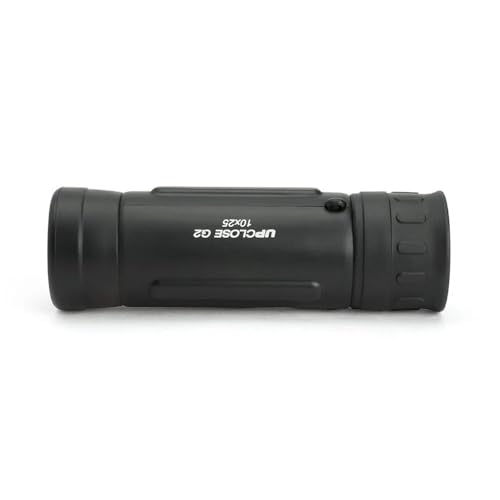
 Celestron UpClose G2 10x25 Monocular for Hiking10 x 255.5 x 1.5 x 1.5 inches0.2 poundsCheck on Amazon
 Blackhawk 10x40 Waterproof Monocular Compact Optic Binocular6 x 2 x 0.1 inches0.63 poundsCheck on Amazon
Why the Best Binoculars vs Monoculars for Birding Needs 8×42
Binoculars vs monoculars for birding needs 8×42 because a binocular with a magnification of 8x and an objective lens of 42 mm, such as the Vortex Diamondback HD 8×42, gives you a bright image, a wide field of view, and a steady view, while a binocular with a magnification of 10x is harder to hold steady. A monocular with a magnification of 8x and an objective lens of 42 mm, such as the Vortex Solo 8×36, is also good, because it is lighter and more compact. A binocular with a magnification under 7x is too low for detail, while a monocular with a magnification over 12x is too hard to hold steady without a tripod.
Binoculars vs monoculars for birding also needs a wide field of view. A binocular with a field of view of 420 feet at 1000 yards is a good choice for most birders, because it lets you find birds quickly in trees. A monocular with a field of view of 360 feet at 1000 yards is narrower, because it uses one eye, but it is still good for spotting a bird you already found. A binocular with a field of view under 350 feet is too narrow for birding in forests.
Best Binoculars vs Monoculars for Birding: Magnification, Field of View and Eye Relief
Magnification matters most for birding optics, because it determines how much detail you can see. A magnification of 8x is a good choice for most birders, while a magnification of 10x is better for open water and distant birds. A magnification of 8x is easier to hold steady than a magnification of 10x, especially for a beginner. A magnification of 12x is better for a monocular on a tripod, because it is hard to hold steady by hand.
Eye relief also matters. An optic with an eye relief of 15 mm or more is a good choice for birders who wear glasses, because it lets you see the full field of view with glasses on. An optic with twist-up eyecups is better than an optic with fixed eyecups, because it lets you adjust for glasses. An optic with a close focus under 6 feet is better than an optic with a close focus over 10 feet, because it lets you watch butterflies and nearby birds.
Best Binoculars vs Monoculars for Birding Comparison Table
| Model | Type | Magnification | Objective Lens | Field of View |
|---|---|---|---|---|
| Vortex Diamondback HD Binoculars, 8×42 | Binoculars | 8x | 42 mm | 420 ft at 1000 yd |
| Nikon Monarch M7 Binoculars, 8×42 | Binoculars | 8x | 42 mm | 435 ft at 1000 yd |
| Celestron Nature DX Binoculars, 8×42 | Binoculars | 8x | 42 mm | 393 ft at 1000 yd |
| Vortex Solo Monocular, 10×36 | Monocular | 10x | 36 mm | 325 ft at 1000 yd |
| Bushnell Legend Ultra HD Monocular, 10×42 | Monocular | 10x | 42 mm | 340 ft at 1000 yd |
| Gosky Titan Monocular, 12×50 | Monocular | 12x | 50 mm | 300 ft at 1000 yd |
Celestron UpClose G2 10x25 Monocular for Hiking, Travel & Birding | Compact Monocular Design, Lightweight for Travel, Multi-Coated Optics, Rubber Armored Body, Comfortable One-Handed Viewing



As an Amazon Associate we earn from qualifying purchases. Product prices and availability are accurate as of the date/time indicated.

Deesoo 15x56 High Powered Binoculars for Adults with Phone Adapter | BAK4 Prism FMC Optics, Birding for Wildlife Observation, Cruise Ship Travel, Waterproof for Hunting, Eyeglass Friendly
As an Amazon Associate we earn from qualifying purchases. Product prices and availability are accurate as of the date/time indicated.
Blackhawk 10x40 Waterproof Monocular Compact Optic Binocular


As an Amazon Associate we earn from qualifying purchases. Product prices and availability are accurate as of the date/time indicated.
Top Binoculars and Monoculars for Birding Reviewed
Vortex Diamondback HD Binoculars, 8×42
They have a bright image, a wide field of view, and a good value. They are a good choice if you want the best binoculars vs monoculars for birding with a proven Vortex design.
Nikon Monarch M7 Binoculars, 8×42
They have a very wide field of view, a clear image, and a good value. They are a good choice if you want Nikon binoculars with a very wide field of view.
Celestron Nature DX Binoculars, 8×42
They have a low price, a good image, and a good value. They are a good choice if you want Celestron binoculars with a low price.
Vortex Solo Monocular, 10×36
It has a low price, a compact size, and a good value. It is a good choice if you want a Vortex monocular with a low price.
Bushnell Legend Ultra HD Monocular, 10×42
It has a bright image, a compact size, and a good value. It is a good choice if you want a Bushnell monocular with a bright image.
Gosky Titan Monocular, 12×50
It has a low price, a high magnification, and a good value. It is a good choice if you want a Gosky monocular with a high magnification, but use it with a tripod for best results, because 12x is hard to hold steady.
Buying Guide: How to Choose the Best Binoculars vs Monoculars for Birding
Start with your birding, your eyes, and your budget. If you bird in forests, binoculars, such as the Vortex Diamondback HD 8×42, are a good choice, because they give you a wide field of view and depth perception with two eyes. If you bird while hiking and want a light optic, a monocular, such as the Vortex Solo 10×36, is a good choice, because it is compact and light. If you wear glasses, choose an optic with an eye relief of 15 mm or more, with twist-up eyecups. If you have a budget under $200, binoculars such as the Celestron Nature DX or Vortex Diamondback HD are good choices.
Next, check magnification, field of view, and weight. A magnification of 8x is a good choice for most birders, while a magnification of 10x is better for open water. A field of view over 400 feet at 1000 yards is a good choice for binoculars, while a field of view over 320 feet is good for monoculars. A binocular that weighs under 25 ounces is a good choice for long walks, while a monocular that weighs under 12 ounces is even lighter.
Check your budget, your use, and your future.
Finally, do not buy an optic based only on price or magnification. A binocular with a narrow field of view will make it hard to find birds, even if it is cheap, while a monocular with a high magnification will be hard to hold steady, even if it is light. Choose binoculars if you want a wide view and depth, and a monocular if you want a light, compact optic for quick spotting. Test your optic outdoors before you buy if you can, with your glasses on, and check that it is comfortable to hold for an hour.
How to Use Binoculars and Monoculars for Birding
To use binoculars for birding, first adjust your binoculars for your eyes, with your interpupillary distance, and focus on a distant tree. Find a bird with your eyes first, then raise your binoculars to your eyes without looking away. Focus with your center wheel, and follow the bird slowly. To use a monocular for birding, hold it with one hand, with your other hand steadying it, and focus with your focus wheel. Use a tripod or a tree for support if you use 10x or 12x, and take breaks to avoid eye strain. Keep your optic clean, with a lens cloth, and store it in a dry case.
Frequently Asked Questions
What is the best binoculars vs monoculars for birding?
What is the best binoculars vs monoculars for birding depends on your birding and budget. Choose binoculars for regular birding, and a monocular for hiking and travel.
Are binoculars better than monoculars for birding?
Are binoculars better than monoculars for birding, yes, binoculars are better than monoculars for most birding, because they use two eyes, give you depth perception, and have a wider field of view. A monocular is better than a binocular if you want a light, compact optic, because it is smaller and lighter. Choose binoculars if you bird for hours, and a monocular if you want a backup optic in your pocket.
Should I choose 8x or 10x for birding?
Should you choose 8x or 10x for birding, a magnification of 8x is a good choice for most birders, because it is easier to hold steady and has a wider field of view. A magnification of 10x is better for open water and distant birds, because it shows more detail, but it is harder to hold steady. Choose 8x if you bird in forests, and 10x if you bird on lakes and coasts.
Can I use a monocular with glasses?
Can you use a monocular with glasses, yes, you can use a monocular with glasses if it has an eye relief of 15 mm or more and twist-up eyecups. Twist your eyecups down for glasses, and up for no glasses, and check that you can see the full field of view. A monocular with an eye relief under 12 mm is not good for glasses, because you will lose the edge of the view. Check eye relief before you buy if you wear glasses.
Related guides
- Best Optics for Beginners Winter Use in 2026: Fogproof Binoculars Graded on the Cold Transition — Warm Car to Frozen Field Without Losing the View
- Best Cell Phone Monocular in 2026: 7 Best Cell Phone Monoculars With Clear View, Simple Use, and Easy Use for Cell Phone Monocular
- Best Monocular for Glasses Wearers Comfort in 2026: Monocular for Glasses Wearers Comfort, Glasses Wearers Monoculars, and Best Comfortable Monoculars for Glasses Wearers
- Best Binoculars for Camping Trips Viewing in 2026: 7 Binoculars for Camping Trips Viewing That Offer Clear Optics, Easy Carry, and Reliable Performance for Camping
More from Amazon
Programs that pair well with the guide above. Offers and eligibility are set by Amazon and may change.
Free shipping on eligible items, Prime Video and more. Eligible new members can start with a free trial.
Start a Prime free trialAudiobooks and podcasts to listen to on the go. Eligible new members can start with a free trial.
Try Audible freeAd-free music streaming. Eligible new subscribers can start with a free trial.
Try Music Unlimited freeA free business account with business pricing and bulk-buying tools for work, shop or home office.
Create a business accountAs an Amazon Associate we earn from qualifying purchases.

Write Your Review
No reviews yet. Be the first to share your experience!