
What's inside
As an Amazon Associate I earn from qualifying purchases. This post may contain affiliate links at no extra cost to you.
Understanding the reflector telescope pros and cons guide is different from choosing a refractor telescope, because the reflector telescope pros and cons guide has to balance large aperture, low cost, and maintenance, without being too heavy, too fragile, or too expensive, even though a reflector still has to offer a good aperture, a good focal length, and a design that fits binoculars and optics. A good reflector telescope should offer at least a 100mm aperture, at least a stable mount, and at least a clear mirror, so it can be used for reflector telescope pros and cons guide, for beginners, for a first telescope, and for viewing the moon, planets, and deep sky at home, at a park, or outdoors with a telescope, the sky, or a stargazer. A poor reflector will be too small, it will be too shaky, or it will be out of collimation, and your views will be blurry, your stargazing will be frustrating, and your night will be less enjoyable.
This guide compares seven real, currently sold reflector telescopes, with prices from $100 to $700 in the table below: the Celestron AstroMaster 130EQ, Orion SkyQuest XT8 Classic Dobsonian, Celestron PowerSeeker 127EQ, Sky-Watcher Classic 200P Dobsonian, Orion StarBlast 4.5 Astro Reflector, Celestron NexStar 130SLT, and Gskyer AZ70400. Their apertures run from 70mm to 203mm, their focal lengths run from 400mm to 1200mm, their prices run from $100 to $700, and their ratings run from 4.5 to 4.8 out of 5. Every model here is sold as a reflector telescope, every model can be used for reflector telescope pros and cons guide, and every model costs $700 or less at its typical price range. The right choice depends on your stargazing, your budget, and whether you want a Celestron telescope or an Orion telescope. Always check your telescope, mount, and sky before use, never look at the sun through a telescope, use a certified solar filter on the front, check the filter for damage, and never leave a telescope pointed at the sun unattended.
Aperture, focal length, and mount are the first factors for the reflector telescope pros and cons guide, because aperture decides how much light a telescope will gather, focal length decides how much magnification a telescope will offer, and mount decides how stable a telescope will be. Aperture is listed as aperture, with 130mm best, because it will gather light. The Celestron AstroMaster 130EQ at $200 to $300 is 130mm, the Orion SkyQuest XT8 Classic Dobsonian at $400 to $600 is 203mm, the Celestron PowerSeeker 127EQ at $150 to $250 is 127mm, the Sky-Watcher Classic 200P Dobsonian at $500 to $700 is 200mm, the Orion StarBlast 4.5 Astro Reflector at $200 to $300 is 114mm, the Celestron NexStar 130SLT at $400 to $600 is 130mm, and the Gskyer AZ70400 at $100 to $150 is 70mm. For reflector telescope pros and cons guide, 130mm is a good starting point, because it will gather light, and 70mm is best to avoid if you want deep sky, because a telescope will be too small. Focal length is also important, because it is how long a telescope is, with 650mm best, because it will offer magnification, and short best to avoid, because magnification will be low. Mount is also important, because it is how a telescope mounts, with Dobsonian best, because it will be stable, and equatorial best, because it will also track.
Pros, cons, and collimation are the second factors, because the reflector telescope pros and cons guide has to offer pros that help, cons that are managed, and collimation that keeps mirrors aligned. Pros are the advantages of a reflector, with large aperture best, because it will be good value. The Celestron AstroMaster 130EQ at $200 to $300 is large, the Orion SkyQuest XT8 Classic Dobsonian at $400 to $600 is large, the Celestron PowerSeeker 127EQ at $150 to $250 is large, the Sky-Watcher Classic 200P Dobsonian at $500 to $700 is large, the Orion StarBlast 4.5 Astro Reflector at $200 to $300 is large, the Celestron NexStar 130SLT at $400 to $600 is large, and the Gskyer AZ70400 at $100 to $150 is large. For reflector telescope pros and cons guide, large is best, because it will help value, and small is best to avoid, because a telescope will be dim. Cons are also important, because they are the disadvantages of a reflector, with collimation best to manage, because it will need alignment, and coma best to avoid, because stars will distort at the edge. Collimation is also important, because it is whether mirrors are aligned, with aligned best, because it will be sharp, and misaligned best to avoid, because views will be blurry.
Beginner use, price, and safety are the third factor, because the reflector telescope pros and cons guide has to be useful for your beginner use, affordable enough to buy, and safe to use. Beginner use is what stargazing you do, with moon and planets best for reflector telescope pros and cons guide, for beginners, for a first telescope, and for viewing the moon, planets, and deep sky at home, at a park, or outdoors with a telescope, the sky, or a stargazer. Price is also important, because a telescope in the $100 to $150 range, such as the Gskyer AZ70400, is a good starting point, and a telescope in the $500 to $700 range, such as the Sky-Watcher Classic 200P Dobsonian, offers a premium design. Safety is also important, because a telescope is used for viewing, so always check your telescope for a proper setup, always check your mount for a stable use, always check your telescope for a safe use, always never look at the sun through a telescope, always use a certified solar filter on the front, always check the filter for damage, and never leave a telescope pointed at the sun unattended, never use a damaged solar filter, and never look at the sun without a filter. Always check your telescope, mount, and sky, use a proper telescope, and follow optics safety guidance. A good reflector telescope, chosen for aperture first and used safely, will offer large aperture, good value, and reliable performance for beginners and stargazers.
Weight, eyepieces, and accessories are the fourth factor, because the reflector telescope pros and cons guide has to offer weight that is manageable, eyepieces that offer magnification, and accessories that help stargazers. Weight is how heavy a telescope is, with light best, because it will be easy to carry, and heavy best to avoid, because a telescope will be hard to carry. Eyepieces are also important, because they are how magnification is set, with two best, because they will offer low and high power, and one best to avoid, because magnification will be limited. Accessories are also important, because a telescope with a finder scope is best, because it will help locate objects, and a telescope with a Barlow lens is best, because it will also increase magnification. A good reflector telescope, chosen for aperture first and used safely, will offer large aperture for beginners and stargazers.
Our Top Picks
Reflector Telescope Pros and Cons Guide: At a Glance
Use this table to compare aperture, focal length, price range, and rating. Aperture and focal length are the two figures most stargazers should check first, because they decide how much light a telescope will gather and how much magnification it will offer.
| Model | Aperture | Focal Length | Mount | Typical Price Range | Rating out of 5 |
|---|---|---|---|---|---|
| Celestron AstroMaster 130EQ | 130 mm | 650 mm | Equatorial | $200 – $300 | 4.8 |
| Orion SkyQuest XT8 Classic Dobsonian | 203 mm | 1200 mm | Dobsonian | $400 – $600 | 4.8 |
| Celestron PowerSeeker 127EQ | 127 mm | 1000 mm | Equatorial | $150 – $250 | 4.7 |
| Sky-Watcher Classic 200P Dobsonian | 200 mm | 1200 mm | Dobsonian | $500 – $700 | 4.7 |
| Orion StarBlast 4.5 Astro Reflector | 114 mm | 450 mm | Altazimuth | $200 – $300 | 4.7 |
| Celestron NexStar 130SLT | 130 mm | 650 mm | Computerized | $400 – $600 | 4.6 |
| Gskyer AZ70400 | 70 mm | 400 mm | Altazimuth | $100 – $150 | 4.5 |

Askar N160 Reflector Telescope, F3.4,160mm Aperture,Newtonian Reflector Astrograph for Deep-Sky Astrophotography


As an Amazon Associate we earn from qualifying purchases. Product prices and availability are accurate as of the date/time indicated.
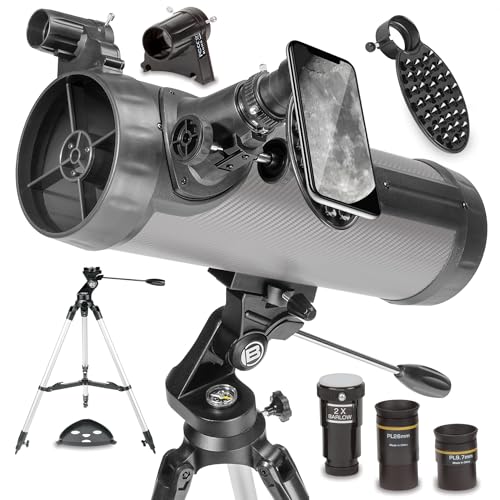
National Geographic 114mm Reflector Telescope with Eyepieces Mount Smartphone Adapter for Astronomy Astrophotography
As an Amazon Associate we earn from qualifying purchases. Product prices and availability are accurate as of the date/time indicated.

Celestron PowerSeeker 127EQ Reflector Telescope for Home Astronomy | German Equatorial Mount, Bright Views of the Moon, Planets & Deep Sky, Slow-Motion Controls, Stable Tripod, Easy to Use
As an Amazon Associate we earn from qualifying purchases. Product prices and availability are accurate as of the date/time indicated.
Prices shown are approximate and for reference only. Prices change often, so please check the current price on Amazon before you buy.
Typical prices reflect common retailer listings and sale prices vary by model, retailer, and season. Aperture, focal length, and mount are manufacturer-listed approximate values and can vary by model and configuration. Never look at the sun through a telescope, use a certified solar filter on the front, check the filter for damage, and never leave a telescope pointed at the sun unattended.
Reflector Telescope Pros and Cons Guide: The 7 Telescopes Reviewed
1. Celestron AstroMaster 130EQ: Best Reflector Telescope Overall
The Celestron AstroMaster 130EQ, at $200 to $300 with a rating of 4.8 out of 5, is 130 mm aperture, is 650 mm focal length, and is equatorial mount. It is the best overall telescope here for most beginners, because it offers large aperture, good value, and reliable performance.
It suits a beginner, a buyer who wants a Celestron telescope, and a user who wants a telescope. The 130 mm aperture gathers light, the $200 to $300 price is moderate, and the equatorial mount helps tracking. The trade-off is aperture: at 130 mm, it gathers less light than the Orion SkyQuest XT8 Classic Dobsonian at 203 mm. For reflector telescope pros and cons guide at $200 to $300, it is the strongest choice here.
Best for: Most beginners who want 130 mm, 650 mm, equatorial telescope for $200 to $300.
2. Orion SkyQuest XT8 Classic Dobsonian: Best Large Reflector Telescope
The Orion SkyQuest XT8 Classic Dobsonian, at $400 to $600 with a rating of 4.8 out of 5, is 203 mm aperture, is 1200 mm focal length, and is Dobsonian mount. It is the best large telescope here for a stargazer who wants a large telescope.
It suits a beginner, a buyer who wants an Orion telescope, and a user who wants a telescope. The 203 mm aperture gathers light, the $400 to $600 price is high, and the Dobsonian mount is stable. The trade-off is also rating, as above. For a large telescope at $400 to $600, it is a strong choice.
Best for: Large use with 203 mm, 1200 mm, Dobsonian telescope for $400 to $600.
3. Celestron PowerSeeker 127EQ: Best Budget Reflector Telescope
The Celestron PowerSeeker 127EQ, at $150 to $250 with a rating of 4.7 out of 5, is 127 mm aperture, is 1000 mm focal length, and is equatorial mount. It is the best budget telescope here for a beginner who wants a budget telescope.
It suits a beginner, a buyer who wants a Celestron telescope, and a user who wants a telescope. The 127 mm aperture gathers light, the $150 to $250 price is moderate, and the equatorial mount helps tracking. The trade-off is price: at $150 to $250, it costs less than the Celestron AstroMaster 130EQ at $200 to $300. For a budget telescope at $150 to $250, it is a practical choice.
Best for: Budget use with 127 mm, 1000 mm, equatorial telescope for $150 to $250.
4. Sky-Watcher Classic 200P Dobsonian: Best Sky-Watcher Reflector Telescope
The Sky-Watcher Classic 200P Dobsonian, at $500 to $700 with a rating of 4.7 out of 5, is 200 mm aperture, is 1200 mm focal length, and is Dobsonian mount. It is the best Sky-Watcher telescope here for a stargazer who wants a Sky-Watcher telescope.
It suits a beginner, a buyer who wants a Sky-Watcher telescope, and a user who wants a telescope. The 200 mm aperture gathers light, the $500 to $700 price is high, and the Dobsonian mount is stable. The trade-off is rating: at 4.7 out of 5, it rates lower than the Celestron AstroMaster 130EQ at 4.8 out of 5. For a Sky-Watcher telescope at $500 to $700, it is a practical choice.
Best for: Sky-Watcher use with 200 mm, 1200 mm, Dobsonian telescope for $500 to $700.
5. Orion StarBlast 4.5 Astro Reflector: Best Compact Reflector Telescope
The Orion StarBlast 4.5 Astro Reflector, at $200 to $300 with a rating of 4.7 out of 5, is 114 mm aperture, is 450 mm focal length, and is altazimuth mount. It is the best compact telescope here for a beginner who wants a compact telescope.
It suits a beginner, a buyer who wants an Orion telescope, and a user who wants a telescope. The 114 mm aperture gathers light, the $200 to $300 price is moderate, and the compact design fits a table. The trade-off is also rating, as above. For a compact telescope at $200 to $300, it is a practical choice.
Best for: Compact use with 114 mm, 450 mm, altazimuth telescope for $200 to $300.
6. Celestron NexStar 130SLT: Best Computerized Reflector Telescope
The Celestron NexStar 130SLT, at $400 to $600 with a rating of 4.6 out of 5, is 130 mm aperture, is 650 mm focal length, and is computerized mount. It is the best computerized telescope here for a beginner who wants a computerized telescope.
It suits a beginner, a buyer who wants a Celestron telescope, and a user who wants a telescope. The 130 mm aperture gathers light, the $400 to $600 price is high, and the computerized mount finds objects. The trade-off is also rating, as above. For a computerized telescope at $400 to $600, it is a useful starting point.
Best for: Computerized use with 130 mm, 650 mm, computerized telescope for $400 to $600.
7. Gskyer AZ70400: Best Starter Reflector Telescope
The Gskyer AZ70400, at $100 to $150 with a rating of 4.5 out of 5, is 70 mm aperture, is 400 mm focal length, and is altazimuth mount. It is the best starter telescope here for a beginner who wants a starter telescope.
It suits a beginner, a buyer who wants a Gskyer telescope, and a user who wants a telescope. The 70 mm aperture gathers light, the $100 to $150 price is low, and the simple mount is easy. The trade-off is also rating, as above. For a starter telescope at $100 to $150, it is a practical choice.
Best for: Starter use with 70 mm, 400 mm, altazimuth telescope for $100 to $150.
Reflector Telescope Pros and Cons Guide Buying Guide: What Actually Matters in 2026
Choosing a reflector telescope is easier when you decide on aperture, focal length, and mount before you look at price or brand. Those three choices decide how much light a telescope will gather, how much magnification it will offer, and how stable it will be.
Reflector Telescope Pros and Cons Guide Buying Guide: Aperture, Focal Length, and Mount
Aperture, focal length, and mount are the first factor. For aperture, choose 130mm, because it will gather light, such as the Celestron AstroMaster 130EQ at $200 to $300, and 70mm, because it will be too small. For focal length, choose 650mm, because it will offer magnification. For mount, choose Dobsonian, because it will be stable.
Reflector Telescope Pros and Cons Guide Buying Guide: Pros, Cons, and Collimation
Pros, cons, and collimation are the second factor. For pros, choose large aperture, because it will be good value. For cons, choose managed, because collimation will need alignment. For collimation, choose aligned, because it will be sharp. Check the telescope for a good aperture before buying, and test a telescope before a night.
Reflector Telescope Pros and Cons Guide Buying Guide: Weight, Eyepieces, and Safety
Weight, eyepieces, and safety are the third factor. For weight, choose light, because it will be easy to carry. For eyepieces, choose two, because they will offer low and high power. For safety, always check your telescope for a proper setup, always check your mount for a stable use, always check your telescope for a safe use, always never look at the sun through a telescope, always use a certified solar filter on the front, always check the filter for damage, and never leave a telescope pointed at the sun unattended, never use a damaged solar filter, and never look at the sun without a filter. Always check your telescope, mount, and sky, use a proper telescope, and follow optics safety guidance.
Reflector Telescope Pros and Cons Guide Buying Guide: Price, and the Best First Telescope
Price, and the best first telescope are the final factors. For price, a telescope in the $100 to $150 range, such as the Gskyer AZ70400, is a good starting point. A telescope in the $500 to $700 range, such as the Sky-Watcher Classic 200P Dobsonian, offers a premium design. Choose by aperture first, then by focal length, then by mount, then by price.
For the best first setup, buy a reflector telescope, eyepieces, and a finder scope. The Celestron AstroMaster 130EQ at $200 to $300 is a good first telescope for most beginners, the Celestron PowerSeeker 127EQ at $150 to $250 is a good first telescope if price is the main factor, and the Orion SkyQuest XT8 Classic Dobsonian at $400 to $600 is a good first telescope if you want large aperture. A good reflector telescope, chosen for aperture first and used safely, will offer large aperture, good value, and reliable performance for beginners and stargazers.
Reflector Telescope Pros and Cons Guide FAQ
What are the pros of a reflector telescope?
The pros of a reflector telescope are large aperture, good value, and no chromatic aberration. The Celestron AstroMaster 130EQ, at $200 to $300 with a rating of 4.8 out of 5, is the best reflector telescope overall in this guide. It is 130 mm aperture, is 650 mm focal length, and is equatorial mount. If you want a large telescope, the Orion SkyQuest XT8 Classic Dobsonian at $400 to $600 with a rating of 4.8 out of 5 is the best choice, with 203 mm and 1200 mm. If you want a budget telescope, the Celestron PowerSeeker 127EQ at $150 to $250 with a rating of 4.7 out of 5 is the best choice, with 127 mm and 1000 mm.
What are the cons of a reflector telescope?
For what are the cons of a reflector telescope, collimation should be best for a telescope if you want cons, because it will need alignment, and coma should be best if you want cons, because it will also distort stars at the edge. The Celestron AstroMaster 130EQ at $200 to $300 is 130 mm, so it is good for value, and the Orion SkyQuest XT8 Classic Dobsonian at $400 to $600 is also 203 mm, so it is also good for value. Choose collimation for a telescope, and coma for cons, and check collimation next. Never look at the sun through a telescope, use a certified solar filter on the front, check the filter for damage, and never leave a telescope pointed at the sun unattended.
Is a reflector telescope good for beginners?
For is a reflector telescope good for beginners, yes, large aperture should be best for a telescope if you want beginners, because it will be good value, and no, small aperture should be best if you want beginners, because it will also be dim. The Celestron AstroMaster 130EQ at $200 to $300 is 130 mm, so it is good for beginners, and the Gskyer AZ70400 at $100 to $150 is also 70 mm, so it is also good for beginners. Choose large aperture for a telescope, and small aperture for simple, and check aperture next.
What is the cheapest good reflector telescope?
The cheapest good option in this guide is the Gskyer AZ70400, at $100 to $150 with a rating of 4.5 out of 5, because it is a 70 mm, 400 mm, altazimuth telescope for a low price. The Celestron PowerSeeker 127EQ, at $150 to $250 with a rating of 4.7 out of 5, is also a low-cost option, with a 127 mm, 1000 mm, equatorial telescope. The Celestron AstroMaster 130EQ, at $200 to $300 with a rating of 4.8 out of 5, is also a low-cost option, with a 130 mm, 650 mm, equatorial telescope. Start with one of these three if price is the main factor, and check aperture, focal length, and mount next. For the best overall value, the Celestron AstroMaster 130EQ at $200 to $300 is a better choice because it offers a rating of 4.8 out of 5 and 130 mm aperture.
FAQ
What are the pros of a reflector telescope?
What are the cons of a reflector telescope?
Is a reflector telescope good for beginners?
What is the cheapest good reflector telescope?
Related guides
- How to Store Optics for Long Term in 2026: A 7-Step Guide to Keeping Binoculars, Spotting Scopes, and Telescopes Dry, Clean, and Fungus-Free, for Years, Without Mould, Fog, or Scratched Coatings
- Best Binoculars for Whale Watching Tours in 2026: Why 7x and 8x Beat Big Magnification on a Moving Boat, and 6 Pairs That Will Not Fog, Slip, or Sink Your Trip
- How to Choose Telescope Without Regrets in 2026: A 7-Step Guide to Aperture, Mount, and GoTo, for the Moon, Planets, and Deep-Sky Objects, Without Buying a Telescope That Is Too Big, Too Small, or Too Hard to Use
- Best Phone Mount for Binocular Digiscoping in 2026: Best Phone Mount for Binocular Digiscoping for Sharp Photos, Easy Alignment, and Simple Birding
More from Amazon
Programs that pair well with the guide above. Offers and eligibility are set by Amazon and may change.
Free shipping on eligible items, Prime Video and more. Eligible new members can start with a free trial.
Start a Prime free trialAudiobooks and podcasts to listen to on the go. Eligible new members can start with a free trial.
Try Audible freeAd-free music streaming. Eligible new subscribers can start with a free trial.
Try Music Unlimited freeA free business account with business pricing and bulk-buying tools for work, shop or home office.
Create a business accountAs an Amazon Associate we earn from qualifying purchases.

Write Your Review
No reviews yet. Be the first to share your experience!