
What's inside
As an Amazon Associate I earn from qualifying purchases. This post may contain affiliate links at no extra cost to you.
The best telescopes for stargazing spring nights are chosen for a season with a personality of its own. Spring is galaxy season in the northern hemisphere. The Milky Way’s bright core hides below the horizon in the evening, which sounds like a loss until you realize what replaces it: a dark, transparent window looking out of our own galaxy toward thousands of others. Leo, Virgo, Coma Berenices, and Canes Venatici fill the southern sky with galaxies, globular clusters, and double stars, while the Moon and the last of the winter’s bright constellations share the early evening. These targets reward aperture, contrast, and honest eyepieces more than they reward gadgets, and they punish a telescope that is a chore to carry outside, because spring nights start late, end chilly, and often turn clear with an hour’s notice.
This guide compares six real, currently sold telescopes that suit spring observing across budgets and living situations, from a collapsible tabletop Dobsonian for a balcony to a full 8-inch Dobsonian that will show the Virgo Cluster as a field of smudges becoming structures, and a computerized 8-inch Schmidt-Cassegrain for the observer who wants tracking and a database. We explain what each design does with galaxies specifically, because a galaxy is the most demanding common target in amateur astronomy: faint, extended, and visible mostly as a contrast difference against the sky. The telescope that wins a spring night is rarely the one with the highest advertised magnification. It is the one with enough light grasp, a mount that stays still while you study a faint edge, and a setup routine short enough that you actually go out on a Tuesday.
Our Top Picks
What Spring Skies Demand From a Telescope
Aperture and Contrast for Galaxies
A galaxy’s light is spread across an area, so making the image bigger does not make it brighter. What reveals a galaxy is aperture gathering more light, good optical contrast, and a dark sky, in roughly that order after the sky itself. A 6-inch telescope under a suburban sky will show the bright cores of the Leo Triplet and the pair of M81 and M82 as soft glows. An 8-inch under the same sky adds the hint of spiral structure in the best targets and resolves the edges of bright globular clusters such as M3 and M13 into stars. A smaller refractor, meanwhile, cannot match that light grasp, but its unobstructed optics and wide fields make it superb for large open clusters, double stars, and sweeping the spring Milky Way’s outskirts at low power. Choose with your targets in mind: galaxies and globulars point to aperture, wide fields and portability point to the smaller designs.
Mount Stability and the Cost of Wobble
At the magnifications galaxies and globulars reward, typically 80x to 200x, a shaky mount destroys more detail than a modest optic ever will. Every touch of the focuser becomes a jiggle, every breeze becomes a dance, and a faint galaxy blurs into the background each time the image moves. Dobsonian mounts earn their popularity here: a simple, low, rigid base that you push by hand, with no motors to align and no spindly legs. Equatorial and computerized mounts add tracking, which keeps a target centered while you sketch, share the view, or study it for the long minutes faint detail requires. Neither is wrong. The honest question is whether you will spend your spring evenings learning the sky by star-hopping, which a Dobsonian teaches beautifully, or whether a GoTo system that finds targets for you will get you out more often in the limited clear hours a working life allows.
Cool-Down, Dew, and Spring Practicalities
Spring nights swing in temperature. A telescope brought from a warm house into cooling air needs time for its mirror or lens to reach ambient temperature, or its images boil with internal air currents; larger mirrors need the longest, and a small fan or an early setup helps. Dew forms readily on corrector plates and refractor objectives on still spring nights, so a dew shield is a working accessory, not an ornament, and a simple one extends a session by hours. Finally, plan for the season’s short darkness at higher latitudes: a telescope that sets up in five minutes will collect more spring galaxies in a month than a superior instrument that needs forty.
Best Telescopes for Stargazing Spring Nights: Quick Comparison
| Model | Key Specs | Mount and Best Use | Typical Price Range | Rating |
|---|---|---|---|---|
| Apertura AD8 Dobsonian | 8-inch (203mm) reflector, 1200mm focal length, f/6, 2-inch focuser, cooling fan, includes 2-inch wide-field eyepiece class accessories | Manual Dobsonian, best value for galaxies and globulars | $600 – $750 | 4.8 / 5 |
| Sky-Watcher Heritage 150P | 6-inch (150mm) parabolic reflector, 750mm focal length, f/5, collapsible tube, tabletop design | Tabletop Dobsonian, best for balconies and travel | $310 – $390 | 4.5 / 5 |
| Celestron StarSense Explorer DX 130AZ | 5.1-inch (130mm) reflector, 650mm focal length, f/5, smartphone-assisted star recognition | Alt-azimuth, best guided first telescope | $430 – $520 | 4.4 / 5 |
| Celestron NexStar 8SE | 8-inch (203mm) Schmidt-Cassegrain, 2032mm focal length, f/10, computerized database of tens of thousands of objects | GoTo fork mount, best for tracking and public nights | $1,500 – $1,800 | 4.7 / 5 |
| Sky-Watcher Virtuoso GTi 150P | 6-inch (150mm) reflector, 750mm focal length, f/5, collapsible tube, Wi-Fi controlled GoTo and tracking | Tabletop GoTo Dobsonian, best compact tracking option | $470 – $560 | 4.5 / 5 |
| Celestron AstroMaster 102AZ | 4-inch (102mm) refractor, 660mm focal length, f/6.5, coated glass optics, no correct image diagonal class setup varies by bundle | Alt-azimuth, best for Moon, doubles, and wide views | $280 – $360 | 4.1 / 5 |
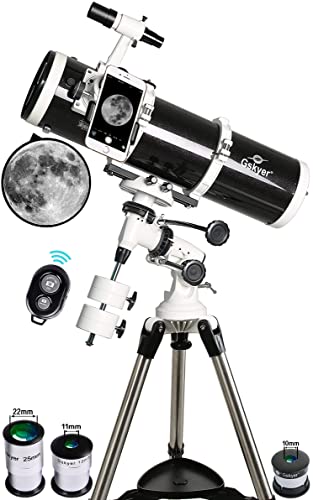
Gskyer 130EQ Professional Astronomical Reflector Telescope | 130mm Large Optic German Technology Scope, EQ130 Perfect Telescope for Beginners Adults Stargazing
As an Amazon Associate we earn from qualifying purchases. Product prices and availability are accurate as of the date/time indicated.

Telescope for Kids and Adults, 70/500 Astronomy Telescope for Beginners | Kids' Christmas Gift, Refractor Telescope with Phone Adapter and Tripod, Outdoor Stargazing and Landscape Viewing
As an Amazon Associate we earn from qualifying purchases. Product prices and availability are accurate as of the date/time indicated.

Celestron Travel Scope 70mm Beginner Portable Telescope with Backpack | 70mm Refractor Telescope Kit, Bright Lunar & Planetary Views, Day & Night Use, Backpack Included, Quick No-Tool Setup
As an Amazon Associate we earn from qualifying purchases. Product prices and availability are accurate as of the date/time indicated.
Prices shown are approximate and for reference only. Prices change often, so please check the current price on Amazon before you buy.
Specifications summarize manufacturers’ published figures for current models; included eyepieces and accessories vary by retailer and bundle. Ratings are editorial, weighing optical performance on spring targets, mount stability, ease of use, and value at typical prices.
The Six Best Telescopes for Spring Nights Reviewed
1. Apertura AD8 Dobsonian: Best Overall for Galaxy Season
The AD8 is the telescope spring was made for. Its 8-inch f/6 mirror gathers enough light to make the Virgo and Coma galaxy fields genuinely interesting from a dark site and worthwhile from the suburbs, its focal ratio is forgiving of eyepieces and collimation, and the accessory package is unusually honest, with a 2-inch wide-field eyepiece, a 1.25-inch Plössl, a laser collimator, and a primary mirror cooling fan in the box. The Dobsonian base moves smoothly and settles quickly, which matters at 150x on M51. It is a two-piece carry, tube and base, and it needs a car rather than a backpack. For a first serious telescope bought mainly for deep-sky observing, this remains the benchmark against which everything else in the table is measured.
2. Sky-Watcher Heritage 150P: Best for Small Spaces
The Heritage 150P collapses to a fraction of its working length, sits on a table or sturdy stool, and delivers a true 6-inch parabolic mirror at a price and size no other design matches. On spring targets it will show the Leo Triplet’s brighter members, resolve M13 handsomely, and split spring doubles such as Algieba with ease. Its open truss design benefits from a simple light shroud in lit gardens, and the focuser is a basic helical type that rewards a gentle touch. For an apartment observer who must store the telescope in a closet and carry it to a park, it is not a compromise so much as the only honest way to own this much aperture.
3. Celestron StarSense Explorer DX 130AZ: Best Guided Start
StarSense uses your smartphone’s camera and Celestron’s plate-solving technology to recognize where the telescope is pointing and guide you, with on-screen arrows, to real targets. For a beginner facing the Virgo Cluster’s dozens of similar faint galaxies, that guidance is the difference between an evening of finds and an evening of frustration. The 130mm mirror is capable on bright galaxies, globulars, and the Moon, and the alt-azimuth mount is intuitive. The mount is lighter than a Dobsonian’s and less steady at high power, and the system depends on your phone’s battery and compatibility. As a first telescope for someone who knows they will not star-hop patiently, it earns its place.
4. Celestron NexStar 8SE: Best Computerized Telescope
The 8SE pairs the same aperture class as the AD8 with full GoTo pointing and tracking in a package that breaks down for car transport and sets up on a single fork arm. Its long focal length favors the Moon, planets, globular clusters, and the bright cores of galaxies at higher magnifications, and tracking transforms long looks and sharing views with family. It needs power, alignment time, and a dew shield on spring nights, and its narrower field makes it less of a low-power sweeper than the Dobsonians. Bought by an observer who values finding and following targets over star-hopping, and who may add imaging later, it is a decade-long instrument.
5. Sky-Watcher Virtuoso GTi 150P: Best Compact Tracker
The Virtuoso GTi takes the Heritage’s collapsible 6-inch tube and adds motorized GoTo and tracking controlled over Wi-Fi from a phone app, while still allowing manual movement when you simply want to push the tube. For spring observing from a balcony or a small garden, that combination is quietly brilliant: find M104 with the app, then watch it stay in the field while you change eyepieces and fetch a guest. Its tabletop format still needs a solid support, and app control is a different pleasure from a hand controller, which some observers love and some tolerate. As a compact, capable, modern Dobsonian, it has few direct rivals.
6. Celestron AstroMaster 102AZ: Best Refractor Under Strain
A 102mm refractor cannot compete with the reflectors here on galaxies, and this guide will not pretend otherwise. What it offers is immediacy: no collimation, sharp and contrasty views of the Moon and double stars, wide low-power fields for open clusters and the Beechcraft-bright spring showpieces, and a setup that takes minutes. Its mount is the lightest in the table and the limiting factor at high magnification, so it suits the casual observer who values crisp, quick looks over deep-sky reach. For a household that will observe the Moon with children more often than it will hunt galaxies at midnight, that honesty may make it the right purchase, and it pairs naturally with a larger Dobsonian later.
Buying Guide: How to Choose the Best Telescope for Stargazing Spring Nights
Decide Where You Will Observe From
Your observing site decides more than your budget does. Under dark rural skies, aperture is king and the AD8 will occupy you for years. Under bright suburban skies, galaxies wash out regardless of aperture, and the ability to transport the telescope to darker ground, or a GoTo system that maximizes a short session on the targets that survive light pollution, globulars, doubles, and the Moon, may matter more. Measure your storage space, your car, and the distance to your observing spot, then buy the largest telescope that comfortably survives that journey, because the best telescope is reliably the one that gets used.
Ignore Maximum Magnification Claims
Any telescope box advertising several hundred times magnification for a small aperture is marketing, not astronomy. Useful magnification is limited by aperture and by the atmosphere, and most spring deep-sky observing happens between 40x and 200x. Spend on aperture, a stable mount, and one or two good eyepieces in that working range before spending on anything else. A quality 2-inch wide-field eyepiece for sweeping galaxy fields and a mid-power eyepiece for globulars will teach you more about your telescope in one spring than a case of cheap glass will in a year.
Budget for the Working Accessories
Reserve money for a dew shield if your telescope has a corrector plate or exposed objective, a red flashlight that preserves night vision, a planisphere or a reputable sky app, and an observing chair, which sounds like a joke until you discover how much more you see sitting still at the eyepiece than standing hunched over it. Dobsonian buyers should confirm a collimation tool is included or add one. GoTo buyers should budget for a proper external power source, because a night of slewing drains small batteries quickly. None of these purchases is glamorous, and together they decide whether the telescope becomes a habit or a storage problem.
Learn Three Spring Skills in Order
First, dark adaptation: twenty to thirty minutes away from white light, including phone screens, transforms what any telescope in this table can show you, and it is free. Second, averted vision: looking slightly away from a faint galaxy lets your eye’s more sensitive periphery detect it, a technique that routinely reveals targets that direct staring cannot. Third, patience at the eyepiece: faint structure in M51, M101, or the Markarian’s Chain field emerges over minutes, not seconds, as your eye and brain settle. Buy the telescope that encourages those three habits, with quick setup, a comfortable mount, and a chair, and spring will reward you out of all proportion to your budget.
Frequently Asked Questions About Telescopes for Spring Stargazing
What is the best telescope size for seeing galaxies?
An 8-inch aperture is the traditional sweet spot for galaxy observing, large enough to show dozens of spring galaxies with real character from a dark site and to hint at structure in the brightest, while remaining affordable and portable in Dobsonian form. A 6-inch telescope shows the brighter galaxy showpieces and is far better than its modest size suggests, especially away from city lights. Smaller telescopes still show galaxy cores and the great showpieces such as M81, M82, and the Leo Triplet’s brighter members, but with less detail. Remember that a 6-inch telescope under a dark sky will outperform an 8-inch under heavy light pollution on galaxies almost every time, so transport and site are part of the answer, not an afterthought.
Should a beginner buy a GoTo telescope or a Dobsonian?
Buy the one that matches how you honestly expect to observe. A Dobsonian gives you more aperture per dollar, a steadier mount, and a direct education in the sky, because you learn where things are by finding them; many observers find that learning is the hobby’s deepest pleasure. A GoTo telescope removes the finding problem, tracks targets for you, and can rescue short sessions under light-polluted skies where star-hopping is genuinely hard because guide stars are washed out. Neither choice is a shortcut around learning to focus, cool, and collimate a telescope, and neither is more serious than the other. The deciding question is simple: will you go out more often with a telescope you push, or with one that points itself?
What should I look at first on a spring night?
Start with the Moon if it is up, because it rewards any telescope and warms up your eye, then move to the globular cluster M3 in Canes Venatici, one of the finest in the northern sky and an easy early-evening target. Continue to the galaxy pair M81 and M82 high in Ursa Major, which fits in one low-power field and shows two genuinely different galaxies side by side. Later, sweep the Virgo Cluster region between Denebola and Vindemiatrix slowly at low power, letting galaxies drift through the field, and finish with the Whirlpool Galaxy, M51, near the handle of the Big Dipper. That single sequence, repeated across the season as your skills grow, will teach you more than a scattered tour of fifty objects seen once each.
Do I need a telescope with a camera for spring galaxies?
No, and for most beginners the visual experience should come first. Spring galaxies are faint, and photographing them well requires a tracking equatorial mount, a suitable camera, guiding, and hours of processing, a commitment several times the cost of the telescopes in this guide. A GoTo telescope such as the NexStar 8SE can take pleasing short-exposure images of the Moon and bright clusters and can grow toward more ambitious imaging, which is a fair reason to choose it. But a visual observer with an 8-inch Dobsonian, a chair, and a dark site will see the spring sky in a way no beginner photograph matches, and will know within one season whether imaging is a genuine ambition or an expensive distraction.
Related guides
- Best Monocular for Safari Wildlife Viewing in 2026: Best Monocular for Safari Wildlife Viewing
- Best Lightweight Rangefinder for Hiking Trips in 2026: Vortex, Leupold, Bushnell, and Sig Sauer Compared for an Honest Hiking Office, a Weight Counted With Its Case and Battery, and a Beam Never Pointed at Eyes or the Sun
- Telescope for Planets vs Telescope for Deep Sky in 2026: 7 Telescopes That Offer Clear Planet Views, Bright Deep Sky Views, and Reliable Performance for Telescope for Planets vs Telescope for Deep Sky
- Best Monocular for Wildlife Viewing in 2026: 6 Monoculars With at Least 10x Magnification, at Least 36mm Objective, and a Price Range, for Wildlife Viewing
More from Amazon
Programs that pair well with the guide above. Offers and eligibility are set by Amazon and may change.
Free shipping on eligible items, Prime Video and more. Eligible new members can start with a free trial.
Start a Prime free trialAudiobooks and podcasts to listen to on the go. Eligible new members can start with a free trial.
Try Audible freeAd-free music streaming. Eligible new subscribers can start with a free trial.
Try Music Unlimited freeA free business account with business pricing and bulk-buying tools for work, shop or home office.
Create a business accountAs an Amazon Associate we earn from qualifying purchases.

Write Your Review
No reviews yet. Be the first to share your experience!