
What's inside
As an Amazon Associate I earn from qualifying purchases. This post may contain affiliate links at no extra cost to you.
The best star chart gifts for beginners succeed on the first clear night, and that is a harder test than it sounds. A star chart gift is not a poster for a wall or a coffee table ornament; it is a tool that a new observer will hold in cold hands, in the dark, under a sky that looks nothing like the tidy diagrams in books, trying to answer the only question a beginner ever asks: what am I looking at? Gifts that answer it, a planisphere that shows tonight’s sky for their latitude, an atlas simple enough to use at the eyepiece, a guidebook that walks them to their first dozen objects, get carried outside for years. Gifts that merely depict the sky, however beautifully, get framed, admired, and never once consulted under the stars. This guide compares six real, currently sold star chart and sky guide gifts graded for beginners specifically, matches them to the people receiving them, children, teenagers, adult newcomers, and the binocular owner who needs a next step, and explains the latitude, date, and light rules that decide whether a chart gift works at all, because a planisphere bought for the wrong latitude band is a beautiful gift that lies politely about the sky.
Understand the three families before choosing, because they do different jobs and the best gifts pair two of them. A planisphere is a rotating two-disc chart: set the date and time, and the window shows the sky as it stands at that moment for its latitude band, which makes it the beginner’s orientation instrument, the answer to where things are tonight. An atlas is a book of detailed charts, page by page across the whole sky, less about orientation and more about navigation once the observer is pointed roughly right, the tool that grows with them from constellations to star hopping to faint objects. A guidebook teaches the sky as a curriculum, month by month or object by object, with finder charts and descriptions written for small instruments and naked eyes. The planisphere is the gift that works on night one, the guidebook is the gift that structures the first year, and the atlas is the gift that says you believe there will be a second year. Choose by which of those sentences you are trying to say, and read the receiver’s latitude off a map before you buy anything with a rotating disc.
Our Top Picks
Best Star Chart Gifts for Beginners: Planisphere, Atlas, or Guidebook?
The Latitude Rule: The One Specification That Decides Everything
A planisphere is drawn for a band of latitudes, commonly a range such as 30 to 40 degrees or 40 to 50 degrees north, because the slice of sky visible above the southern horizon changes as the observer moves north or south, and a chart drawn for one band shows another band’s sky with the wrong stars rising and the horizon cutting the wrong constellations. Buy the band that contains the receiver’s home, which for most of the continental United States means the middle bands, and check whether they observe from home or from a cabin or a parent’s house a few hundred miles away, because a gift tuned to the wrong sky teaches its owner that charts are unreliable, when in fact the chart was simply homesick. Southern hemisphere observers need southern editions, which the good makers publish and the listing will state plainly. This single check, thirty seconds with the product page and a map, is the difference between the best star chart gifts for beginners and the most returned ones, and gift buyers skip it more than any other step in this article.
Size, Print, and Reading a Chart by Red Light
Charts are read in the dark, by dim red light that preserves night vision, with eyes that may be cold, tired, and wearing reading glasses, so legibility is a specification and not a style. Small planispheres are pocketable and cheap, and their star names shrink to a squint; the large formats, ten inches and beyond, trade the coat pocket for print a beginner can actually read at arm’s length under a red torch, which is where beginners hold charts. Judge the print the way you would judge a map for a road trip at night: constellation lines drawn boldly, the brightest stars named, the Milky Way shown as a shaded band the beginner can match against the sky’s own pale river, and a horizon window whose edge is marked with directions large enough to orient a cold brain. Atlases live by the same rule, with the addition of binding that opens flat in a lap and paper that tolerates dew, because a chart book that will not stay open is a chart book that stays home. The reviews below grade each gift on this outdoor legibility first, because a star chart’s beauty contest is held at midnight, in gloves.
Pairing the Chart With the Sky They Already Own
The most-used gifts extend equipment the receiver already has. The binocular owner, this site’s own reader, needs charts that mark binocular objects, double stars, wide clusters, the Moon’s terminator features, rather than the telescopic faint fuzzies of a deep atlas, and the guidebook in this table written for small instruments serves them better than any planisphere alone. The naked eye beginner needs the planisphere and patience, the constellations learned as the sky’s street map before any instrument makes sense of its neighborhoods. The child needs durability and wonder in the right order, a chart that survives being dropped on wet grass and a first success in the first ten minutes, which usually means the Moon, a bright planet, and one famous constellation found together with the adult who gave the gift. Which is the last grading rule in this guide: the best star chart gift for a beginner is the one whose giver shows up for its first night, because a chart is a promise of company under the sky, and the gifts in this table are ranked assuming that promise is kept.
Best Star Chart Gifts for Beginners: Quick Comparison
| Star Chart Gift | Key Specs | Best For | Typical Price Range | Rating |
|---|---|---|---|---|
| David S. Chandler The Night Sky Planisphere (Large) | Two-sided rotating planisphere, latitude-band editions, large readable format, distortion-minimizing projection in this design class | Best star chart gift for beginners overall | $15 – $25 | 4.8 / 5 |
| Sky and Telescope Pocket Sky Atlas (2nd Edition) | Bound atlas, 80 charts in this edition class, opens flat, dew-tolerant pages class, deep object plotting for small telescopes | Best atlas for a growing observer | $25 – $40 | 4.7 / 5 |
| Turn Left at Orion (Cambridge University Press) | Guidebook, hundreds of objects with finder charts in this edition class, written for small telescopes and binoculars, seasonal organization | Best guidebook gift | $30 – $45 | 4.7 / 5 |
| Firefly Planisphere (Firefly Books) | Rotating planisphere with book-style presentation in this class, latitude editions, constellation and object information panels | Best presentation gift | $20 – $30 | 4.4 / 5 |
| Orion Star Target Planisphere | Rotating planisphere, 260-object class listings in this product family, latitude-band versions, telescope-retailer support | Best budget planisphere | $12 – $20 | 4.3 / 5 |
| Celestron Sky Maps (glow-in-the-dark star chart book) | Spiral chart book in this product class, glow feature for low-light orientation, seasonal charts, beginner object notes | Best gift for younger beginners | $15 – $25 | 4.2 / 5 |

Cosmic Shards: Stargazing Cards – Messier Catalog, 110 Astronomy Flashcards | Telescope & Binocular Guide, Star Charts, Astrophotography, Facts, Laminated Cards, Astronomy & Space Gift for Kids & Adults


As an Amazon Associate we earn from qualifying purchases. Product prices and availability are accurate as of the date/time indicated.

110 Night Sky Treasures to see with a Telescope: A Fun Stargazing Book for Kids and Astronomy Beginners: A Fun Space Guide Book for Kids to Explore Planets, Constellations, and Distant Galaxies!

As an Amazon Associate we earn from qualifying purchases. Product prices and availability are accurate as of the date/time indicated.

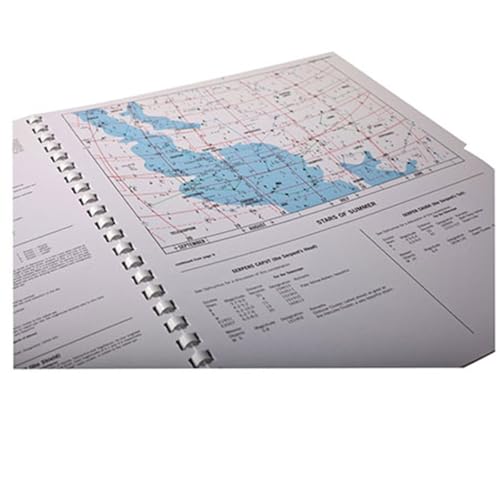
Celestron Sky Maps – Seasonal Star Charts for Stargazing | Learn Constellations & Deep-Sky Objects, Learn the Night Sky, Constellation Guide, Beginner Friendly, Planisphere



As an Amazon Associate we earn from qualifying purchases. Product prices and availability are accurate as of the date/time indicated.
Prices shown are approximate and for reference only. Prices change often, so please check the current price on Amazon before you buy.
Editions and latitude bands change between printings; confirm the band and hemisphere on the listing before ordering, as the guide explains. Ratings are editorial, weighing first-night usability, outdoor legibility, durability, and how long the gift stays useful as the beginner grows.
The Six Star Chart Gifts Reviewed
1. David S. Chandler The Night Sky Planisphere: Best Overall
Chandler’s planisphere is the connoisseur’s answer disguised as a simple gift: two-sided, so the sky’s crowded regions get room to breathe, drawn with a projection that keeps constellation shapes honest near the window’s edge, and printed in its large edition at a size that red light and real eyes can use. Beginners find their first constellations on it without an instructor because its horizons and directions are unmissable and its stars are graded the way the sky grades them. It costs a few dollars more than the bargain discs and repays it on the first night, and it is the planisphere that astronomy clubs hand to newcomers when the club’s own reputation is attached to the recommendation. Give it in the right latitude band and you have given the single most useful object a beginning observer can own, which is why it leads this table without a close argument.
2. Sky and Telescope Pocket Sky Atlas: Best Atlas for the Growing Observer
The Pocket Sky Atlas is the gift for the beginner who has caught the fever: eighty charts that plot the sky down to the small telescope’s working depth, in a binding that opens flat in a cold lap on paper that forgives dew, sized to live in the observing bag rather than on the shelf. It assumes the constellations are learned, which makes it the second gift rather than the first, the one given at the birthday after the planisphere, and its longevity is measured in decades of penciled notes in its margins by observers who started exactly where your receiver stands. For the teenager with a first telescope or the adult whose binocular sessions keep ending in questions, it is the chart gift that respects their trajectory, and its price buys more years of use per dollar than anything else in this table.
3. Turn Left at Orion: Best Guidebook Gift
Turn Left at Orion teaches the sky the way a patient friend would, one findable object at a time: here is the constellation, here is the star hop, here is what the object looks like in a small telescope or binoculars, here is why it is interesting, across hundreds of objects organized by season and difficulty. Its finder charts are drawn from the eyepiece’s own perspective, which is the perspective every other book forgets, and its descriptions are honest about small instruments, promising the smudge and the sparkle that a beginner’s optics will actually deliver rather than the Hubble portraits that make beginners think they have failed. As a gift it has the heft and beauty of a real book and the utility of a course, and paired with the Chandler planisphere it forms this guide’s recommended complete gift: orientation and curriculum, the where and the what-next, in one wrapped box.
4. Firefly Planisphere: Best Presentation Gift
The Firefly presents the planisphere as a gift object, a handsome production with information panels and a finish that survives the coffee table as gracefully as the observing field, in latitude editions for its markets. Its chart is competent and readable, a step behind the Chandler in the field’s strict grading and a step ahead of everything here as an object to unwrap, which is a real criterion for a gift and this guide refuses to pretend otherwise. Give it to the adult beginner whose taste runs to beautiful tools, the office colleague, the in-law whose interest is genuine but new, and it will be used because it was first admired, a sequence the purists underrate and gift givers understand in their bones.
5. Orion Star Target Planisphere: Best Budget Planisphere
Orion’s Star Target does the essential job at the essential price: set the date and time, read tonight’s sky, with object listings that point the beginner at the season’s highlights and a construction honest about its price point. Its print is smaller than the Chandler’s and its materials lighter, and it is bought by the classroom, the scout troop, and the grandparent equipping three grandchildren at once, contexts where a good chart in every hand beats a perfect chart in one. As a stocking-level gift or the chart that rides in the car’s glovebox for unplanned dark skies, it earns its row, and a generation of observers started on discs exactly like it, which is not nostalgia but evidence.
6. Celestron Sky Maps: Best for Younger Beginners
Celestron’s Sky Maps wraps seasonal charts in a spiral book with a glow in the dark feature that, whatever its practical limits under real red light discipline, performs the one service a child’s first chart must perform: it makes the chart itself an object of delight, handled and opened and carried to the window on cloudy nights too. Its charts are sound beginner material with friendly notes, its format survives young hands, and its price forgives the mud it will meet. Give it to the eight to twelve year old with an adult committed to those first nights, and understand what you are really giving: not information, which the Chandler gives better, but an invitation, printed in glow ink, that a child can accept on their own at bedtime, which is where astronomers are actually made.
Buying Guide: How to Choose the Best Star Chart Gift for a Beginner
Step One: Fix the Latitude, the Hemisphere, and the Receiver’s Instrument
Before any other choice, establish where the receiver observes, home town latitude and hemisphere, and choose the planisphere band that contains it, southern editions for southern skies, because every other virtue in this table is void where that one fails. Then inventory what they observe with: naked eyes only, which calls for the planisphere alone or the planisphere and Turn Left pairing; binoculars, which calls for the guidebook’s small instrument honesty above all; or a first telescope, which adds the atlas to the trajectory and makes the Pocket Sky Atlas the gift with a future. Note their eyes too, reading glasses argue for the large formats without exception, and their age, which sorts the Celestron’s invitation from the Chandler’s instrument. Write the answers on the order before browsing, because star chart listings are a thicket of editions, and the wrong edition of the right chart is the commonest failed gift in amateur astronomy.
Step Two: Give the Chart With Its First Night Attached
The wrapping should contain more than the chart: a red flashlight if they do not own one, because white light ruins the night vision the chart depends on and no beginner knows this until told; a note naming the first three targets for the current season, the Moon on any clear evening, the brightest planet up that month, and one constellation the chart will teach in ten minutes; and a date, your own presence promised for a first session within the fortnight, weather permitting, because gifts with appointments get used and gifts without them get shelved. Check the chart on arrival, spin the disc, confirm the band printed on it matches your order, and if the season is deep winter, add the honest encouragement that the summer sky rewards patience, since the chart shows the whole year’s sky and the waiting is part of the hobby’s education. This step costs almost nothing and is worth more than upgrading any single row in the table to the one above it.
Step Three: Plan the Second Gift While the First Is Still New
Star charts form a ladder, and the thoughtful giver buys the first rung while knowing the rest: planisphere for orientation in the first season, the guidebook for curriculum as the constellations settle, the atlas when the objects outgrow the guidebook’s charts, and, for this site’s readers, the binocular or its upgrade when the eyes ask for more sky than the naked view provides. Ask, a month after giving, what they have found, and let the answer choose the next gift, because a beginner who found the Orion Nebula needs the atlas’s depth while one still hunting Cassiopeia needs company more than equipment. Keep your own expectations in the gift’s terms too: a chart used six nights a year for a decade is a triumph, not a failure, and the sky’s slow curriculum is the point of it. The best star chart gifts for beginners are finally judged in years, by whether the receiver, some clear night long after the wrapping is forgotten, still sets a date and a time on a disc and steps outside knowing where to look, and every choice in this guide is aimed at that night.
Frequently Asked Questions About Star Chart Gifts for Beginners
Are star chart apps better than a paper planisphere as a gift?
Apps are better instruments and worse gifts, and the distinction decides most purchases in this category. A good planetarium app shows the sky in real time, identifies anything it is pointed at, and costs little or nothing, and every beginner should eventually have one. But a phone at an observing session is a white light accident waiting to happen, a battery, a notification stream, and an object that cannot be wrapped, inscribed, or kept for twenty years, while a planisphere teaches the sky’s actual structure, how the sky turns with the hours and the seasons, in a way the app’s instant answers bypass entirely, which is why astronomy educators still start students on the disc. Give the chart, mention the app in the card as the companion you recommend, and the receiver gets both the education and the convenience, in the order that builds an observer rather than a spectator.
What latitude planisphere should I buy for the United States?
Match the band to the receiver’s home latitude, which you can read from any map: roughly, the southern states sit in the 30s, the middle of the country around 35 to 42 degrees, and the northern tier and New England in the low to high 40s. Makers band their editions differently, commonly 20 to 30, 30 to 40, 40 to 50, and 50 to 60 degrees, so choose the band containing the receiver’s latitude, favoring the band whose middle is nearest their home if they sit near an edge, since the horizon distortion grows toward a band’s extremes. If the receiver travels to observe, a cabin or a dark site within a few degrees of home, the home band still serves, because a few degrees shifts the southern horizon’s guest list rather than rewriting the sky. When the listing does not state a band at all, treat that as the answer about that product and choose one of the makers in this table who print it on the disc.
What is a good star chart gift for a child?
The Celestron Sky Maps in this table for the younger child, and the large Chandler planisphere for the older child who reads confidently, with the same condition attached to both: an adult’s company for the first nights, because a child’s astronomy lives or dies on shared first successes. Choose targets that cannot fail, the Moon above all, whose craters along the terminator thrill through any binocular, the bright planets in their seasons, and the one or two constellations the child can find unaided by the second night, because ownership of a constellation is the hook the hobby sets. Durability argues for the spiral and laminated formats, print size for the large editions, and price honesty for the giver: a modest chart with three shared nights outperforms a beautiful atlas shelved in a silent room, every time, in every family this guide has ever heard from.
Can I give a star chart to someone in the southern hemisphere or another country?
Yes, with the latitude discipline applied across the equator: southern observers need southern hemisphere editions, which Chandler, Firefly, and the atlas publishers all produce, drawn for southern latitude bands with the south celestial pole at their center and the northern constellations in their proper, reduced role. The Pocket Sky Atlas and Turn Left at Orion travel better than planispheres, since an atlas covers the whole sky in pages and a guidebook’s seasonal organization merely needs its months mentally reversed below the equator, but the planisphere, the beginner’s first tool, must be bought in its southern edition or not at all. Check the listing’s hemisphere statement as carefully as its band, allow for the longer shipping that cross hemisphere editions sometimes involve, and the gift arrives as what it should be: a chart of the sky its receiver actually lives under, which is the entire point of giving one.
Related guides
- How to Choose Christmas Optics Gifts in 2026: How to Choose Christmas Optics Gifts
- Best Monocular for Whale Watching Tours in 2026: 6 Best Monocular for Whale Watching Tours Picks for Clear Views, Easy Use, and Reliable Ocean Watching
- Best Binoculars for Storm Watching From Porches in 2026: Best Binoculars for Storm Watching From Porches for Clear View, Waterproof Build, and Simple Porch Use
- Best Myths About ED Glass Debunked: 6 Best Myths About ED Glass Debunked for Binocular Buyers in 2026
More from Amazon
Programs that pair well with the guide above. Offers and eligibility are set by Amazon and may change.
Send a Prime gift membership to someone who would use free shipping and Prime Video.
Gift Amazon PrimeGive audiobooks to someone who loves to listen. Plans and prices are set by Amazon.
Gift AudibleFree shipping on eligible items, Prime Video and more. Eligible new members can start with a free trial.
Start a Prime free trialAudiobooks and podcasts to listen to on the go. Eligible new members can start with a free trial.
Try Audible freeAs an Amazon Associate we earn from qualifying purchases.

Write Your Review
No reviews yet. Be the first to share your experience!