
What's inside
- Best Cheap Binoculars for Stargazing Beginners Compared: Quick Comparison Table
- Best Cheap Binoculars for Stargazing Beginners in 2026: Detailed Reviews
- Best Cheap Binoculars for Stargazing Beginners Buying Guide: How to Choose the Right Binoculars
- Best Cheap Binoculars for Stargazing Beginners FAQ: Stargazing Binocular Questions Answered
As an Amazon Associate I earn from qualifying purchases. This post may contain affiliate links at no extra cost to you.
Cheap binoculars for stargazing beginners are binoculars, usually 7×50, 10×50, or 15×70, that cost less than $100 to $150, with a large objective lens, a bright image, and a design that is easy for a beginner to hold and focus, so a beginner can see stars, the Moon, and planets clearly without needing an expensive telescope or a professional setup. They are useful for stargazing beginners because binoculars are easier to use than a telescope, with a wider field of view, a more natural view with two eyes, and a lower price, and they let a beginner learn the night sky before they buy a telescope. The best cheap binoculars for stargazing beginners are not the most expensive binoculars, and they are not the highest magnification binoculars. They are the binoculars that have the right magnification for hand-holding, the right objective size for brightness, and a comfortable design for a beginner, without being too heavy or too shaky.
For most stargazing beginners, the best overall choice in 2026 is the Celestron SkyMaster 15×70 Binoculars. They have a magnification of 15x, an objective lens of 70mm, an exit pupil of 4.7mm, a weight of about 3.3 pounds, and a tripod adapter included.
This guide compares seven real, currently sold cheap binoculars for stargazing beginners. It explains how to choose binoculars based on magnification, objective size, and exit pupil, why 7×50 is better than 15×70 for hand-holding, and how to use binoculars for stargazing correctly. Binoculars are only useful if they are bright enough and stable enough for stargazing, so this guide also covers how to hold binoculars steady and how to keep your night vision while stargazing.
Our Top Picks
Best Cheap Binoculars for Stargazing Beginners Compared: Quick Comparison Table
Use this table to compare the best cheap binoculars for stargazing beginners at a glance. Ratings are editorial scores out of five based on brightness, ease of holding, field of view, eye relief, and value for stargazing beginners.
| Model | Key Specs | Best For |
|---|---|---|
| Celestron SkyMaster 15×70 | 15x, 70mm, 4.7mm exit pupil, 3.3 lb, tripod adapter | Best overall cheap binoculars for stargazing beginners |
| Celestron Cometron 7×50 | 7x, 50mm, 7.1mm exit pupil, 1.8 lb, hand-held | Best hand-held cheap binoculars for stargazing beginners |
| Nikon Aculon A211 10×50 | 10x, 50mm, 5.0mm exit pupil, 2.0 lb, hand-held | Best Nikon cheap binoculars for stargazing beginners |
| Bushnell Falcon 10×50 | 10x, 50mm, 5.0mm exit pupil, 2.0 lb, hand-held | Best Bushnell cheap binoculars for stargazing beginners |
| Celestron SkyMaster 12×60 | 12x, 60mm, 5.0mm exit pupil, 2.5 lb, tripod adapter | Best 12x cheap binoculars for stargazing beginners |
| Orion Scenix 7×50 | 7x, 50mm, 7.1mm exit pupil, 1.9 lb, hand-held | Best 7×50 cheap binoculars for stargazing beginners |
| Barska 10×50 Porro Binoculars | 10x, 50mm, 5.0mm exit pupil, 2.0 lb, hand-held | Best budget 10×50 cheap binoculars for stargazing beginners |

Stargazing Binoculars 12x60, Star Gazing Binoculars Kit for Adults Outdoor Enthusiast, 60mm Large Clear View, Includes Carrying Case


As an Amazon Associate we earn from qualifying purchases. Product prices and availability are accurate as of the date/time indicated.
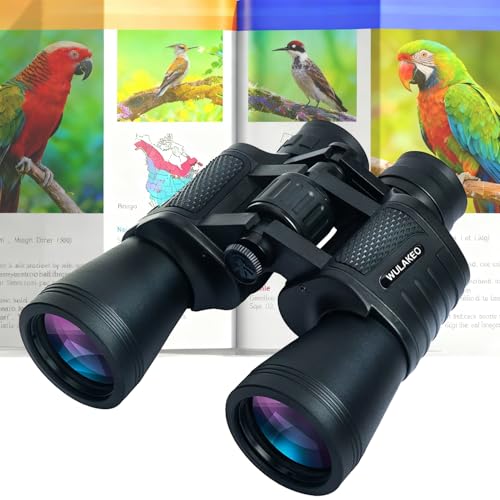
20x50 High Powered Binoculars for Adults, Waterproof Compact Binoculars with Low Light Vision for Bird Watching Hunting Football Games Travel Stargazing Cruise, Christmas Birthday Gifts for Men
As an Amazon Associate we earn from qualifying purchases. Product prices and availability are accurate as of the date/time indicated.

BFVV 60x60 HD Binoculars for Adults Kids with Compass, Low Light Vision | Compact High Powered Binocular for Bird Watching Stargazing Sports Concert Hunting Traveling Gifts for Men Women
As an Amazon Associate we earn from qualifying purchases. Product prices and availability are accurate as of the date/time indicated.
Best Cheap Binoculars for Stargazing Beginners in 2026: Detailed Reviews
Each binocular below suits a different stargazing beginner and a different type of stargazing. Some are best for hand-holding, others are best for a tripod, and some are best for a beginner who wants a versatile pair for day and night. Read the magnification and exit pupil notes, because those two factors affect whether binoculars will be bright and stable enough for stargazing more than any other spec.
1. Celestron SkyMaster 15×70 Binoculars — Best Cheap Binoculars for Stargazing Beginners Overall
The Celestron SkyMaster 15×70 Binoculars are the best overall cheap binoculars for stargazing beginners because they are bright, powerful, and perfect for stargazing, with a magnification of 15x, an objective lens of 70mm, an exit pupil of 4.7mm, a weight of about 3.3 pounds, and a tripod adapter included. They have a Porro prism design, a large objective that lets in a lot of light, and a design that is made for astronomy.
For stargazing beginners, the Celestron SkyMaster 15×70 is a good choice because at 70mm, its objective is large, with a large objective giving a bright image in low light, and at 15x, its magnification is high enough to see the Moon’s craters, Jupiter’s moons, and star clusters clearly, with a magnification of 15x being higher than a typical birding binocular at 8x, and a magnification of 15x giving a narrower field of view, so it is harder to find objects, although it is better for seeing detail. It is also a good choice because its exit pupil of 4.7mm is good for low light, with an exit pupil of 5 to 7mm being ideal for stargazing, and an exit pupil of 4.7mm being close to ideal, although a 7×50 binocular with an exit pupil of 7.1mm is even brighter, so a 15×70 is brighter than a 10×50, but less bright per magnification than a 7×50. Note that 15x binoculars need a tripod or a rest, because 10x is hand-holdable, and 12x needs a tripod or a rest, so 15x definitely needs a tripod, and the SkyMaster 15×70 includes a tripod adapter, so you should use it on a tripod, not hand-held, because hand-holding 15x will be very shaky.
Why we like these binoculars: bright 70mm, powerful 15x, and tripod adapter. Consider: needs tripod, because 15x is too shaky hand-held, although it is excellent on a tripod.
2. Celestron Cometron 7×50 Binoculars — Best Hand-Held Cheap Binoculars for Stargazing Beginners
The Celestron Cometron 7×50 Binoculars are hand-held binoculars with a magnification of 7x, an objective lens of 50mm, an exit pupil of 7.1mm, and a weight of about 1.8 pounds. They have a Porro prism design, a wide field of view, and a design that is easy to hold.
For stargazing beginners who want a hand-held pair, the Cometron 7×50 is an excellent choice, because at 7x, its magnification is low enough to hand-hold steadily, with a magnification of 7x being easier to hold than 10x, and a magnification of 10x being hand-holdable, while 12x needs a tripod, so 7x is very stable hand-held, and at 50mm, its objective gives an exit pupil of 7.1mm, which is ideal for stargazing, because your eye pupil can open to about 7mm in darkness, so an exit pupil of 7.1mm gives you the brightest possible image, and a 7×50 binocular is the classic astronomy binocular for beginners, because it is bright, stable, and has a wide field of view, so it is easy to find stars and constellations.
Why we like these binoculars: brightest 7.1mm exit pupil, stable 7x, and very affordable. Consider: 7x is less powerful than 15x, so it shows less detail on the Moon, although it is best for learning the sky.
3. Nikon Aculon A211 10×50 Binoculars — Best Nikon Cheap Binoculars for Stargazing Beginners
The Nikon Aculon A211 10×50 Binoculars are binoculars with a magnification of 10x, an objective lens of 50mm, an exit pupil of 5.0mm, and a weight of about 2.0 pounds. They have a Porro prism design, a good optical quality, and a design that is durable and well made by Nikon.
For stargazing beginners who want a Nikon pair, the Aculon A211 10×50 is a practical choice, because at 10x, its magnification is hand-holdable, with 10x being the highest magnification that is hand-holdable for most people, and at 50mm, its objective gives an exit pupil of 5.0mm, which is good for low light, although it is less bright than a 7×50 with an exit pupil of 7.1mm, so a 10×50 is a good balance of magnification and brightness, with a magnification of 10x giving more detail than 7x, and an exit pupil of 5.0mm still being bright enough for stargazing. It is a good option for a beginner who wants a versatile pair for stargazing and for daytime use, although it is more expensive than the Cometron 7×50, and its optical quality is better, so it is worth the extra cost if you want a Nikon.
Why we like these binoculars: hand-holdable 10x, bright 5.0mm, and Nikon quality. Consider: more expensive than Cometron, although it is more versatile.
4. Bushnell Falcon 10×50 Binoculars — Best Bushnell Cheap Binoculars for Stargazing Beginners
The Bushnell Falcon 10×50 Binoculars are binoculars with a magnification of 10x, an objective lens of 50mm, an exit pupil of 5.0mm, and a weight of about 2.0 pounds. They have a Porro prism design, a design that is simple and functional, and a price that is very affordable for a beginner.
For budget stargazing beginners, the Bushnell Falcon 10×50 is a good choice, because it is very affordable, it has a magnification of 10x that is hand-holdable, and an exit pupil of 5.0mm that is good for low light, although its optical quality is less good than Nikon, and its eye relief is less than 14mm, so it is less good for glasses wearers, although it is functional for most beginners who do not wear glasses. It is a good option for a first pair for a beginner who wants a cheap 10×50.
Why we like these binoculars: very affordable, hand-holdable 10x, and 5.0mm. Consider: eye relief less than 14mm, so less good for glasses wearers.
5. Celestron SkyMaster 12×60 Binoculars — Best 12x Cheap Binoculars for Stargazing Beginners
The Celestron SkyMaster 12×60 Binoculars are binoculars with a magnification of 12x, an objective lens of 60mm, an exit pupil of 5.0mm, and a weight of about 2.5 pounds. They have a Porro prism design, a tripod adapter included, and a design that is made for astronomy.
For stargazing beginners who want a 12x pair, the SkyMaster 12×60 is a practical choice, because at 12x, its magnification is higher than 10x, so it shows more detail on the Moon, although 12x needs a tripod or a rest, because 10x is hand-holdable and 12x needs support, so you should use it on a tripod, not hand-held, and at 60mm, its objective gives an exit pupil of 5.0mm, which is good for low light. It is a good option for a beginner who wants a step up from 10×50 but does not want the weight of a 15×70, although it still needs a tripod.
Why we like these binoculars: 12x powerful, 5.0mm, and tripod adapter. Consider: needs tripod, because 12x is too shaky hand-held.
6. Orion Scenix 7×50 Binoculars — Best 7×50 Cheap Binoculars for Stargazing Beginners
The Orion Scenix 7×50 Binoculars are binoculars with a magnification of 7x, an objective lens of 50mm, an exit pupil of 7.1mm, and a weight of about 1.9 pounds. They have a Porro prism design, a wide field of view, and a design that is made for astronomy. Note that Orion Telescopes closed in 2024, so Orion-branded products should be verified for stock before you buy, although the Scenix 7×50 is still sold by some retailers, so check stock before you order.
For stargazing beginners who want a 7×50 pair, the Orion Scenix is a good choice, because at 7x, it is stable hand-held, and at 50mm, it gives an exit pupil of 7.1mm, which is ideal for stargazing, although you should verify stock before you buy, because Orion closed in 2024, and some Orion products may be discontinued, so check with the retailer before you order.
Why we like these binoculars: brightest 7.1mm, stable 7x, and wide field. Consider: verify stock, because Orion closed in 2024.
7. Barska 10×50 Porro Binoculars — Best Budget 10×50 Cheap Binoculars for Stargazing Beginners
The Barska 10×50 Porro Binoculars are binoculars with a magnification of 10x, an objective lens of 50mm, an exit pupil of 5.0mm, and a weight of about 2.0 pounds. They have a Porro prism design, a design that is simple, and a price that is affordable for a beginner.
For budget stargazing beginners, the Barska 10×50 is a practical choice, because it is affordable, it has a magnification of 10x that is hand-holdable, and an exit pupil of 5.0mm that is good for low light, although its optical quality is less good than Nikon or Celestron, and it is less durable, although it is functional for a first pair for a beginner who wants a cheap 10×50.
Why we like these binoculars: affordable, hand-holdable 10x, and 5.0mm. Consider: less durable than Nikon, although it is functional for beginners.
Best Cheap Binoculars for Stargazing Beginners Buying Guide: How to Choose the Right Binoculars
Choosing cheap binoculars for stargazing beginners is not just about picking the cheapest binoculars. It is about matching magnification, objective size, and exit pupil to your eyes, your hands, and how you will use them for stargazing. Binoculars that are perfect for birding can be wrong for stargazing, and binoculars that are perfect for a beginner can be wrong for an experienced stargazer. Use the three questions below to narrow your choice before you look at price.
Magnification, Exit Pupil, and Hand-Holding: Choosing Binoculars That Are Bright and Stable
Magnification and exit pupil are the first filter, and they are critical for stargazing. Exit pupil is calculated as objective lens diameter divided by magnification, with an exit pupil of 7×50 being 7.1mm, 10×50 being 5.0mm, 8×42 being 5.25mm, 10×42 being 4.2mm, 8×30 being 3.75mm, and 15×70 being 4.7mm, and a larger exit pupil is better for stargazing, because your eye pupil can open to about 7mm in darkness, so an exit pupil of 5 to 7mm is ideal, because it gives you the brightest image, and an exit pupil below 4mm will be darker in low light. For magnification, 7x is easiest to hold, with 7x being very stable hand-held, 8x being easy to hold, 10x being hand-holdable for most people, and 12x needing a tripod or a rest, so a magnification of 7x to 10x is best for hand-held stargazing, while a magnification of 12x to 15x needs a tripod, because it is too shaky hand-held.
For a stargazing beginner, a 7×50 binocular is best for learning the sky, because it has a wide field of view, a bright image with an exit pupil of 7.1mm, and a stable image that is easy to hold, while a 10×50 binocular is best for a beginner who wants more detail, because it has a higher magnification and still has an exit pupil of 5.0mm, although it is slightly less stable than 7x, and a 15×70 binocular is best for a beginner who wants the most detail and is willing to use a tripod, because it has a high magnification and a large objective, but it is too heavy and too shaky to hand-hold, so it must be used on a tripod.
Objective Size, Eye Relief, and Glasses: Choosing Binoculars That Fit Your Eyes
Objective size and eye relief are the second filter. For stargazing, a larger objective is better, because it lets in more light, with a 70mm objective letting in more light than a 50mm objective, and a 50mm objective letting in more light than a 42mm objective, although a larger objective is heavier, so a 70mm binocular is heavier than a 50mm binocular, and a 50mm binocular is heavier than a 42mm binocular, so a 50mm objective is a good balance of brightness and weight for a beginner, while a 70mm objective is best for a beginner who will use a tripod and does not mind the weight. For eye relief, an eye relief of at least 14mm is needed for glasses wearers, with an eye relief below 14mm being too short for glasses, and an eye relief of 14mm or more letting a glasses wearer see the full field of view, so check eye relief before you buy if you wear glasses, with eyecups down for glasses and up without glasses, because eyecups down lets glasses sit closer to the eyepiece, and eyecups up blocks stray light when you do not wear glasses.
For a beginner, a binocular with a field of view of at least 400 feet at 1000 yards is good for birding, although for stargazing, a wider field of view is better for finding stars, with a 7×50 binocular having a wider field of view than a 15×70 binocular, because a lower magnification gives a wider field, so a 7×50 is easier to find objects with than a 15×70, although a 15×70 shows more detail once you find an object. For a beginner, choose a binocular with a wide field of view and a low magnification first, then move to a higher magnification later, once you learn the sky.
Tripod, Red Light, and Night Vision: Setting Up Binoculars for Stargazing Correctly
Tripod and red light are the third filter. For stargazing, a tripod is essential for binoculars over 10x, because 10x is hand-holdable, and 12x needs a tripod or a rest, so a 15×70 binocular must be used on a tripod, with a tripod load needing to be at least the binocular weight plus 2 pounds, so a binocular that weighs 3.3 pounds needs a tripod that can hold at least 5.3 pounds, and a fluid head being better than a ball head for stargazing, because a fluid head lets you pan smoothly to follow a star, while a ball head is jerky. For a tripod, a weight of less than 3 pounds is best for travel, with a folded length of less than 17 inches being best for travel, and a folded length of 15 inches or less being best for carry-on, although a tripod for stargazing does not need to fit in a carry-on, it is still good to be portable.
For night vision, use a red light only, because a red light preserves your night vision, while a white light will ruin it, and it will make it harder to see stars, so use a red flashlight, not a white flashlight, when you are outside at night, and let your eyes adapt to the dark for about 20 minutes before you look through binoculars, because eyes need time to adapt. For safety, never look at the Sun through binoculars, because looking at the Sun through any optic can cause permanent eye damage, and never look at the Sun without a front solar filter, because a solar filter must be on the front of the binoculars, not on the eyepiece. For a beginner, start with the Moon, because the Moon is the easiest object to see, with a bright image that is easy to find, and the best Moon is at quarter Moon, not full Moon, because at quarter Moon, the terminator shadows make craters stand out, while at full Moon, the Moon is flat and has no shadows.
Best Cheap Binoculars for Stargazing Beginners FAQ: Stargazing Binocular Questions Answered
What is the best cheap binoculars for stargazing beginners?
The Celestron Cometron 7×50 is the best hand-held alternative, while the Nikon Aculon A211 10×50 is the best versatile alternative.
What magnification is best for stargazing beginners?
For stargazing beginners, a magnification of 7x to 10x is best for hand-holding, because 7x is very stable, 8x is easy to hold, and 10x is hand-holdable for most people, while 12x needs a tripod or a rest, and 15x definitely needs a tripod. Start with 7×50 for learning the sky, then move to 10×50 for more detail, and use 15×70 on a tripod for the most detail.
How do I calculate exit pupil for stargazing binoculars?
To calculate exit pupil, divide your objective lens diameter by your magnification, with an exit pupil of 7×50 being 7.1mm, 10×50 being 5.0mm, 8×42 being 5.25mm, and 15×70 being 4.7mm. For stargazing, an exit pupil of 5 to 7mm is ideal, because your eye pupil can open to about 7mm in darkness, so an exit pupil of 7.1mm gives you the brightest image, and an exit pupil below 4mm will be darker in low light.
Do I need a tripod for stargazing binoculars?
For stargazing binoculars, you need a tripod if your magnification is 12x or higher, because 10x is hand-holdable, and 12x needs a tripod or a rest, so a 15×70 binocular must be used on a tripod, with a tripod load needing to be at least the binocular weight plus 2 pounds. A 7×50 or 10×50 binocular can be hand-held, although a tripod will still make the image steadier, especially for long viewing sessions.
FAQ
What is the best cheap binoculars for stargazing beginners?
What magnification is best for stargazing beginners?
How do I calculate exit pupil for stargazing binoculars?
Do I need a tripod for stargazing binoculars?
Related guides
- Best Optics for Beginners Winter Use in 2026: Fogproof Binoculars Graded on the Cold Transition — Warm Car to Frozen Field Without Losing the View
- Best Cell Phone Monocular in 2026: 7 Best Cell Phone Monoculars With Clear View, Simple Use, and Easy Use for Cell Phone Monocular
- Best Monocular for Glasses Wearers Comfort in 2026: Monocular for Glasses Wearers Comfort, Glasses Wearers Monoculars, and Best Comfortable Monoculars for Glasses Wearers
- Best Binoculars for Camping Trips Viewing in 2026: 7 Binoculars for Camping Trips Viewing That Offer Clear Optics, Easy Carry, and Reliable Performance for Camping
More from Amazon
Programs that pair well with the guide above. Offers and eligibility are set by Amazon and may change.
Free shipping on eligible items, Prime Video and more. Eligible new members can start with a free trial.
Start a Prime free trialAudiobooks and podcasts to listen to on the go. Eligible new members can start with a free trial.
Try Audible freeAd-free music streaming. Eligible new subscribers can start with a free trial.
Try Music Unlimited freeA free business account with business pricing and bulk-buying tools for work, shop or home office.
Create a business accountAs an Amazon Associate we earn from qualifying purchases.

Write Your Review
No reviews yet. Be the first to share your experience!