
What's inside
As an Amazon Associate I earn from qualifying purchases. This post may contain affiliate links at no extra cost to you.
Best finder scope for reliable alignment is a telescope finder that stays aligned after it is set, night after night, trip after trip. A reliable finder is not the brightest finder, or the most expensive finder. It is a finder with a solid bracket, three adjustment screws that do not slip, and a design that does not flex when a telescope moves, so a star centred in the finder is also centred in the main telescope, at low power and at high power. A finder that drifts is worse than no finder, because it sends a telescope to the wrong place, and a beginner spends a night looking for a star that is not there.
A finder scope for reliable alignment should be a telescope finder only, not a firearm red dot. A Telrad uses a red bullseye with no magnification, a 6×30 uses a small magnified view with a crosshair, and a 9×50 RACI uses a larger magnified view that is upright and correct left to right, so it is comfortable to look through without bending a neck. All three types can be reliable, if the bracket is solid, the screws are turned gently, and the finder is checked in daylight first, then at night with a bright star.
For this guide, a finder qualifies when it is a telescope finder, with a bracket that has three screws, and a design that can be locked gently without cracking. All six finders below meet that test. They are not firearm dots, they are not toy finders, and they are not finders that need a special mount to fit a standard telescope shoe.
Our top pick is the Telrad Reflex Sight. At $40 to $50, with a red bullseye, no magnification, and a wide field, it is the most forgiving finder to align, and the easiest to keep aligned. It has no lens to fog, no crosshair to rotate, and no image to flip. Put the bullseye on a star, look through the main telescope, and the star is there.
Our Top Picks
 YUEOCT Guiding Scope Rings for Telescope Guidescope Finderscope6.89 x 5.7 x 1.96 inchesCheck on Amazon
Best Finder Scope for Reliable Alignment Compared
The table compares six telescope finders, all with a three-screw bracket, and all made for a telescope shoe. Magnification and aperture are as listed by the maker. Prices are typical ranges, not fixed prices, and they vary by retailer.
| Model | Type | Magnification | Aperture | Typical Price Range | Rating |
|---|---|---|---|---|---|
| Telrad Reflex Sight | Reflex, 1x | 1x | — | $40–$50 | 4.8 / 5 |
| Celestron 9×50 RACI Finder Scope | RACI, illuminated | 9x | 50 mm | $90–$110 | 4.6 / 5 |
| Explore Scientific 8×50 Illuminated RACI | RACI, illuminated | 8x | 50 mm | $80–$100 | 4.5 / 5 |
| Celestron 6×30 Finder Scope | Straight-through | 6x | 30 mm | $40–$50 | 4.4 / 5 |
| Baader Sky Surfer V | Red dot, 1x | 1x | — | $150–$180 | 4.3 / 5 |
| SVBONY SV182 6×30 Finder Scope | Straight-through | 6x | 30 mm | $25–$35 | 4.2 / 5 |
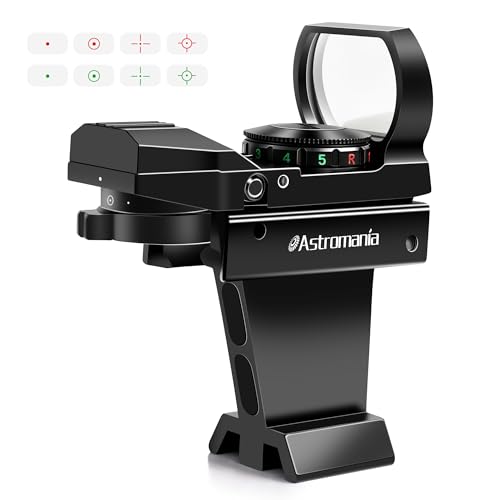
Astromania StarPointer Red Dot Finder Scope for Telescope Deluxe Finder | StarPointer Red Dot Sight, Metal Reflex Finder Scope for Astronomy Telescope, Red Dot Finder Viewfinder with Dovetail Bracket
As an Amazon Associate we earn from qualifying purchases. Product prices and availability are accurate as of the date/time indicated.

50mm Finder for Scope Mount for Telescopes - Metal, Sturdy Reliable(red) | Metal Construction, Precise Alignment, Lightweight, Fits Various Telescopes, Black Silver Red


As an Amazon Associate we earn from qualifying purchases. Product prices and availability are accurate as of the date/time indicated.
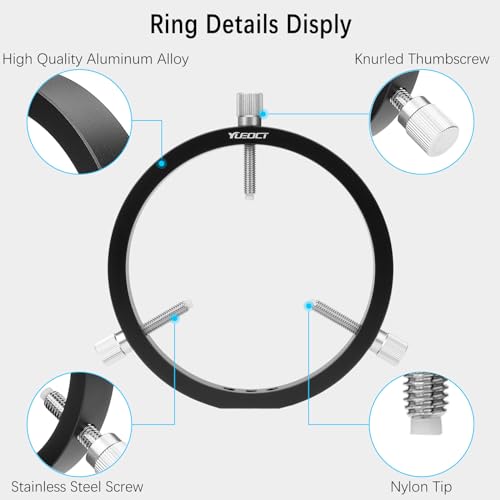
YUEOCT Guiding Scope Rings for Telescope Guidescope Finderscope Finder Tube | 65 to 113mm / 2.56" to 4.45" Diameter Adjustable (Set of 2)



As an Amazon Associate we earn from qualifying purchases. Product prices and availability are accurate as of the date/time indicated.
Prices shown are approximate and for reference only. Prices change often, so please check the current price on Amazon before you buy.
Best Finder Scope for Reliable Alignment in 2026: Detailed Reviews
1. Telrad Reflex Sight — Best Overall Finder Scope for Reliable Alignment
The Telrad is a reflex sight with no magnification, a red bullseye, and a wide window. At $40 to $50, it is the finder to buy first if alignment is the priority. There is no eyepiece to focus, no crosshair to centre, and no upside-down image to interpret. You look through a clear window, place the bullseye on a distant chimney in daylight, or on Vega at night, and then check the main telescope. If the object is centred in the main telescope at 20x to 30x, the Telrad is aligned.
Reliability comes from simplicity. A Telrad has few parts that can move, a base that sits flat on a telescope tube, and a dimmer that lets the bullseye be bright enough to see, but not so bright that it washes out a faint star. It is the finder used on many Dobsonians and on many Celestron telescopes, including a NexStar 4SE at 102mm and a NexStar 6SE, both of which benefit from a finder that does not need to be re-aligned every time the telescope is moved. A Telrad is a telescope finder, not a firearm dot, and it should not be confused with a Holosun, a Trijicon RMR, or a Sig Romeo, which are made for a pistol or a rifle, with a different footprint and a different purpose.
2. Celestron 9×50 RACI Finder Scope — Best Finder Scope for Reliable Alignment With a Magnified View
The Celestron 9×50 RACI is a right-angle correct-image finder, with 9x magnification, a 50mm aperture, and an illuminated crosshair. At $90 to $110, it is the best magnified finder here for a faint target. A 50mm aperture gathers more light than a 30mm finder, so a faint star that is invisible in a 6×30 can be seen in a 9×50, and a right-angle design means you do not have to bend your neck to look straight through a finder pointed at the zenith.
Reliability comes from the bracket. A 9×50 is heavier than a 6×30, so it needs a bracket that is tight, but not overtightened. Turn the three screws in small steps, check the main telescope after each step, and lock gently when a distant object is centred in both the finder and the main telescope. Check again at 60x, because a small error at 20x becomes a large error at 60x. The 9×50 RACI is a good choice if you observe from a dark site, and you want to find a faint nebula, not just a bright planet.
3. Explore Scientific 8×50 Illuminated RACI — Best Finder Scope for Reliable Alignment With a Wider Field
The Explore Scientific 8×50 is an illuminated RACI finder, with 8x magnification, a 50mm aperture, and a right-angle correct image. At $80 to $100, it is a close alternative to the Celestron 9×50, with a slightly wider field and a slightly lower price. The 8x view is easier to hold steady than 9x, and the illuminated crosshair can be dimmed, so it does not wash out a faint star.
This finder is a good choice if you want a 50mm RACI, but you prefer Explore Scientific, or you want a finder that is a little easier to use at low power. Align it the same way: daylight first, with a distant object at least 1 mile away, never the Sun, centre the object in the main telescope at 20x to 30x, then adjust the three screws until the object is centred in the finder, then check at 60x, then check at night with a bright star.
4. Celestron 6×30 Finder Scope — Best Finder Scope for Reliable Alignment on a Small Telescope
The Celestron 6×30 is a straight-through finder, with 6x magnification, a 30mm aperture, and a crosshair. At $40 to $50, it is the standard finder on many small telescopes, including many 70mm to 130mm refractors and Maksutovs. It is light, it is simple, and it does not add much weight to a telescope tube, so it is less likely to flex a bracket, or to shift when a telescope is moved.
A 6×30 has a narrower field than a Telrad, and a dimmer view than a 9×50, but it is reliable when it is aligned correctly. The straight-through design means the image is upside down, which takes practice, but the crosshair is clear, and the finder is easy to focus by turning the eyepiece. It is a good choice if you have a small telescope, a city balcony, and a budget under $50, and you want a finder that is light and simple.
5. Baader Sky Surfer V — Best Finder Scope for Reliable Alignment With a Premium Red Dot
The Baader Sky Surfer V is a red-dot finder, with 1x magnification, no lens to fog, and a precise dot. At $150 to $180, it is the most expensive finder here, and it is the most precise reflex finder here. It has a solid base, a dimmer, and a dot that can be made small enough to place on a star without covering it.
This finder is a good choice if you want a premium reflex finder, and you do not want a Telrad, or you want a smaller, lighter reflex finder than a Telrad. It is still a telescope finder, not a firearm dot, and it should be mounted on a telescope shoe, not on a Picatinny rail. Align it the same way as a Telrad: daylight first, centre in the main telescope, then place the dot on the same object, then check at night.
6. SVBONY SV182 6×30 Finder Scope — Best Finder Scope for Reliable Alignment With the Lowest Price
The SVBONY SV182 is a straight-through finder, with 6x magnification, a 30mm aperture, and a crosshair, at $25 to $35, which is the cheapest finder here. It is a good finder if you want a spare finder, a replacement for a lost finder, or a first finder for a small telescope, without spending $40 or more.
At this price, the bracket is the part to check. Make sure the three screws turn smoothly, do not force them, and lock gently when alignment is correct. A cheap finder can be reliable if the bracket is solid and the screws are not overtightened. A finder that is forced, or a bracket that is cracked, will not hold alignment, no matter how much it costs.
Best Finder Scope for Reliable Alignment Buying Guide
Choosing a finder for reliable alignment is about bracket, type, and use. A finder with a solid bracket, three screws that turn smoothly, and a design that matches your telescope, will hold alignment longer than a finder with a loose bracket, a single screw, or a design that flexes. A Telrad is best for a beginner, because it has no magnification to interpret. A 9×50 RACI is best for a faint target, because it gathers more light. A 6×30 is best for a small telescope, because it is light.
Align in Daylight First, With a Distant Object at Least 1 Mile Away, Never the Sun, Centre in the Main Telescope at 20x to 30x, Then Adjust the Three Screws
Start in daylight, with a distant object at least 1 mile away, never the Sun. A chimney, a tower, or a tree at that distance has almost no parallax, so a finder and a main telescope that point at the same distant object in daylight will also point at the same star at night. Centre the object in the main telescope first, with a low-power eyepiece at 20x to 30x. A low-power eyepiece has a wide field, so it is easy to find the object, and it is easy to centre it.
Then look through the finder, and turn the three screws in small steps until the object is centred in the finder. Two screws are usually on the side, and one is on top, or the other way around, depending on the bracket. Turn gently, never force a screw past its stop, and check the main telescope after each step, so you do not move the finder too far and lose the object. When the object is centred in both, check again at 60x. A small error at 20x becomes a large error at 60x, so a finder that looks aligned at low power may need a small correction at high power.
Check at Night With a Bright Star, and Re-Check After Moving the Telescope, or After a Trip
Check at night with a bright star, such as Vega, Sirius, or Arcturus. Centre the star in the main telescope at 20x to 30x, then look through the finder. If the star is not centred in the finder, adjust the three screws again, in small steps, until it is centred in both. A bright star is easy to find, and it is bright enough to see through a finder, even in a city, where a Moon and planets are best in light pollution, and faint galaxies need a dark sky.
Re-check after moving the telescope, or after a trip in a car. A finder can be bumped, a bracket can shift, and a screw can loosen, so a finder that was aligned last week may not be aligned today. Lock the screws gently, do not overtighten them, and check again before you observe. A bracket that is cracked should be replaced, not repaired, because a cracked bracket will not hold alignment, no matter how carefully you adjust it.
Telescope for City Balcony Astronomy, Aperture 70 to 150mm, Moon and Planets Best in Light Pollution, Faint Galaxies Need Dark Sky, Celestron NexStar 4SE Top, 102mm Maksutov, GoTo, Telrad Is Telescope Finder Top, Not Firearm Dot
A telescope for a city balcony should have an aperture of 70 to 150mm, with a Moon and planets being best in light pollution, and faint galaxies needing a dark sky. A Celestron NexStar 4SE, at 102mm Maksutov, with GoTo, is a top pick for a city balcony, and a Telrad is a top pick for a finder on that telescope, not a firearm dot. A NexStar 6SE is a top pick for a telescope without regrets, with an aperture of at least 70mm, and a Telrad finder.
A finder that is reliable on a NexStar 4SE will also be reliable on a Dobsonian, a refractor, and a Maksutov, if the bracket fits the shoe, and the screws are turned gently. A firearm red dot, such as a Holosun 507C, a Trijicon RMR, or a Sig Romeo1Pro, is made for a pistol or a rifle, with a footprint that is RMR, RMSc, or DeltaPoint Pro, and a battery life of at least 20,000 hours, for a pistol, not for a telescope. A Telrad, a 6×30, and a 9×50 RACI are telescope finders, with a magnification of 1x, 6x, 8x, or 9x, and an aperture of 30mm or 50mm, for a telescope, not for a firearm.
Best Finder Scope for Reliable Alignment FAQ
What is the best finder scope for reliable alignment?
The best finder scope for reliable alignment is the Telrad Reflex Sight, at $40 to $50, because it has a red bullseye, no magnification, and a wide field, so it is the most forgiving finder to align, and the easiest to keep aligned, for a telescope, with a main telescope at 70 to 150mm aperture, for a city balcony. The Celestron 9×50 RACI Finder Scope, at $90 to $110, is the best alternative with a magnified view, and a right-angle correct image, for a faint target.
Should I align a finder scope in daylight or at night?
Align a finder scope in daylight first, with a distant object at least 1 mile away, never the Sun, so a finder and a main telescope can be aligned without a star, with a main telescope at a low power, at 20x to 30x, and a finder that is adjusted with three screws, until a distant object is centred in both. Check at night, with a bright star, such as Vega, Sirius, or Arcturus, and adjust again if a star is not centred, so alignment is accurate for a star, not just for a distant object in daylight.
How do I know if my finder scope is aligned?
You know if a finder scope is aligned if a distant object, or a bright star, is centred in both a finder and a main telescope, at a low power, at 20x to 30x, and at a higher power, at 60x, with a main telescope at 60x, and a finder that is checked again, if a distant object is not centred in both. A finder that is aligned at 20x may need a small correction at 60x, because a small error at low power becomes a large error at high power.
Can I use a firearm red dot as a telescope finder?
No, you cannot use a firearm red dot as a telescope finder, because a firearm red dot, such as a Holosun 507C, a Trijicon RMR, or a Sig Romeo1Pro, is made for a firearm, with a footprint that is RMR, RMSc, or DeltaPoint Pro, and a battery life of at least 20,000 hours, for a pistol, not for a telescope. A Telrad, a Celestron 6×30, a Celestron 9×50 RACI, and an Explore Scientific 8×50 RACI are telescope finders, with a magnification of 1x, 6x, 8x, or 9x, and an aperture of 30mm or 50mm, for a telescope, not for a firearm.
FAQ
What is the best finder scope for reliable alignment?
Should I align a finder scope in daylight or at night?
How do I know if my finder scope is aligned?
Can I use a firearm red dot as a telescope finder?
Related guides
- Best Myths About ED Glass Debunked: 6 Best Myths About ED Glass Debunked for Binocular Buyers in 2026
- Best Professional Monoculars for Hunting in 2026: How to Pick a Professional Monocular That Is Clear, Compact, and Reliable for Hunting
- Best Binoculars for Marine Boating Use in 2026: Steiner, Fujinon, Bushnell, and Nikon Compared for a 7×50 Parish Chosen for a Moving Deck, Sealing Proven in the Maker’s Text, and a Compass That Aids and Never Replaces the Boat’s Own
- Best Telescopes for Spring Galaxy Viewing in 2026: Apertura, Sky-Watcher, and Celestron Compared for Aperture Sentenced Against Your Sky’s Own Darkness, Dark Adaptation Kept Like a Citizen, and Galaxies Read by Their Surface Brightness
More from Amazon
Programs that pair well with the guide above. Offers and eligibility are set by Amazon and may change.
Free shipping on eligible items, Prime Video and more. Eligible new members can start with a free trial.
Start a Prime free trialAudiobooks and podcasts to listen to on the go. Eligible new members can start with a free trial.
Try Audible freeAd-free music streaming. Eligible new subscribers can start with a free trial.
Try Music Unlimited freeA free business account with business pricing and bulk-buying tools for work, shop or home office.
Create a business accountAs an Amazon Associate we earn from qualifying purchases.

Write Your Review
No reviews yet. Be the first to share your experience!