
What's inside
- Best Monocular for Stargazing and Bird Watching: The Figures That Serve Both Skies
- Quick Comparison: Monoculars for Birds and Stars Compared
- The Seven Dual-Purpose Monoculars Reviewed
- Buying Guide: Decide Your Mix, Compute the Exit Pupil, Budget the Tripod
- How We Selected These Monoculars
- Frequently Asked Questions: Monoculars for Stargazing and Bird Watching
As an Amazon Associate I earn from qualifying purchases. This post may contain affiliate links at no extra cost to you.
The best monocular for stargazing and bird watching asks one instrument to serve two masters that want different things, and the honest buyer starts by admitting the compromise rather than shopping past it. Bird watching is a daylight discipline of speed: a bird appears, moves, and vanishes, so the monocular must be found quickly, focused quickly, and held steady on a small moving target at close to middle distance. It rewards a wide field of view, a modest magnification that does not shake, a close focus short enough for a feeder or a butterfly, and colour that is true enough to separate one brown warbler from another. Stargazing is the opposite parish: a night discipline of patience, rewarding aperture above almost everything, because the objective lens gathers the light that makes a faint cluster, a nebula, or the moons of Jupiter visible at all. It rewards a generous exit pupil for a bright image at dusk, coatings that waste as little light as possible, and a thread for a tripod, because at night the hand’s tremor is joined by long looking, and the sky does not forgive a wandering tube.
A monocular, one barrel instead of two, makes the compromise sharper and also cheaper. You give up the two-eyed comfort and depth that binoculars give the bird watcher, and the summed brightness that two eyes give the astronomer. In return you get an instrument that is half the weight, often half the price for the same quality of glass, small enough to live in a coat pocket or a car’s glovebox, and quick to bring to one eye with one hand while the other hand holds a guide, a phone, or a dog’s lead. For the walker who birds by day and scans the sky from a campsite by night, that trade is often the right one, provided the figures are chosen with both parishes in mind. This guide works through those figures in order, compares real, currently sold monoculars across the useful range, and ends with a buying method that starts from your own mix of feather and star rather than from a headline magnification.
One safety note belongs at the head of any stargazing guide and admits no exception: never point any monocular, binocular, or telescope at or near the Sun. Instant and permanent eye damage can result, and no filter made for night or birding use makes solar viewing safe. These instruments are for birds, landscapes, the Moon, planets, and stars, and the Moon itself is best enjoyed with a little care at full phase simply because it is bright. With that rule fixed, the rest of the choice is arithmetic and taste.
Our Top Picks
 Monocular Telescope 80x100 Monoculars High Powered Monocular with2.65 x 3.65 x 3.99 inches1 poundsCheck on Amazon
Best Monocular for Stargazing and Bird Watching: The Figures That Serve Both Skies
Magnification and Objective for the Best Monocular for Stargazing and Bird Watching
A monocular is named by two numbers, magnification first and objective diameter in millimetres second, and the pair must be read together. Magnification decides how large the subject appears and how much your hand’s shake is magnified with it. For birds, the settled wisdom of the handheld parish is the eight to ten power range: eight is steadier and wider, ten reaches further and trembles more. For the sky, magnification matters less than beginners expect, because most loved targets, the Moon apart, are faint rather than small; doubling the power on a dim cluster spreads its little light thinner and can make it harder, not easier, to see. Objective diameter decides how much light enters, and light is the night’s whole currency. A 25mm tube is a daylight convenience. A 36mm or 42mm objective is the dual-purpose heartland, bright enough for dawn birds and for the brighter sky. A 50mm or 56mm objective is a genuine night instrument that still works by day, at the price of size and weight that no longer disappear into a pocket.
Divide the objective by the magnification and you get the exit pupil, the width of the beam that leaves the eyepiece for your eye, and it is the single most useful figure in this guide. In daylight your own pupil is small, so almost any exit pupil fills it. At dusk and under a dark sky your pupil opens wide, and an exit pupil that matches it delivers the brightest image the instrument can give. An 8×42 monocular yields a beam a little over five millimetres wide, a generous figure for dawn, dusk, and night. A 10×42 yields a narrower beam, still serviceable at night, dimmer at the day’s edges. A 12×55 yields a beam under five millimetres on a much larger light grasp, which is why the big high-power monoculars can serve the sky when mounted, even though their exit pupil alone looks modest. Read the pair, compute the beam, and you have read the instrument’s character.
Field, Focus, and Glass for the Best Monocular for Stargazing and Bird Watching
Field of view is the bird watcher’s speed. Stated as a width at a standard distance or as an angle, it decides how much landscape the tube shows at once, and therefore how easily a bird is found and followed. A wide field forgives an imperfect aim; a narrow one turns every sighting into a search. High magnification narrows the field by arithmetic, which is the second reason the birding parish favours eight power. Close focus is the quiet figure: a monocular that focuses down to a few metres serves feeders, nests watched from a respectful distance, butterflies, and flowers, while one whose focus stops far away is a landscape and sky instrument only. For the sky, focus travel to infinity and a smooth, precise wheel matter more, because star focus is a knife edge and a coarse wheel hunts around it.
Glass and coatings decide how much of the gathered light reaches your eye and how truthfully. Fully multi-coated optics, in the makers’ usual language, mean the important surfaces carry multiple anti-reflective layers, and the practical result is a brighter, higher-contrast image at dawn and under the stars, with truer colour on a bird’s flank by day. ED, or extra-low dispersion, glass in the better models reduces the coloured fringing that appears on high-contrast edges, a white egret against dark water, a bright limb of the Moon against black sky, and it is worth having in a dual-purpose instrument because both of your parishes are full of exactly those edges. The prism type and its coatings shape the same result; reputable makers publish these details, and in this category a maker’s willingness to state its glass and coating parish plainly is itself a mark of seriousness.
Handling, Weatherproofing, and Mounting for the Best Monocular for Stargazing and Bird Watching
A monocular is held in one hand for birds and, ideally, not held at all for stars. By day, judge the grip, the focus wheel’s size and resistance with a cold or gloved hand, the eyecup’s adjustment for glasses, and the eye relief behind it, because a spectacle wearer needs that distance stated and sufficient or the field shrinks to a porthole. Weatherproofing matters in both parishes: a sealed, nitrogen or argon purged tube, in the makers’ terms, resists the internal fogging that a cold night or a wet morning otherwise guarantees, and a stated waterproof rating lets a shower be weather rather than disaster. Rubber armour is not vanity on an instrument that will be set down on rocks, posts, and car roofs.
By night, the tripod thread is the feature that separates a stargazing monocular from a birding one with ambitions. Above ten power, or for any long session on the Moon, planets, or clusters, mounting the tube on a small tripod or monopod transforms it: the shake leaves, the eye relaxes, and faint detail that a trembling image hides becomes visible. Check whether the model has a standard thread, whether an adapter is included or sold separately, and whether the focus wheel can still be worked comfortably when mounted. The dual-purpose buyer should treat that thread as close to compulsory, and should budget the small tripod into the purchase from the start rather than discovering the need on the first clear night.
Quick Comparison: Monoculars for Birds and Stars Compared
| Monocular | Best For | Key Specs | Typical Price Range | Rating |
|---|---|---|---|---|
| Vortex Solo 8×36 | Balanced — best monocular for stargazing and bird watching overall | 8×36, exit pupil about 4.5mm, fully multi-coated optics as published, waterproof and fogproof parish, tripod adaptable, moderate close focus | $100 – $140 | 4.6 / 5 |
| Hawke Endurance ED 10×42 | Glass quality — best colour and clarity parish | 10×42, exit pupil about 4.2mm, ED glass and fully multi-coated parish as published, waterproof, close focus in the short parish, tripod adaptable | $150 – $210 | 4.6 / 5 |
| Bushnell Legend Ultra HD 10×42 | Low light — best dusk parish | 10×42, exit pupil about 4.2mm, ED prime glass and premium coatings as published, waterproof and fogproof, tripod adaptable | $180 – $240 | 4.5 / 5 |
| Celestron Outland X 10×50 | Night value — best aperture per dollar parish | 10×50, exit pupil about 5mm, multi-coated BaK-4 parish as published, waterproof and fogproof, tripod adaptable | $80 – $120 | 4.4 / 5 |
| Vortex Solo 10×42 | Reach — best handheld distance parish | 10×42, exit pupil about 4.2mm, fully multi-coated optics as published, waterproof and fogproof parish, tripod adaptable | $130 – $170 | 4.4 / 5 |
| Levenhuk Wise Plus 10×56 | Stargazing — best night parish | 10×56, exit pupil about 5.6mm, fully multi-coated optics as published, waterproof parish, tripod adaptable, largest and heaviest in this table | $90 – $140 | 4.4 / 5 |
| Gosky 12×55 HD | Mounted reach — best tripod parish | 12×55, exit pupil about 4.6mm, ED glass parish as published on current versions, waterproof, tripod adapter commonly included, smartphone adapter on many listings | $90 – $140 | 4.3 / 5 |
Monocular Telescope 80x100 Monoculars High Powered Monocular with Smartphone Holder Tripod Handheld Telescope Suitable for Bird Watching Stargazing


As an Amazon Associate we earn from qualifying purchases. Product prices and availability are accurate as of the date/time indicated.

12x50 High Power HD Monocular Telescope with Phone Adapter & Tripod | Waterproof Compact Monocular for Bird Watching, Hiking, Camping - Clear Low Light Vision
As an Amazon Associate we earn from qualifying purchases. Product prices and availability are accurate as of the date/time indicated.
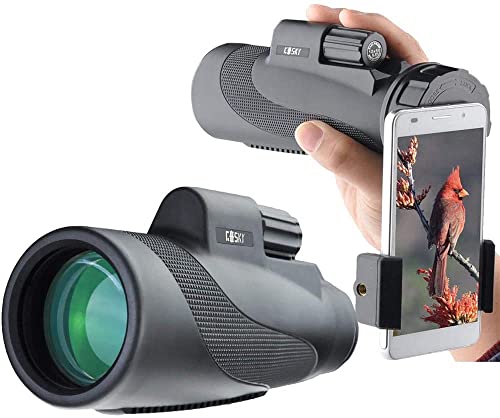
Gosky Titan 12x50 Monocular for Adults High Powered with Phone Adapter | BAK4 Prism & FMC Lens, IPX7 Waterproof, Monocular Telescope for Bird Watching, Wildlife Viewing, Travel, Hunting, Sports
As an Amazon Associate we earn from qualifying purchases. Product prices and availability are accurate as of the date/time indicated.
Prices shown are approximate and for reference only. Prices change often, so please check the current price on Amazon before you buy.
Ratings are editorial assessments based on makers’ published specifications and value at typical prices. Exit pupil figures are the objective divided by the magnification, rounded. Check the exact current version’s specification before buying, as model lines are revised.
The Seven Dual-Purpose Monoculars Reviewed
1. Vortex Solo 8×36 — Best Overall Compromise
The Solo 8×36 sits where the two parishes overlap most kindly: wide and steady for birds, bright enough for the brighter sky, small enough to be carried without negotiation, and backed by a famously strong warranty parish. For the buyer who will do more birding than astronomy, it is the audit’s natural end.
2. Hawke Endurance ED 10×42 — Best Glass
Hawke’s Endurance ED brings ED colour correction and a short close focus to a 42mm tube, serving the warbler at dawn and the Moon at night with the same clean edges. As the quality parish, it shares the head of this table.
3. Bushnell Legend Ultra HD 10×42 — Best at Dusk
The Legend’s glass and coatings are tuned for the low-light hours when birds feed last and stars come out first. As the dusk parish, it earns its row for the observer whose sessions live at the day’s edges.
4. Celestron Outland X 10×50 — Best Night Value
Celestron’s 50mm tube gathers genuinely more light for genuinely modest money, with a five-millimetre exit pupil that flatters the night. As the aperture value parish, it holds its row, accepting a larger body as the price.
5. Vortex Solo 10×42 — Best Handheld Reach
The 10×42 Solo trades a little steadiness and field for reach on distant birds and shorebirds, keeping the line’s build and warranty. As the distance parish, it holds its place for the steadier hand.
6. Levenhuk Wise Plus 10×56 — Best for the Sky
The 56mm objective and the widest exit pupil in this table make the Wise Plus the night specialist, and on a tripod it shows the sky its smaller brothers cannot. As the stargazing parish, it holds its place, with size as its stated tax.
7. Gosky 12×55 HD — Best Mounted Reach
Twelve power is too much for most hands and just right for a tripod, where this big Gosky serves lunar and planetary looking and distant daytime subjects. As the mounted parish, it completes the table, bought deliberately as a mounted instrument.
Buying Guide: Decide Your Mix, Compute the Exit Pupil, Budget the Tripod
Step One: Write Your Mix of Feather and Star
Put a rough proportion on your observing before you look at a price: mostly birds with occasional sky, an even split, or mostly sky with birds as the bonus. Note where you observe, garden, coast, woodland, campsite, and how dark your skies honestly are, because under heavy light pollution a large aperture buys less than it does in the country, while reach on birds buys the same everywhere. Note whether you wear glasses, whether the instrument must live in a pocket or can live in a pack, and whether you already own a small tripod. This short document points at a row of the table more reliably than any review, including this one.
Step Two: Audit the Figures in Order
Read each finalist in the order this guide has taught: the number pair first, then the exit pupil you compute from it, then field of view and close focus against your birding, then glass, ED or not, and coatings as the maker publishes them, then eye relief if you wear glasses, then the waterproof and fogproof parish, and finally the tripod thread and what adapter it needs. Compare total prices composed whole, monocular, case, and the tripod or adapter where the sky is half your purpose. Refuse any model whose maker will not publish its field, close focus, and coating parish; in optics, unpublished figures are a figure of their own.
Step Three: First Light, First Bird, and the Keeping Round
Begin with the Moon, the kindest first target, and learn the focus wheel’s knife edge on its craters before you hunt fainter things; then take the instrument out at dawn and learn its field on common birds before the rare one tests you. Keep a small notebook or phone note of what you see and under what sky, because a dual-purpose instrument teaches two crafts and the notes compound. Keep the keeping round: caps on, lens cleaned only with proper cloth and solution and only when needed, the tube stored dry in its case, and never, on any day, pointed anywhere near the Sun. Re-check the focus and the tripod fit at the season’s turn, and let the instrument’s two parishes grow together.
How We Selected These Monoculars
We included only real, named, currently sold monoculars whose makers publish magnification, objective, field, close focus, and coating specifications, spanning the 36mm to 56mm objectives and the eight to twelve power range that dual-purpose use actually occupies. Prices are typical retail ranges. Ratings weight the balance of the two parishes first, then glass and coatings, handling, weatherproofing and mounting, and value.
Frequently Asked Questions: Monoculars for Stargazing and Bird Watching
Is a monocular really enough for stargazing, or do I need a telescope?
For the wide and bright sky, it is not only enough, it is often the better start. A monocular of 42mm or more shows the Moon in satisfying detail, the four great moons of Jupiter as points in a line, the Orion Nebula as a genuine glowing patch, star clusters, the Andromeda Galaxy as a soft smudge from a dark site, and the Milky Way’s star fields better than any telescope, because its wide field takes in what a telescope’s narrow one cannot. What it will not do is magnify Saturn’s rings into a postcard or split close double stars; that is telescope work at powers a hand cannot hold. The mounted rows of this table extend the monocular’s reach considerably, and many astronomers began exactly here, learning the sky wide before they learned it deep.
Which magnification is best if I care equally about birds and stars?
Ten power on a 42mm or 50mm objective is the balanced answer, and eight power is the steadier one. Ten gives the bird watcher useful reach and the sky watcher a workable view of the Moon and planets, at the cost of a narrower field, a smaller exit pupil, and more visible shake, all of which a tripod largely refunds at night. Eight gives a wider, brighter, calmer image that finds birds faster and flatters dawn and dusk, and it is the kinder choice for a walker, a younger observer, or anyone whose hands are not steady. Twelve power belongs on a tripod for both parishes and should be bought as a mounted instrument, as its row in this table states.
Why does the image look dimmer at night through a high-power monocular?
Because of the exit pupil, the beam computed throughout this guide. The light an objective gathers is spread across the magnification, so as power rises on the same objective, the beam reaching your eye narrows and the image dims, even though the subject looks larger. Under a dark sky your own pupil is wide open and waiting, and a beam narrower than it cannot fill it. This is why the night rows of the table pair their power with large objectives, why an 8×42 can look brighter at dusk than a 10×42 despite gathering the same light, and why the honest night comparison is always the pair of numbers together, never the magnification alone.
Can I use a monocular with glasses, and for photography through it?
Yes to glasses, with the eye relief checked: look for a stated eye relief in the generous parish and adjustable or fold-down eyecups, set them down for glasses, and confirm in the specification that the full field is available to you, since a short eye relief quietly crops the view to its centre. For photography, a phone adapter of the kind bundled with some models here can clamp a handset to the eyepiece for Moon shots and record photographs of birds, with patience and modest expectations; the Moon rewards the attempt handsomely, while birds test it, since the subject moves and the focus is manual. Keep the phone’s own safety in mind as well, and never use any such arrangement anywhere near the Sun, for the phone’s sake as well as your eyes’.
Related guides
- Best Thermal Monocular for Coyote Hunting in 2026: How to Pick a Thermal Monocular That Lets You Spot Coyotes at Night
- How to Store Optics for Long Term in 2026: A 7-Step Guide to Keeping Binoculars, Spotting Scopes, and Telescopes Dry, Clean, and Fungus-Free, for Years, Without Mould, Fog, or Scratched Coatings
- Best Binoculars for Whale Watching Tours in 2026: Why 7x and 8x Beat Big Magnification on a Moving Boat, and 6 Pairs That Will Not Fog, Slip, or Sink Your Trip
- How to Choose Telescope Without Regrets in 2026: A 7-Step Guide to Aperture, Mount, and GoTo, for the Moon, Planets, and Deep-Sky Objects, Without Buying a Telescope That Is Too Big, Too Small, or Too Hard to Use
More from Amazon
Programs that pair well with the guide above. Offers and eligibility are set by Amazon and may change.
Free shipping on eligible items, Prime Video and more. Eligible new members can start with a free trial.
Start a Prime free trialAudiobooks and podcasts to listen to on the go. Eligible new members can start with a free trial.
Try Audible freeAd-free music streaming. Eligible new subscribers can start with a free trial.
Try Music Unlimited freeA free business account with business pricing and bulk-buying tools for work, shop or home office.
Create a business accountAs an Amazon Associate we earn from qualifying purchases.

Write Your Review
No reviews yet. Be the first to share your experience!