
What's inside
As an Amazon Associate I earn from qualifying purchases. This post may contain affiliate links at no extra cost to you.
Binoculars vs monocular for birding is a choice between two eyes and one eye. Binoculars use both eyes, give depth, and feel natural for scanning a tree line for a long time. A monocular uses one eye, weighs less, packs smaller, and is easier to carry on a walk where birding is one part of the day, not the whole day. Neither is universally better. The right choice depends on how long you will look, how far you will walk, and whether you need depth to judge distance in a hedge or a wood.
For most birders, binoculars win. The usual field pair is 8×42, with a magnification of 8x, an objective of 42mm, an exit pupil of 5.25mm, and a field of view that is wide enough to find a bird quickly. A 10×42 pair gives more detail at distance, with an exit pupil of 4.2mm, but it is harder to hold steady. A monocular is best as a second optic, for a walk, a pocket, or a trip where weight matters, or for a birder who wants a light backup to a spotting scope.
This guide compares binoculars and monoculars side by side, with real models in the table, and explains the numbers that decide the choice: exit pupil, field of view, eye relief, close focus, and weight. It is written for a beginner who wants one optic to start, and for a birder who already has binoculars and wonders whether a monocular adds anything.
Our Top Picks
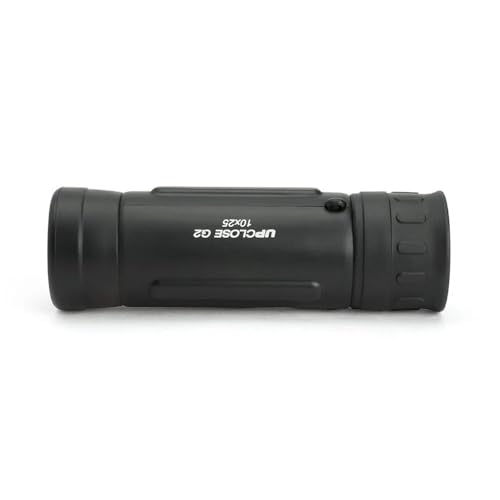
 Celestron UpClose G2 10x25 Monocular for Hiking10 x 255.5 x 1.5 x 1.5 inches0.2 poundsCheck on Amazon
Binoculars vs Monocular for Birding Compared
The table below mixes binoculars and monoculars so the trade-off is visible on the same page. Exit pupil is objective divided by magnification, so 8×42 is 5.25mm, 10×42 is 4.2mm, 8×32 is 4.0mm, 10×36 is 3.6mm, and 12×55 is 4.58mm. A larger exit pupil is brighter in low light, which matters at dawn and dusk. Weight is the other clear difference: a pocket monocular can be under 10 ounces, while a full-size 8×42 binocular is usually 20 to 25 ounces.
| Model | Key Specs | Best For |
|---|---|---|
| Nikon Monarch M7 8×42 Binoculars | 8x, 42mm, 5.25mm exit pupil, about 24 oz, wide field | Best binoculars for birding overall |
| Vortex Diamondback HD 8×42 Binoculars | 8x, 42mm, 5.25mm exit pupil, about 21 oz, wide field | Best value 8×42 binoculars for birding |
| Celestron Nature DX 8×42 Binoculars | 8x, 42mm, 5.25mm exit pupil, about 22 oz, close focus | Best budget 8×42 binoculars for birding |
| Vortex Solo 10×36 Monocular | 10x, 36mm, 3.6mm exit pupil, about 9 oz, compact | Best monocular for birding on a walk |
| Gosky 12×55 Monocular | 12x, 55mm, 4.58mm exit pupil, about 16 oz, tripod socket | Best high-power monocular for birding at distance |
| Nikon Prostaff P7 10×42 Binoculars | 10x, 42mm, 4.2mm exit pupil, about 23 oz, more detail | Best 10×42 binoculars for birding at distance |
| Celestron Nature DX 8×32 Binoculars | 8x, 32mm, 4.0mm exit pupil, about 18 oz, light and compact | Best compact binoculars for birding while travelling |

Monocular 12x42 Roof Prism Binoculars for Adults -Monoculars for Adults High Power with BAK4 Prism & FMC Lens, Suitable for Bird Watching Hunting Hiking Camping
As an Amazon Associate we earn from qualifying purchases. Product prices and availability are accurate as of the date/time indicated.
Celestron UpClose G2 10x25 Monocular for Hiking, Travel & Birding | Compact Monocular Design, Lightweight for Travel, Multi-Coated Optics, Rubber Armored Body, Comfortable One-Handed Viewing



As an Amazon Associate we earn from qualifying purchases. Product prices and availability are accurate as of the date/time indicated.

Deesoo 15x56 High Powered Binoculars for Adults with Phone Adapter | BAK4 Prism FMC Optics, Birding for Wildlife Observation, Cruise Ship Travel, Waterproof for Hunting, Eyeglass Friendly
As an Amazon Associate we earn from qualifying purchases. Product prices and availability are accurate as of the date/time indicated.
Binoculars vs Monocular for Birding in 2026: Detailed Reviews
1. Nikon Monarch M7 8×42 Binoculars — Best Binoculars for Birding Overall
The Nikon Monarch M7 8×42 is a roof-prism binocular with 8x magnification, a 42mm objective, an exit pupil of 5.25mm, and a weight of about 24 ounces. It has a wide field of view, which is the spec that matters most when a bird moves between branches. A wide field lets a birder find the bird quickly, then follow it without losing it at the edge of the view.
At 8x, the Monarch M7 is easy to hold steady. At 10x, the same bird is larger, but the image shakes more, and the field is narrower. That is why 8×42 is the usual starting point for birding, and why it is also the usual recommendation for glasses wearers, seniors, and beginners. The M7 has long eye relief for its class, so a glasses wearer can keep glasses on, twist the eyecups down, and still see the full field. Eyecups up is for use without glasses, eyecups down is for use with glasses, because glasses need the eye closer to the eyepiece.
Its weight, about 24 ounces, is in the normal range for a full-size 8×42. A birder who carries it on a neck strap for three hours will feel it, but a harness distributes the weight better than a neck strap, and the M7 is light enough for a day walk. It is not a pocket optic. It is a field optic, and it should be judged as one.
2. Vortex Diamondback HD 8×42 Binoculars — Best Value 8×42 Binoculars for Birding
The Vortex Diamondback HD 8×42 is a roof-prism binocular with 8x magnification, a 42mm objective, an exit pupil of 5.25mm, and a weight of about 21 ounces. It is lighter than the Monarch M7 by about 3 ounces, and it is less than half the price, which is why it is often the first serious binocular for a birder who has outgrown a budget pair.
Its field of view is wide for its price, and its close focus is short enough for dragonflies and butterflies as well as birds, which matters for a birder who also watches insects in summer. Close focus is the shortest distance at which the optic can focus sharply. For dragonflies, a close focus of 6 feet or less is useful, and about 5 feet is ideal, because it lets a birder see a dragonfly on a reed without stepping back. The Diamondback HD focuses close enough for that use, though the exact figure varies by sample and should be checked on the maker’s page before buying for insect work.
The Diamondback HD is a good example of why 8×42 is a better starting point than 10×42 for most birders. It is brighter in low light, with an exit pupil of 5.25mm against 4.2mm for 10×42, it is easier to hold, and it has a wider field. A birder who wants more detail at distance can add a 10×42 later, or a spotting scope, rather than starting with a harder-to-hold pair.
3. Celestron Nature DX 8×42 Binoculars — Best Budget 8×42 Binoculars for Birding
The Celestron Nature DX 8×42 is a roof-prism binocular with 8x magnification, a 42mm objective, an exit pupil of 5.25mm, and a weight of about 22 ounces. It is the cheapest full-size 8×42 in this list, and it shows the trade-off clearly: the optics are good for the price, but the build and the low-light performance are a step below the Diamondback HD and the Monarch M7.
For a beginner, it is a practical first pair. It has the right magnification and objective for birding, it is light enough for a day walk, and it is cheap enough that a student or a new birder can buy it without a large outlay. Its field of view is narrower than the Monarch M7, so finding a fast-moving warbler takes a little longer, but for a slow bird on a feeder or a heron on a lake, it is more than enough. It is also a good second pair to keep in a car, because it is cheap enough to leave in a boot without worrying.
4. Vortex Solo 10×36 Monocular — Best Monocular for Birding on a Walk
The Vortex Solo 10×36 is a monocular with 10x magnification, a 36mm objective, an exit pupil of 3.6mm, and a weight of about 9 ounces. It is a single tube, held in one hand, with a focus wheel and a clip for a pocket or a pack strap. It is less than half the weight of a full-size 8×42 binocular, and it fits in a jacket pocket.
Its strength is portability. A birder on a walk, a hike, or a trip where birding is one activity among many can carry the Solo without a neck strap, a harness, or a case. Its weakness is the view. With one eye, there is no depth, so judging distance in a hedge is harder. With 10x magnification and a 3.6mm exit pupil, it is also harder to hold steady than an 8×42 binocular, and dimmer at dawn. A monocular is best used in short bursts: raise it, find the bird, identify it, lower it. For a three-hour birding session, binoculars are more comfortable, because two eyes share the work and the image is steadier.
The Solo is a good second optic, not a replacement for binoculars. A birder who already has 8×42 binoculars can add the Solo for a walk, a bike ride, or a holiday where weight matters. A beginner who buys only the Solo will learn birding more slowly, because the narrow field and the single-eye view make finding birds harder.
5. Gosky 12×55 Monocular — Best High-Power Monocular for Birding at Distance
The Gosky 12×55 is a monocular with 12x magnification, a 55mm objective, an exit pupil of 4.58mm, and a weight of about 16 ounces. It has a tripod socket, a phone adapter in many kits, and a large objective that gathers more light than a 10×36 monocular. Its magnification is high for a hand-held optic, and that is its main limitation.
At 12x, hand-holding is hard. The rule for binoculars applies here too: 10x is hand-holdable for most people, 12x needs a tripod or a rest. A 12×55 monocular held in one hand will shake, and the image will be hard to use for more than a few seconds. On a tripod, or braced against a fence or a car door, it is usable for a distant bird on a lake or a field, and the 55mm objective gives a brighter image than a smaller monocular. It is best thought of as a compact spotting scope, not as a pocket binocular replacement.
Its price is low, but a cheap tripod should be added to the cost if it is to be used at 12x. A tripod for a monocular should be light, with a load rating above the monocular weight plus a margin, and a head that can pan smoothly. Without that support, the Gosky is a frustrating optic for birding, even though it looks powerful on paper.
6. Nikon Prostaff P7 10×42 Binoculars — Best 10×42 Binoculars for Birding at Distance
The Nikon Prostaff P7 10×42 is a roof-prism binocular with 10x magnification, a 42mm objective, an exit pupil of 4.2mm, and a weight of about 23 ounces. It is the 10x counterpart to the 8×42 pairs above, and it shows the trade-off in a single comparison: more detail, narrower field, dimmer image, harder to hold.
For open country, a lake, or a shore, where birds are far away and the field is wide, 10×42 is useful. A birder can see a distant wader or a raptor in more detail than with 8×42, and the narrower field matters less because the bird is not moving through branches. For woodland, where birds are close and move fast, 8×42 is better, because the wider field helps find the bird, and the brighter image helps in shade. A birder who already has 8×42 and wants a second pair for open country should consider 10×42. A beginner who buys only one pair should start with 8×42.
7. Celestron Nature DX 8×32 Binoculars — Best Compact Binoculars for Birding While Travelling
The Celestron Nature DX 8×32 is a roof-prism binocular with 8x magnification, a 32mm objective, an exit pupil of 4.0mm, and a weight of about 18 ounces. It is lighter and smaller than a full-size 8×42, by about 4 ounces and a shorter length, and it fits more easily in a day pack or a jacket pocket.
Its compromise is brightness. With an exit pupil of 4.0mm against 5.25mm for 8×42, it is dimmer at dawn and dusk, and less comfortable in a dark wood. In daylight, the difference is small, and the lighter weight is a real benefit on a long walk or a trip. For a traveller who wants binoculars that do not dominate a bag, 8×32 is a good choice. For a birder who watches mainly at dawn, 8×42 is better. The Nature DX 8×32 is also a good choice for a younger birder or a birder with smaller hands, because it is easier to hold than a full-size pair.
Binoculars vs Monocular for Birding Buying Guide
The guide below uses the numbers that actually decide the choice, not the marketing on the box. It is written for a birder who wants one optic to start, and for a birder who wants to add a monocular without duplicating what binoculars already do.
Exit Pupil, Magnification, and Field of View: Why 8×42 Is the Usual Starting Point
Exit pupil is objective divided by magnification. For birding, 8×42 gives 5.25mm, 10×42 gives 4.2mm, 8×32 gives 4.0mm, and 10×36 gives 3.6mm. A larger exit pupil is brighter in low light, because more light reaches the eye. At dawn, in a wood, or on a cloudy day, the difference between 5.25mm and 4.2mm is visible. At midday in open sun, it matters less. That is why 8×42 is the usual recommendation for a first pair: it is bright, it is easy to hold, and it has a wide field.
Field of view is measured in feet at 1000 yards. For birding, a field of at least 400 feet at 1000 yards is useful, because it helps find a bird quickly and follow it through branches. A 10x pair has a narrower field than an 8x pair with the same objective, so finding a bird takes longer. A monocular has an even narrower field at the same magnification, because it uses one eye and a smaller prism system, so finding a bird with a monocular is harder than with binoculars.
Magnification is the most misunderstood number. Higher is not always better for birding. At 8x, a bird is large enough to identify, the image is steady, and the field is wide. At 10x, the bird is larger, but the image shakes more, and the field is narrower. At 12x, the image shakes so much that a tripod or a rest is needed, which is why 12x binoculars and monoculars are not recommended as a first pair. A beginner should start with 8x, learn to find birds, and add 10x later if open-country birding needs it.
Weight, Comfort, and How Long You Will Look: Binoculars for a Session, Monocular for a Walk
Weight decides how long an optic can be carried and used. A full-size 8×42 binocular weighs 20 to 25 ounces. That is not heavy on its own, but on a neck strap for three hours it becomes noticeable. A harness spreads the weight across the shoulders and is worth buying for a birder who watches for a full morning. A pocket monocular weighs 9 to 16 ounces, and it fits in a jacket pocket, so it is easy to carry on a walk where birding is not the main activity.
Comfort is not just weight. It is also how the optic feels in the hand, how the focus wheel turns, and how the eyecups fit. Binoculars use both eyes, so the brain gets depth and a stable image. A monocular uses one eye, so the other eye must be closed or squinted, which is tiring after a few minutes. That is why a monocular is best for short looks, and binoculars are best for a session. A birder who watches for an hour or more should use binoculars. A walker who wants to check a bird on a fence for ten seconds should use a monocular.
Eye relief matters for glasses wearers. An eye relief of at least 14mm is a useful minimum for glasses, because it lets a glasses wearer see the full field without removing glasses. Check the eye relief figure on the maker’s page before buying, and twist the eyecups down for glasses and up without glasses. A monocular has the same eye relief issue, but with one eye it is easier to adjust by moving the monocular slightly closer or further.
Close Focus, Waterproofing, and When a Monocular Makes Sense
Close focus is the shortest distance at which the optic can focus. For birding, a close focus of 6 feet or less is useful for a bird on a feeder or a dragonfly on a reed, and about 5 feet is ideal for dragonflies. The binoculars in this list focus close enough for that use, though the exact figure varies and should be checked before buying for insect work. A monocular often has a longer close focus, so it is less useful for close birds and insects.
Waterproofing is worth checking for a field optic. A binocular that is waterproof and fog-proof will survive rain and a cold morning without fogging inside. That does not mean it can be submerged. Splash and rain resistance is the usual rating for birding binoculars, not submersion, and the same is true for monoculars. A birder who watches in rain should carry a lens cloth and a dry bag, and should not wipe a dirty lens, because wiping a dirty lens can scratch the coating. Brush or blow dust off first, then clean with a microfibre cloth, with fluid on the cloth, never on the lens.
A monocular makes sense in three cases. First, as a pocket optic for a walk, a bike ride, or a trip where weight matters. Second, as a backup to a spotting scope, for a quick look at a distant bird without setting up the scope. Third, for a birder with one eye, or with a vision difference between eyes, where a monocular is more comfortable than binoculars. In every other case, binoculars are the better first buy for birding.
Binoculars vs Monocular for Birding FAQ
Are binoculars or a monocular better for birding?
For most birding, binoculars are better, because they use both eyes, give depth, have a wider field, and are more comfortable for a long session. A monocular is better as a pocket optic for a walk, as a backup, or when weight matters. A beginner should start with 8×42 binoculars, such as the Vortex Diamondback HD 8×42, and add a monocular later if a light pocket optic is needed.
What magnification is best for birding binoculars?
For birding, 8x is the best starting magnification, because it is easy to hold, has a wide field, and gives a bright image with an exit pupil of 5.25mm on an 8×42 pair. A 10×42 pair gives more detail at distance, with an exit pupil of 4.2mm, but it is harder to hold and has a narrower field. A 12x optic needs a tripod or a rest, so it is not recommended as a first pair for birding.
Can I use a monocular for birding instead of binoculars?
Yes, a monocular can be used for birding, but it is harder to find birds with, because it has a narrower field and no depth, and it is more tiring to use for a long session. A monocular like the Vortex Solo 10×36 is useful for a quick look on a walk, but for a three-hour birding session, 8×42 binoculars are more comfortable and more effective. A monocular is best as a second optic, not as the only optic for a serious birder.
How do I calculate exit pupil for birding optics?
To calculate exit pupil, divide the objective lens diameter by the magnification. An 8×42 pair gives 5.25mm, a 10×42 pair gives 4.2mm, an 8×32 pair gives 4.0mm, a 10×36 monocular gives 3.6mm, and a 12×55 monocular gives 4.58mm. A larger exit pupil is brighter in low light, which matters at dawn and dusk, so 8×42 is brighter than 10×42, and 8×42 is the usual recommendation for a first birding pair.
FAQ
Are binoculars or a monocular better for birding?
What magnification is best for birding binoculars?
Can I use a monocular for birding instead of binoculars?
How do I calculate exit pupil for birding optics?
Related guides
- Best Optics for Beginners Winter Use in 2026: Fogproof Binoculars Graded on the Cold Transition — Warm Car to Frozen Field Without Losing the View
- Best Cell Phone Monocular in 2026: 7 Best Cell Phone Monoculars With Clear View, Simple Use, and Easy Use for Cell Phone Monocular
- Best Monocular for Glasses Wearers Comfort in 2026: Monocular for Glasses Wearers Comfort, Glasses Wearers Monoculars, and Best Comfortable Monoculars for Glasses Wearers
- Best Binoculars for Camping Trips Viewing in 2026: 7 Binoculars for Camping Trips Viewing That Offer Clear Optics, Easy Carry, and Reliable Performance for Camping
More from Amazon
Programs that pair well with the guide above. Offers and eligibility are set by Amazon and may change.
Free shipping on eligible items, Prime Video and more. Eligible new members can start with a free trial.
Start a Prime free trialAudiobooks and podcasts to listen to on the go. Eligible new members can start with a free trial.
Try Audible freeAd-free music streaming. Eligible new subscribers can start with a free trial.
Try Music Unlimited freeA free business account with business pricing and bulk-buying tools for work, shop or home office.
Create a business accountAs an Amazon Associate we earn from qualifying purchases.

Write Your Review
No reviews yet. Be the first to share your experience!