
What's inside
As an Amazon Associate I earn from qualifying purchases. This post may contain affiliate links at no extra cost to you.
A spotting scope is the instrument you buy when binoculars stop resolving the detail you came for: the leg band on a shorebird across the marsh, the holes in a target at the far end of the range, the antler points on a hillside buck in the last light. It is also the easiest optic to buy wrong, because the specification that shouts loudest, maximum magnification, is the one that matters least on its own. High power magnifies everything, including heat shimmer, haze, hand tremor, and the shortcomings of cheap glass, and a 60x view through a poor scope on a wobbly tripod is worth less than a clean 25x view through a good one. The honest order of priorities is glass quality first, then a tripod that can hold the scope still, then the magnification range you will actually use, which for most birding, wildlife, and range work sits between about 20x and 45x far more often than at the top of the dial.
Two other decisions shape the purchase. The first is body style: a straight scope suits bench, range, and vehicle-window use and is easier to aim along its length, while an angled scope is kinder on the neck for looking up at birds and for sharing between people of different heights, and it lets the tripod sit lower and steadier. The second is objective size. Bigger front lenses gather more light and support higher useful power, and they weigh more and cost more, which matters if the scope walks uphill with you. None of these choices is visible in a headline, so this guide works through them in order and grades the scopes below as complete viewing systems, scope plus tripod, because that is how you will actually use them.
Our Top Picks
Spotting Scope: Magnification, Glass, and the Tripod That Is Half the Instrument
Power Is Taxed by Light, Air, and Tremor
Every increase in magnification shrinks the exit pupil, the beam of light reaching your eye, so the image dims exactly when you zoom in at dawn or dusk. It also narrows the field of view, which makes finding the subject slower, so work wide first: locate with binoculars or at the scope’s lowest power, centre the subject, and only then zoom. Heat shimmer over sun-warmed ground and water sets a ceiling that no price removes, often well below the scope’s maximum on a summer afternoon. A scope with excellent glass at 30x will show you more real detail than a mediocre scope at 60x in the same air, which is why the reviews below weight optical quality and coatings ahead of the zoom range’s top number, and why ED or HD glass elements, where the maker states them, are worth paying for in the mid-range and up.
The Tripod Is Not an Accessory
Budget for the tripod in the same purchase, not as an afterthought, because a spotting scope on an inadequate tripod is a vibrating telescope that shows you its own shake in high definition. You need a tripod and head that hold the scope at your eye height without extending a wobbly centre column to its limit, with a smooth pan for following birds and a quick-release plate that locks positively. Video heads suit scopes better than most ball heads. Add the scope’s and tripod’s weights together and carry that number honestly up your usual hill before you fall in love with an 85mm flagship. Protect the finished system with a stay-on case or cover in the field, clean lenses only after blowing and brushing grit away, and never use any spotting scope to look at or near the sun, which can destroy your sight instantly; solar viewing requires dedicated equipment made for that purpose alone.
Quick Comparison: Spotting Scope Models
| Model | Magnification, Objective, and Key Specs (Maker-Stated) | Best For | Typical Price Range | Rating |
|---|---|---|---|---|
| Vortex Viper HD 20-60×85 | 20-60x zoom, 85mm objective; HD optical system; angled body; rubber armour; tripod foot | Best spotting scope overall | $700 – $900 | 4.6 / 5 |
| Celestron Ultima 80 20-60×80 | 20-60x zoom, 80mm objective; angled body; includes soft case and basic accessories in stated bundles | Best budget spotting scope | $180 – $250 | 4.1 / 5 |
| Athlon Argos HD 20-60×85 | 20-60x zoom, 85mm objective; HD glass on stated model; waterproof and fogproof stated construction | Best value HD option | $380 – $480 | 4.4 / 5 |
| Leupold SX-2 Alpine HD 20-60×80 | 20-60x zoom, 80mm objective; HD system; angled and straight versions in the line; lightweight for its class | Best for hunting and carrying | $450 – $600 | 4.4 / 5 |
| Bushnell Trophy Xtreme 20-60×65 | 20-60x zoom, 65mm objective; compact body; includes table tripod and case in stated bundles | Best compact option | $200 – $280 | 4.1 / 5 |
| Swarovski ATS 65 HD | Modular premium scope body with separate eyepieces, commonly 25-50x; HD glass; made in Austria | Best premium spotting scope | $2,100 – $2,600 with eyepiece | 4.8 / 5 |

SVBONY SV28 Spotting Scope, Angled 25-75x70 with Tripod for Target Shooting | Spotter Scope, Beginner for Bird Watching, Wildlife, Clearly at 200 Yards, with Phone Adapter, Light Waterproof Fogproof
As an Amazon Associate we earn from qualifying purchases. Product prices and availability are accurate as of the date/time indicated.

25-75x80 Spotting Scope with Desktop Tripod for Target Shooting DiamondEdge | Long-Range Viewing, Dual-Speed Focusing, Twist-Up Eyecup, Waterproof & Fogproof, with Phone Adapter for Bird Watching
As an Amazon Associate we earn from qualifying purchases. Product prices and availability are accurate as of the date/time indicated.
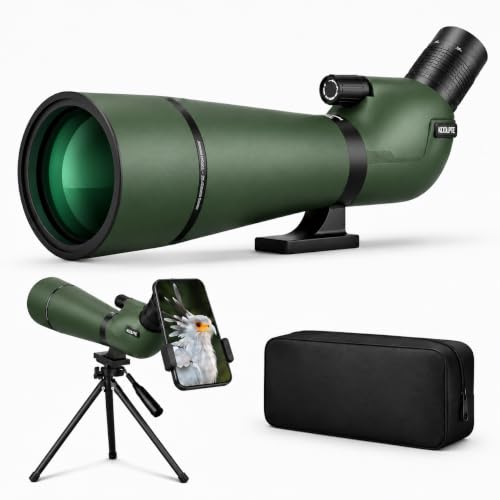
Koolpte 25-75x85 ED Spotting Scope with Tripod, Green | 85mm ED optics for bird watching, wildlife and target shooting; phone adapter, tripod, waterproof fogproof design.
As an Amazon Associate we earn from qualifying purchases. Product prices and availability are accurate as of the date/time indicated.
Prices shown are approximate and for reference only. Prices change often, so please check the current price on Amazon before you buy.
Specifications are each maker’s stated details for the current version; eyepieces, cases, and bundled tripods differ by model and bundle, so check the exact listing. Prices are typical retail ranges for the scope, excluding a full-size tripod unless a bundle states one, and vary by retailer, region, and promotion. Ratings are editorial, with optical quality and build weighted ahead of maximum magnification.
Detailed Reviews: Spotting Scope Picks
1. Vortex Viper HD 20-60×85 – Best Overall
The Viper HD is the mid-range reference: genuinely good glass, a useful zoom range, solid build, and a warranty reputation that matters for equipment used outdoors for decades. Its 85mm objective supports the top of its range in decent light, and at the 25x to 40x settings where most viewing happens it is bright and sharp. It is not light, and it deserves a real tripod, but for birding, wildlife, and range work from a base, it is the balanced buy in this table.
2. Celestron Ultima 80 – Best Budget Spotting Scope
The Ultima 80 is the honest way into the category: a big objective, a serviceable zoom, and a price that leaves money for the tripod it needs. Its glass and mechanics are a clear step below the mid-range, most noticeably at high power and in poor light, and the bundled accessories should be treated as starters. For a new birder, a range shooter reading targets in good light, or a family scope for the shore, it teaches you what you value before you spend serious money.
3. Athlon Argos HD 20-60×85 – Best Value HD Option
Athlon’s Argos HD undercuts the established mid-range while offering HD glass and an 85mm objective on the stated model, and in use it sits closer to the Viper class than to the budget class. It is a sensible buy for the shooter or birder who wants real glass now and would rather put the saving into a better tripod and head, which this guide endorses as the correct order of spending.
4. Leupold SX-2 Alpine HD – Best for Hunting and Carrying
The SX-2 Alpine HD is built for the scope that travels: relatively light for an 80mm class instrument, well armoured, and available in the line in configurations that suit pack and hillside use. Western hunters glassing at distance in changing weather are its natural owners. Its price buys portability and build more than a leap in glass over the Argos, so judge it by the miles you will carry it.
5. Bushnell Trophy Xtreme 20-60×65 – Best Compact Option
The 65mm Trophy Xtreme trades light gathering for size, and for range use, travel, and vehicle-based watching that trade is rational. The smaller objective shows its limit at high power and low light sooner than the 80mm class, which is physics, not a flaw. Bundled mini tripods are for tables and benches; buy a full tripod for standing use and the little scope performs well above its travel weight.
6. Swarovski ATS 65 HD – Best Premium Spotting Scope
The ATS system is what the mid-range is measured against: superb glass, beautiful mechanics, and a modular eyepiece system, at a price that buys three mid-range scopes. It earns its rating in the view, in dawn light, fine feather detail, and contrast that lesser scopes flatten. Buy it as a decade-scale instrument if birding or wildlife observation is a central pursuit, and insure it like one.
Buying Guide: How to Choose a Spotting Scope
Choose the Format for Your Actual Viewing
Birders who look up into trees and share the scope should default to angled; range shooters and bench users to straight; anyone unsure should try both, because neck comfort across a morning is a real specification. Choose 65mm if the scope walks with you, 80 to 85mm if it mostly works from a car, a hide, or a bench and you view at dawn and dusk. Set the zoom range aside until last, and prefer the scope whose image at 30x is cleanest, because that is the view you will live in.
Budget the System: Scope, Tripod, Head, Case
Write the whole system price before ordering: scope, tripod and head rated for the combined load, a stay-on case or cover, and a cleaning kit of blower, brush, and cloth used in that order. A mid-range scope on a good tripod outperforms a premium scope on a poor one in the field, every time. Then learn the scope at home and at a local patch before a big trip: practise finding subjects wide, zooming in steps, and recording what you see, because a spotting scope rewards technique as much as any optic you will own.
Frequently Asked Questions About the Spotting Scope
What is the best spotting scope for most people?
The Vortex Viper HD 20-60×85 for a base and vehicle-based instrument, the Athlon Argos HD for similar glass on a tighter budget, and the Celestron Ultima 80 as a first scope. All three still need a proper tripod, which should be budgeted with the scope, not after it.
Angled or straight spotting scope?
Angled for birding, shared viewing, and looking upward, because it is easier on the neck and lets the tripod sit lower. Straight for the range, a bench, and window mounts, because aiming along the body is intuitive. Neither is better glass; it is a posture and purpose decision.
How much magnification do I really need?
Most useful viewing happens between about 20x and 45x. Higher power helps in good light and steady air on distant targets, and it hurts in shimmer, haze, and low light. Judge a scope by its image in the middle of its range, not by the number at the end of it.
Can a spotting scope be used for astronomy or looking at the sun?
Many spotting scopes give pleasant casual views of the Moon and bright planets, within their design limits. The sun is different and absolute: never point a spotting scope at or near the sun, and never look at the sun through one. Solar viewing requires dedicated solar equipment used exactly as its maker directs.
Related guides
- Best Telescope Eyepiece for Retirees in 2026: Best Telescope Eyepiece for Retirees for Comfortable Viewing, Easy Focus, and Simple Stargazing
- Spotting Scope vs Rifle Scope for Target Shooting in 2026: Vortex, Celestron, Athlon, and Leupold Compared for Reading Holes, Calling Corrections, and Why the Two Optics Do Different Jobs on the Same Firing Line
- Hama Telescope in 2026: 6 Best Hama Telescopes for Beginners, Stargazing, and the Moon
- ELT Telescope in 2026: What the Extremely Large Telescope Is, and the Best Telescopes to See Deep-Sky Objects Yourself
More from Amazon
Programs that pair well with the guide above. Offers and eligibility are set by Amazon and may change.
Free shipping on eligible items, Prime Video and more. Eligible new members can start with a free trial.
Start a Prime free trialAudiobooks and podcasts to listen to on the go. Eligible new members can start with a free trial.
Try Audible freeAd-free music streaming. Eligible new subscribers can start with a free trial.
Try Music Unlimited freeA free business account with business pricing and bulk-buying tools for work, shop or home office.
Create a business accountAs an Amazon Associate we earn from qualifying purchases.

Write Your Review
No reviews yet. Be the first to share your experience!