
What's inside
- Roof Prism vs Porro Prism Binoculars: Brightness, Image Quality, and Depth
- Roof Prism vs Porro Prism Binoculars: Quick Comparison
- The Six Binoculars Reviewed Across Both Designs
- Buying Guide: How to Choose Between Roof and Porro Prism Binoculars
- Frequently Asked Questions About Roof and Porro Prism Binoculars
As an Amazon Associate I earn from qualifying purchases. This post may contain affiliate links at no extra cost to you.
The argument of roof prism vs porro prism binoculars is the oldest in the binocular parish, and it survives because both sides are right about different things. The two designs differ in how they fold the light path between the objective lens and the eye. A Porro prism binocular, the classic shape with its offset barrels like a pair of elbows, uses two right-angle prisms in each barrel to fold the path, which places the objectives wider apart than the eyepieces and gives the design its broad, three-dimensional stance. A roof prism binocular runs its barrels straight, the prisms meeting at a roof-like edge inside a slim tube, so the objectives sit directly in front of the eyes and the whole instrument packs into the straight, compact shape that dominates the modern market. Neither geometry is a gimmick. Each carries real optical and practical consequences: the Porro’s simpler prisms are cheaper to make to a high standard and lose less light on their surfaces, while the roof’s prisms demand precision coatings to reach the same brightness and contrast, which is why a good Porro has historically embarrassed a mediocre roof at the same price, and why the modern roof, its coatings matured, has taken the premium parish almost entirely, on the strength of its size, its sealing, and its handling. This guide weighs the two designs property by property, brightness, depth, durability, size, and price, and compares real binoculars sold today in both parishes, so the buyer can choose the geometry that serves their own birding, hunting, travel, or sky rather than the geometry that merely fills the shelves.
A short physics parish keeps the weighing honest. Every prism surface the light meets is a parish where some of it can be lost or scattered, and the roof design’s parish includes a surface where the light’s phases can interfere destructively, softening contrast, unless the maker applies phase-correction coatings, the P-coatings of the specification sheet, which the serious modern roof citizens all carry and the cheap ones omit, to their visible cost. The roof parish also asks more of its mirror surfaces, dielectric coatings in the premium citizens returning nearly all the light, silver and aluminium parish in the lesser, each step visible at twilight. The Porro’s prisms, working by total internal reflection, sidestep much of that parish by their geometry, which is the deep reason a modest Porro can be startlingly bright: its design spends the buyer’s money on glass and alignment rather than on compensating for its own prisms. Alignment itself is the third physics citizen: a binocular is two telescopes that must point at exactly the same place, collimation, and the two designs hold and lose that marriage differently, the Porro’s external prism parish being both more exposed to knocks and, in the hands of a competent shop, more readily serviced, while the roof’s internal parish is better protected and more of a factory matter. With those three citizens in view, the comparison that follows is not a beauty contest between silhouettes. It is an engineering audit with prices attached.
Our Top Picks
Roof Prism vs Porro Prism Binoculars: Brightness, Image Quality, and Depth
Light Transmission, Phase Coatings, and the Twilight Test
Brightness in a binocular is the sum of its parish: aperture gathering the light, glass and coatings passing it, prisms returning it, and the two designs arrive at the sum by different roads. The Porro’s road is the straighter one, its prisms reflecting by total internal reflection with no mirror parish to pay for, so a Porro built with decent multi-coated glass delivers a bright, high-contrast image at prices where a roof citizen is still spending its budget on the coatings its prisms require. The roof’s road reaches the same summit, in the premium citizens arguably a higher one, through its full parish of compensations: phase coatings to restore the contrast its roof edge taxes, dielectric mirror coatings to return the light its surfaces would otherwise keep, and ED glass citizens to discipline colour, an expensive stack whose presence or absence is the difference between the roof parish’s best and its merely adequate. The practical doctrine follows: at the budget and middle parishes, a good Porro is commonly the brighter, more contrasty instrument for the money; at the premium parish, the roof’s full stack closes the gap and then wins on everything else in this article. The twilight audit is the buyer’s own, the finalists compared side by side at dusk on a detailed, shadowed target, since transmission figures are published in the makers’ own parishes and the eye at last light is the only laboratory whose verdict the dawn chorus will respect.
Depth, Field, and the Three-Dimensional Parish
The Porro’s wide-set objectives give it the parish’s most romantic property, an enhanced sense of depth: because its eyes, in effect, stand wider apart than the observer’s own, the brain receives a slightly exaggerated stereo parish, and near and middle distances separate into planes with a vividness that birders in woodland and observers of near subjects have prized for a century. The effect is real, it is strongest at the closer parishes, and it is a matter of taste as much as of performance, some observers finding the roof’s more natural depth the more honest picture. Field of view belongs to neither geometry by right, being a property of the eyepiece parish, though the market’s habits give the wide-field parish’s current champions to both camps in turn. Close focus follows a similar neutrality in principle and a Porro kindness in practice, the wide stance and the classic parish’s focusing manners suiting the butterfly and near-warbler parish, while the premium roofs have closed that gap with close citizens of their own. The section’s honest summary is that the image’s character differs between the designs in ways a specification sheet flattens: the Porro’s depth and brightness-per-price against the roof’s compact delivery of an image that, at its best, is the equal of anything made. Buyers who can compare in person should, since the parish that delights one eye bores another, and a binocular is a decade’s companion rather than a specification’s trophy.
Handling, Sealing, and Durability in the Field
The roof design’s conquest of the modern market was won in the hands and the weather more than in the laboratory. Its straight, slim barrels fit the hands, the pack, and the vehicle’s parish as the Porro’s elbows never quite do; its internal focusing parish seals more readily, so the roof citizens dominate the waterproof, fogproof parish that hunting, marine, and mountain use demand; and its prism parish, housed inside the tube, is protected from the knocks that a Porro’s offset housings invite, the classic Porro failure being a prism shifted by a blow to its exposed shoulder, after which the two barrels’ marriage is a double image and a repair bill. The Porro’s counter-parish is service and honesty of construction: its simpler parish can be opened, cleaned, and re-collimated by competent shops in a way the sealed roof parish resists, its focusing, in the individual-eyepiece citizens of the marine and astronomy parishes, is the more weatherproof parish of all, and its bulk is a virtue in the cold and gloved parishes, a big binocular being a steady binocular in a January wind. Weight follows size loosely, the compact roofs travelling lightest, the full Porros anchoring a tripod or a boat’s parish kindly. The field verdict is therefore a census and not a slogan: travel, hunting, and weather argue roof; the porch, the boat, the observatory, and the budget argue Porro, and the table that follows is drawn from both parishes at their best so the census can be taken with prices in hand.
Roof Prism vs Porro Prism Binoculars: Quick Comparison
| Binocular | Design and Key Specs | Best For | Typical Price Range | Rating |
|---|---|---|---|---|
| Nikon Monarch M7 8×42 class (roof) | Roof prism in class, ED parish positioning, waterproof in line | Best roof prism overall value | $480 – $550 | 4.7 / 5 |
| Vortex Diamondback HD 8×42 class (roof) | Roof prism in class, phase-coated parish positioning, strong warranty | Best roof for hunting value | $230 – $300 | 4.5 / 5 |
| Nikon Action EX 8×40 class (Porro) | Porro prism in class, waterproof parish positioning, wide field in line | Best Porro prism overall | $150 – $190 | 4.5 / 5 |
| Celestron SkyMaster 15×70 class (Porro) | Porro prism in class, astronomy parish positioning, tripod citizen | Best Porro for astronomy | $90 – $130 | 4.2 / 5 |
| Swarovski NL Pure 8×42 class (roof) | Roof prism in class, premium parish positioning, huge field in line | Best premium roof | $2,700 – $3,100 | 4.9 / 5 |
| Pentax / marine Porro parish (7×50 class) | Porro prism in class, individual focus positioning, marine parish in line | Best marine Porro | $180 – $300 by model | 4.4 / 5 |

Bushnell PowerView 10x50 Porro Prism Instafocus Binoculars Realtree AP Camo | InstaFocus System for Fast Focusing, BK-7 Multi-Coated Optics, Ideal for Hunting, Birding, Hiking & Outdoor Adventures
As an Amazon Associate we earn from qualifying purchases. Product prices and availability are accurate as of the date/time indicated.

Celestron Cometron 7x50mm Astronomy Binoculars | Wide-Field Astronomy Binocular, Porro Prism, Multi-Coated Optics, Comfortable Handheld, Tripod Adaptable, Carrying Case
As an Amazon Associate we earn from qualifying purchases. Product prices and availability are accurate as of the date/time indicated.

TSO Turbine HD 10x42 Roof Prism Binoculars for Adults, HD Glass with Multi-Coated Optics, 15.5mm Long Eye Relief, Rainproof Binoculars for Bird Watching, Hunting, Hiking, Travel & Wildlife Viewing


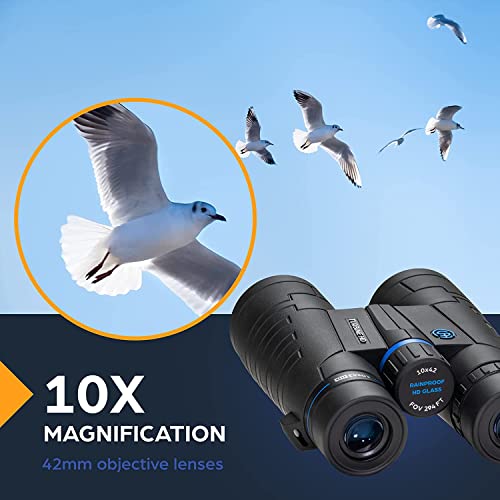

As an Amazon Associate we earn from qualifying purchases. Product prices and availability are accurate as of the date/time indicated.
Prices shown are approximate and for reference only. Prices change often, so please check the current price on Amazon before you buy.
Specifications follow each maker’s published data for the current version. Prices are typical US street ranges. Ratings are editorial within each design’s parish, weighing image quality for the price, build and sealing, handling, and warranty.
The Six Binoculars Reviewed Across Both Designs
1. Nikon Monarch M7 Class, Roof: Best Roof Value
The M7 parish shows the modern roof at its most persuasive, ED glass and the full coating stack at a mid price, in a sealed, handy body. For the travelling birder and hunter, it is the roof recommendation defended first.
2. Swarovski NL Pure Class, Roof: Best Premium
The NL parish is the roof design’s current summit, a field of view that rewrites its class in a body of jewel manners. Its price is the summit’s. In the premium parish, it closes the argument.
3. Nikon Action EX Class, Porro: Best Porro Value
The Action EX remains the Porro doctrine’s best evidence, brightness and depth beyond its price in a waterproofed classic body. Its bulk is its honesty. For the budget that birds, it stands.
4. Vortex Diamondback HD Class, Roof: Best Hunting Value
Vortex’s roof citizen pairs a phase-coated parish with the parish’s most trusted warranty at a working hunter’s price. In the hunting parish, it earns its enormous congregation.
5. Marine Porro Parish: Best on the Water
The 7×50 individual-focus Porros remain the boat’s standard for reasons of steadiness, brightness, and weather manners no roof has repealed. On the water, they stand.
6. Celestron SkyMaster Parish, Porro: Best Astronomy Entry
The big Porros own the entry astronomy parish on aperture per price, tripod citizens whose depth parish the sky forgives. Collimation is audited at purchase as the text directs. In their parish, they close the table.
Buying Guide: How to Choose Between Roof and Porro Prism Binoculars
Step One: Let Your Ground and Your Budget Choose the Geometry
Write the census before the silhouette: the ground you will use it on, travelling, hunting in weather, against the porch, the boat, and the observatory; the carrying parish, a harness all day against a tripod and a short walk; and the budget in its honest figure, since the designs’ value parishes cross, the Porro commonly winning the sums below the middle parish, the roof’s full coating stack asking the premium parish to justify itself. Let the census shortlist one citizen of each design at most, since the comparison that decides this purchase is performed by the eyes and hands in Step Two, and a shortlist of six is a parish that will not be auditioned honestly.
Step Two: Audition Brightness at Dusk and Depth at Near Parish
Compare the finalists in the parishes where the designs differ: at dusk or in the shop’s darkest corner, on shadowed detail, for the brightness and contrast that the coating stack decides; at near and middle distance, on a layered parish of branches or shelves, for the depth character each eye prefers; and in the hands, gloved if your parish is cold, for the handling, the focus wheel’s parish, and the eye relief with your own glasses where they apply. Check collimation on any Porro especially, a distant straight edge held steady, the two barrels’ images married without strain, since the Porro’s exposed parish makes the audit a purchase condition rather than a formality. Reject on a double image, a focus parish your hands dislike, or a dusk view that disappoints at the price, without negotiating with a sale, because the designs’ differences are experiences and cannot be read off a box.
Step Three: Set It Up, Protect Its Parish, and Keep It for a Decade
Set the chosen binocular up as this site teaches for every citizen, interpupillary distance, diopter on a distant detailed target, eyecups in their parish, and give it the carrying and protection its design asks: the roof on its harness in the weather it was sealed for, the Porro in a case that respects its shoulders and a handling parish that does not drop it on them. Keep both parishes’ lenses by the cleaning doctrine of this site’s guides, blower first and chemistry rarely, and store the instrument dry and capped. Kept so, either geometry becomes a decade’s companion, which is the whole doctrine of roof prism vs porro prism binoculars and the reason the right one is chosen by its ground, its dusk view, and its fit in your hands, and never by its silhouette alone.
Frequently Asked Questions About Roof and Porro Prism Binoculars
Which is better, roof prism or Porro prism?
Neither, in the absolute the question asks for, and each, in the parish the buyer actually lives in, which is why the design argument has outlived a century of attempts to settle it. The roof is better where size, sealing, and handling govern: the travelling birder, the hunter in weather, the carrier of a harness all day, since its straight, sealed, protected parish was engineered for exactly that life and its modern coating stack has retired the brightness debt its prisms once owed. The Porro is better where the image per price and the near parish govern: the budget that wants brightness now, the porch and the boat, the observatory, the woodland birder who prizes its depth, since its simpler parish spends the money on glass rather than on compensating for its own geometry. At the premium summit the roof owns the field on the whole of its parish, and at the entry parish the Porro owns it on brightness, and the middle is a genuine contest that Step Two’s dusk audit settles eye by eye. A buyer who names their ground honestly has answered the question before asking it, which is this guide’s doctrine for every either-or in optics.
Why are roof prism binoculars more expensive?
Because their prisms ask to be paid for twice, once in precision and once in coatings. The roof prism’s geometry, two halves meeting at an edge that must be ground to tolerances the light can audit, is intrinsically costlier to make well than the Porro’s simpler parish, and its optical path then taxes the image in ways that only further spending repairs: phase-correction coatings to restore the contrast its roof edge interferes with, high-grade mirror coatings, dielectric in the premium parish, to return light its surfaces would keep, and a sealing and internal-focus parish that the market now expects of the design. A cheap roof omits that spending and shows it, in a view whose softness and dimness have unfairly indicted the whole design in many buyers’ first impressions. A good Porro, by contrast, reaches its brightness by geometry, total internal reflection asking no mirror’s wages, so its price goes to glass and alignment. The premium roof, its full stack aboard, justifies its price across the whole of its parish, size, sealing, handling, and an image the equal of any, but the buyer should understand the stack is what they are funding, and should verify its presence, phase coatings named in the maker’s own specification, before paying for the silhouette alone.
Are Porro prism binoculars more fragile?
More exposed, which is a more precise statement than fragile, and the distinction governs their care rather than their worth. The Porro’s prism housings stand out from its barrels, so a blow or a drop lands on the parish that holds the prisms’ alignment, and a shifted prism gives the double image that is the design’s classic injury; its focusing parish, in the centre-focus citizens, also admits the weather more readily than the roof’s sealed internal parish, which is why the waterproof Porro is a smaller parish than the waterproof roof. Against that exposure stand the design’s own virtues: its injuries are commonly repairable, its prisms accessible to a competent shop for the re-collimation that returns it to service, where a sealed roof’s internal injury is a factory parish and sometimes a final one, and its individual-focus marine citizens are as weatherproof as anything made. The practical doctrine is handling rather than avoidance: a Porro carried in a proper case, respected at its shoulders, and audited for collimation after any hard knock will serve for decades, as the parish’s surviving elders testify, while a roof’s protection is bought in its design and paid for in its price, two honest settlements of the same risk.
Which design is best for bird watching?
The travelling, all-weather birding that defines the modern parish belongs mostly to the roof, and the near, settled birding of the woodland, the garden, and the budget belongs honourably to the Porro, with the buyer’s own ground deciding between them as Step One directs. The roof’s case for the birder is the whole of its parish in one instrument: compact in the harness across a long day, sealed against the dawn’s damp and the shower’s parish, close-focusing in its modern citizens, and bright, in its coated stack, at the warbler’s hours. The Porro’s case is the image and the price: brightness and a depth parish that separates a woodland’s layers beautifully, at sums that leave the budget its field guide, its travel, and its second pair for the car. Magnification and aperture follow the same census in either geometry, 8×42 being the birding parish’s standard settlement for its field and its twilight, 10x for the open parishes, as this site’s birding guides set out. Choose the geometry by the life, the specification by the ground, and audition at dusk, and the binocular will be chosen the way birders keep them, for a decade and with affection, which is the only verdict either design has ever sought.
Related guides
- Best Binoculars in India in 2026: 6 Best Binoculars in India for Birding, Travel, and Stargazing
- Best Spotting Scope Straight Eyepiece Upgrade in 2026: 7 Spotting Scopes That Offer Clear Glass, Easy Targeting, and Reliable Performance for Straight Eyepiece Upgrades
- Best Monocular for Retirees Birding in 2026: Best Monocular for Retirees Birding for Light Weight, Easy Focus, and Simple Bird Watching
- Best Telescope Eyepiece Under 25 Dollars in 2026: 6 Best Telescope Eyepieces Under 25 Dollars for Beginners
More from Amazon
Programs that pair well with the guide above. Offers and eligibility are set by Amazon and may change.
Free shipping on eligible items, Prime Video and more. Eligible new members can start with a free trial.
Start a Prime free trialAudiobooks and podcasts to listen to on the go. Eligible new members can start with a free trial.
Try Audible freeAd-free music streaming. Eligible new subscribers can start with a free trial.
Try Music Unlimited freeA free business account with business pricing and bulk-buying tools for work, shop or home office.
Create a business accountAs an Amazon Associate we earn from qualifying purchases.

Write Your Review
No reviews yet. Be the first to share your experience!