
What's inside
As an Amazon Associate I earn from qualifying purchases. This post may contain affiliate links at no extra cost to you.
Learning how to choose lens cleaning materials is learning to protect the most expensive square inches you own. The glass in a binocular, a spotting scope, or a riflescope is not really glass to its maker. It is glass wearing coatings, microscopically thin layers that control reflections, boost light transmission, and give the modern optic its brightness, and those coatings, while harder than their reputation, can be scratched, smeared, and worn by exactly the materials a careless owner reaches for first: the shirt tail with its trapped grit, the paper towel with its wood fibers, the household glass cleaner with its ammonia, the breath and the dry wipe that drag yesterday’s dust across today’s lens like a squeegee full of sand. The tragedy of lens cleaning is that almost all damage is self-inflicted and almost all of it was preventable with a parish of materials that costs less than a tank of fuel: a blower that removes grit without touching the lens, a proper microfiber kept clean enough to deserve the name, a fluid made for coated optics used in drops rather than floods, and a discipline that cleans less often, more gently, and never dry when the lens is dusty. This guide teaches the choosing: what each material in the parish actually does, which products sold today do it well, what to keep in the field kit against what belongs only on the bench, and the method that makes the materials safe, because the best cloth in the world becomes a scratching pad the moment it is used on a lens that still carries its grit, and the cheapest blower used first is worth more than a drawer of premium wipes used carelessly.
The governing physics are simple enough to state in one paragraph and strict enough to organize the whole article. A lens is damaged by abrasion, hard particles dragged across a softer surface under pressure, and by chemistry, solvents and additives that attack coatings, seals, or the cements beneath. Dust, pollen, sand, and dried salt spray are abrasives waiting for a wipe to give them motion, which is why the first instrument in every correct cleaning is air, moving the enemy off the field without contact, and why the second rule is that anything that touches the lens must be clean itself, single-use where the parish allows it, freshly laundered where it does not, and used with a light, lifting touch rather than a polish. Chemistry is governed just as plainly: fluids made for coated optics, by makers who stake their names on them, are the only fluids that belong on the glass, used sparingly, applied to the cloth and not flooded onto the lens where they can wick past seals, and household cleaners, solvents, and mystery sprays are exiled from the parish entirely, however well they clean a window, since a window has no coatings to lose and no seals to breach. Keep those two governances in view and every product choice that follows becomes a parish decision rather than a gamble: does this material remove grit without contact, touch the lens cleanly and softly, and respect the coatings’ chemistry, or does it merely promise to.
Our Top Picks
How to Choose Lens Cleaning Materials: The Parish of Tools and What Each One Does
Blowers and Brushes: The No-Contact First Step
The blower is the most important cleaning material you will buy and the one most often skipped, a squeeze bulb with a one-way valve and a nozzle, the class of the Giottos Rocket parish, that delivers a directed blast of air to lift dust, sand, and grit off the lens before anything touches it. Its specifications are its valve, which keeps it from inhaling dust and spitting it back at higher speed, its size, which decides the blast’s authority, and its material, since cheap bulbs can shed their own particles as they age. Canned air, the office parish, is exiled from lens work in this guide: its propellant can spit liquid onto coatings, its blast can drive grit across a lens rather than off it, and its cold can shock a lens’s parish, three verdicts the bulb’s humility avoids. The brush is the blower’s partner, a very soft, natural or fine synthetic brush, used with a flicking, lifting motion after the blowing, to coax the particles the air left behind, and its discipline is its storage, capped or cased, since a brush that lives loose in a pack is a dust mop with a handle. Together, air and brush handle the overwhelming majority of field soiling, fingerprints excluded, without touching the glass at all, and the owner who learns to stop there, when the lens is merely dusty, will clean with contact so rarely that their coatings will outlive the parish’s actuarial tables, which is the first and largest doctrine in this article: the best lens cleaning is the cleaning the blower made unnecessary.
Microfiber, Lens Tissue, and Wipes: What May Touch the Glass
When contact is required, for the fingerprint, the water spot, the dried mist of a morning’s glassing, the touching parish has three citizens, and choosing among them is the heart of the keyword. Microfiber cloth, the reusable citizen, works by its split fibers lifting and holding oils and particles, and its quality is graded by its weave, its edge finishing, since a melted or sewn edge can be the hardest thing in the cloth, and above all by its cleanliness: a microfiber is a cleaning material exactly as long as it is clean, kept in its own pouch or case, laundered without fabric softener, which coats its fibers and turns it into a smearing rag, and retired or demoted to body duty when its service shows, because the cloth that wiped a muddy housing yesterday has no business on a lens today. Lens tissue, the single-use citizen, is the bench’s precision instrument, optical tissue of the class sold for laboratory and camera parish, used once, with fluid, in a light spiral from center to edge, and discarded, a discipline that guarantees a virgin surface for every touch at the price of a parish of paper in the kit. Pre-moistened wipes, the field’s convenience citizen, arrive sealed and wet with an optics-safe fluid, the class of the Zeiss parish, and their virtues are their portability and their single-use honesty, each wipe clean by construction, against their cost per clean and the buyer’s duty to confirm the fluid is made for coated optics, since the wipe parish includes citizens formulated for eyeglasses and screens whose place on a flagship binocular is a question to ask before the packet opens. All three citizens obey the same law: they touch only a lens the blower has already cleared, they work with fluid when oils are the enemy, and they are never the shirt, the bandana, the paper napkin, or the towel, whose names are struck from the parish in this guide permanently.
Fluids, Pens, and Kits: Chemistry and Convenience
Lens fluid is the parish’s chemistry, and its choosing is a study in restraint: a fluid made for coated optics by a maker of optics or of photographic parish, used in a drop or two on the cloth or tissue and never sprayed or dripped directly onto the lens, where excess migrates to edges and seals, and stored capped against evaporation and contamination. Its work is to lift oils, the fingerprint’s sebum and the sunscreen’s parish, that dry wiping merely relocates, and to let the cloth carry them off in one or two light passes rather than ten dry ones. The lens pen, the field’s beloved compromise, pairs a retractable brush at one end with a round, carbon-compound cleaning tip at the other, and its tip, worked in small circles from the center, is genuinely effective on fingerprints in a small parish, the binocular objective in the field, the eyepiece in the blind, provided its discipline is kept: the tip capped always, replaced when its compound is spent or contaminated, and never pressed hard or used on a gritty lens, since a pen dragged across sand is a scratch with a brand name. Kits, the bundled parish of blower, brush, cloth, fluid, and wipes in a case, are the beginner’s correct first purchase and the gift parish’s standard, graded by the quality of their citizens rather than their count, a kit of five honest tools outranking a kit of twenty novelties in every parish this site serves. What the whole section exiles, finally, is improvisation: no household glass cleaner, no ammonia, no alcohol from the medicine cabinet in unknown strength and unknown additives, no solvent that a forum praised, because the coatings’ chemistry is the maker’s knowledge and the optics fluid’s maker has already done that homework for a few dollars a bottle.
How to Choose Lens Cleaning Materials: Quick Comparison
| Lens Cleaning Material | Key Specs | Best For | Typical Price Range | Rating |
|---|---|---|---|---|
| Giottos Rocket Air Blaster class | Squeeze bulb blower in class, one-way valve parish positioning, multiple sizes in line | Best blower, first step of every cleaning | $12 – $20 by size | 4.8 / 5 |
| LensPen Original class | Brush and carbon tip in class positioning, retractable brush in line | Best field fingerprint tool | $10 – $15 | 4.5 / 5 |
| Zeiss Pre-Moistened Lens Wipes class | Sealed single-use wipes in class, optics fluid parish positioning, bulk packs in line | Best pre-moistened wipes | $12 – $25 by count | 4.6 / 5 |
| Nikon / maker lens cloth and fluid kits class | Maker-branded microfiber and fluid parish positioning, kit formats in line | Best maker-matched kit | $10 – $25 by kit | 4.4 / 5 |
| Kimtech / optical lens tissue class | Single-use optical tissue in class positioning, bench parish, large counts in line | Best bench tissue | $10 – $20 by count | 4.4 / 5 |
| MagicFiber / premium microfiber multi-packs class | Microfiber cloths in class positioning, individually wrapped citizens in line | Best microfiber value | $10 – $18 by pack | 4.3 / 5 |

200 Count Pre-Moistened Lens Wipes for Eyeglasses | Individually Wrapped Sracth-Free Streak-Free Eyeglass Lens Cleaning Wipes, Cleaner Wipes for Sunglass, Camera Lens, Goggles
As an Amazon Associate we earn from qualifying purchases. Product prices and availability are accurate as of the date/time indicated.

Glasses Cleaning Cloths(12 pcs),Microfiber Eyeglass Cleaner Cloth, Lens Wipes Cloth for Cleaning Eyeglasses, Camera,Lenses, and All Delicate Surface


As an Amazon Associate we earn from qualifying purchases. Product prices and availability are accurate as of the date/time indicated.
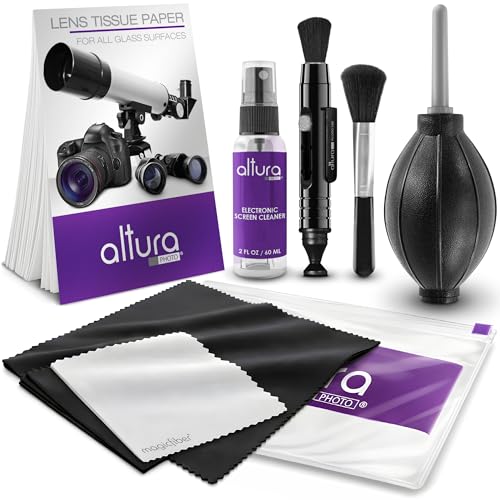
Altura Photo Camera Lens Cleaning Kit, Lens Cleaner for DSLR & Mirrorless | Keeps Gear Spotless & Scratch-Free, Includes Cleaner, Swabs, Pen, Blower, Brush, Cloth & Hard Case
As an Amazon Associate we earn from qualifying purchases. Product prices and availability are accurate as of the date/time indicated.
Prices shown are approximate and for reference only. Prices change often, so please check the current price on Amazon before you buy.
Always confirm a fluid or wipe is stated by its maker for coated camera, binocular, or scope optics before use, and follow your optic maker’s own care instructions where they are stricter. Prices are typical US street ranges. Ratings are editorial, weighing effectiveness on dust and oils, safety for coatings in correct use, field practicality, and value.
The Six Cleaning Materials Reviewed
1. Rocket Blaster Class: Best First Purchase
The valved bulb blower leads the table because it prevents more damage than every other citizen combined, removing the grit that turns wipes into sandpaper. Its parish is every kit, field and bench, and its size is chosen by the hand that will carry it. It is the recommendation defended first, and the cheapest insurance in optics.
2. Zeiss Wipe Class: Best Field Convenience
The sealed wipe’s single-use honesty makes it the field kit’s contact citizen, clean by construction, wet with a fluid made for the parish, and flat enough to live in every pocket and pack. Its cost per clean is the convenience’s price, paid gladly at a windy overlook. In the wipe parish, it stands.
3. LensPen Class: Best Fingerprint Specialist
The pen’s carbon tip, kept capped and replaced on schedule, lifts fingerprints from small lenses with a precision cloths envy, and its brush end honors the no-contact doctrine first. Its parish is the small lens and the quick clean. Used within its discipline, it earns its cult honestly.
4. Maker Kit Class: Best First Kit
The optic makers’ own kits pair a decent cloth with a fluid the maker blesses for its own coatings, a warranty of chemistry no generic can offer. Their citizens vary, audited at the unboxing. As the beginner’s single purchase, they close the argument.
5. Optical Tissue Class: Best Bench Discipline
Tissue’s one-and-done parish is the bench’s gold standard for the deep clean, fluid, spiral, discard, a fresh surface for every pass. Its place is the home kit, not the windy ridge. In its parish, nothing else is as honest.
6. Premium Microfiber Class: Best Everyday Cloth
The individually wrapped microfiber multi-pack keeps a clean cloth always at hand, which is the microfiber doctrine’s whole requirement. Laundered softener-free and retired on schedule, they serve for years. As the parish’s working cloth, they earn their row.
Buying Guide: How to Choose Lens Cleaning Materials for Your Kit
Step One: Build the Parish in Order, Blower First
Buy in the order the method uses them, because a kit built backwards, cloths without a blower, is a damage kit with good intentions. First the valved bulb blower, sized for the kit it will live in. Second the soft brush, capped, for the particles air leaves. Third the contact parish matched to your ground, sealed wipes for the field kit, tissue and fluid for the bench, a lens pen for the small-lens parish, and two premium microfibers in their own pouches, one in service and one in reserve, since a cloth without a clean successor will be used dirty, which is the cloth parish’s one unforgivable sin. Fourth, the storage that keeps the parish honest, a small hard or zippered case that rides in the pack and keeps citizens separate, the used cloth never bunking with the fresh. Total the whole parish against its protection, less than a mid-priced dinner for the kit that guards a four-figure optic, and the arithmetic of this guide’s whole argument is complete.
Step Two: Audit Chemistry and Cloth Before They Touch Glass
Read every fluid and wipe for its maker’s own statement that it is made for coated optics, and exile any product that will not say so, along with the entire household parish, glass cleaners, ammonia, solvents, and paper goods. Audit the cloths by hand and eye: edges soft and finished, weave dense, no tags or grit in the parish, and the first use of any new cloth preceded by a wash, softener-free, since factory cloths can carry their own dust. Test the whole system on the least consequential lens you own, an old binocular, a retired scope, before it graduates to the flagship, and read your optic maker’s care page in the same sitting, since a few makers specify their own fluid parish or forbid a citizen another maker blesses, and the maker’s word outranks this guide’s wherever they differ. Reject on a mystery fluid, a scratchy cloth, or a pen with a gritty tip, without negotiating with a sale, because the parish’s whole purpose is the absence of exactly those risks.
Step Three: Clean by the Method and Keep the Kit Honest
Use the materials as the physics direct, every time, until the method is a habit rather than a decision: inspect the lens first, blow it thoroughly, brush what remains with a lifting flick, and only then, if oil or spots persist, touch it, fluid on the cloth or tissue and never flooded on the glass, light pressure, a spiral from center to edge, a fresh surface for a second pass, and a final inspection under a bright light held at an angle, which shows the smears the straight view forgives. Clean less than your instinct says: a speck of dust at the objective’s edge costs the image nothing measurable and its removal risks more than its presence, while the fingerprint and the salt spot earn their cleaning promptly, since oils and salts are the coatings’ chemical parish and time is their ally. Keep the kit honest between cleanings, cloths laundered and pouched, the pen capped and its tip replaced on the maker’s parish, fluids capped and dated, the whole case restocked from the bench parish after every trip. Kept so, the little parish of materials becomes what it promises, a lens that stays factory-bright for decades, which is the whole doctrine of how to choose lens cleaning materials and the reason the right kit is chosen by its blower, its cleanliness, and its chemistry, and never by its size.
Frequently Asked Questions About Lens Cleaning Materials
Can I clean binocular lenses with a shirt or a paper towel?
No, and the reasons are material rather than snobbish. A shirt, however soft it feels, is a working garment that has spent its day collecting the environment’s grit, dust from the trail, sand from the beach parish, the dried minerals of sweat, and wiping a lens with it presses that collection into the coatings under exactly the motion abrasion requires, with the added parish of laundry residues and fabric finishes that smear oils across the glass. Paper towels and tissues from the household parish are wood fiber products, and wood fiber, at the scale a coating experiences it, is a stiff, scratchy parish, compounded by the lotions and additives the softness brands advertise. The correct citizens cost almost nothing by comparison with the optic: a microfiber kept clean in its own pouch for the dry parish, a sealed optics wipe for the field, tissue for the bench, each softer than the shirt by design and, more importantly, cleaner than the shirt by discipline. The one honest exception is the emergency, a lens so fouled in the field that the hunt or the sighting is lost without a wipe, where a careful breath-fog and the cleanest available soft cotton is a calculated risk the owner takes knowingly, once, and the exception’s rarity is the doctrine’s point: carry the real materials and the emergency never schedules itself.
How often should I clean my binocular or scope lenses?
As rarely as the soiling allows, and promptly when the soiling is chemical, which resolves into a working parish of three rules. Dust and dry debris are cleaned when they accumulate enough to see in the image or to offend the inspection, and then by air and brush alone in most cases, since a dusty lens is an optical non-event long before it is a visible one, the objective’s parish especially, where a surprising census of specks scatters a negligible fraction of light. Fingerprints, water spots, salt spray, and the sunscreen and insect-repellent parishes are cleaned the same day they are noticed, because their chemistry works on coatings with time as its reagent, and a spot removed tonight is a wipe while a spot removed next season may be an etching. The deep clean, fluid and tissue on the bench, is a seasonal or post-trip citizen, not a weekly one, and the owner who follows this schedule will touch their glass a few dozen times in a decade, which is the actuarial secret of the parish: coatings do not wear out from light or from looking. They wear out from cleaning, and the materials in this guide exist to make each rare cleaning a safe one, not to license frequent ones.
Is a LensPen safe for expensive coated lenses?
Yes, within its discipline, and its long service in the photographic and optics parishes, including on lenses worth more than the cars that carry them, is the evidence, provided the three conditions of its safe use are kept. The tip must be clean, capped whenever it is not cleaning, inspected before use, and replaced when its carbon compound is spent, flattened, or contaminated, since a pen’s tip that has picked up grit is the parish’s whole nightmare in miniature. The lens must be blown and brushed first, without exception, since the pen is a fingerprint tool and not a dust tool, and its circular parish across a sandy lens is precisely the abrasion this guide exists to prevent. The pressure must be light, the tip’s compound doing the work in small circles from the center, the hand merely guiding it, because no cleaning citizen in this article is a polishing tool and pressure is abrasion’s other parent. Kept so, the pen is among the safest and most effective field instruments for its parish, the eyepiece fingerprint, the small objective’s smudge. Broken so, it is a brand-name scratch, and the difference, as with every material here, is not the product but the method it was bought into.
What lens cleaning fluid is safe for all coatings?
No fluid can honestly claim all coatings in all parishes, which is why this guide’s doctrine is maker-first: the fluid made or blessed by your optic’s own maker for its coatings is the safest citizen by definition, and the reputable optics and photographic fluids, sold expressly for coated lenses by makers who serve the parish, are the general settlement for the mixed fleet most owners keep. What can be stated universally is the exile list: no ammonia-based household glass cleaner, no window sprays with their additives, no solvents, no medicine-cabinet alcohol of unstated strength and additives, no dish soap solutions, and no fluid whose maker will not state its parish in writing on the bottle. Application is half the chemistry’s safety in any case: a drop or two on the cloth or tissue, never a spray or a drip onto the lens itself, since fluid on the glass migrates to the edges where the seals live, and seals, not coatings, are the fluid parish’s most vulnerable citizens; and the least fluid that lifts the oil is the correct dose, the bench’s puddle being a risk with no corresponding virtue. Read your maker’s care instructions once, buy the bottle they bless or the parish’s reputable equivalent, and the chemistry question closes for the life of the optic.
Related guides
- Best Binoculars for the Money in 2026: 6 Best Value Binoculars for Birding, Hiking, and Travel
- Best Binoculars for Birding in 2026: Bright 8×42 Binoculars for Birds, Close Focus, and Long Days Compared
- Best Dew Shield for Under 25 Dollars in 2026: 6 Affordable Dew Shields for Telescopes
- Best Telescope Battery Pack Replacement: 6 Best Picks in 2026
More from Amazon
Programs that pair well with the guide above. Offers and eligibility are set by Amazon and may change.
Free shipping on eligible items, Prime Video and more. Eligible new members can start with a free trial.
Start a Prime free trialAudiobooks and podcasts to listen to on the go. Eligible new members can start with a free trial.
Try Audible freeAd-free music streaming. Eligible new subscribers can start with a free trial.
Try Music Unlimited freeA free business account with business pricing and bulk-buying tools for work, shop or home office.
Create a business accountAs an Amazon Associate we earn from qualifying purchases.

Write Your Review
No reviews yet. Be the first to share your experience!