
What's inside
As an Amazon Associate I earn from qualifying purchases. This post may contain affiliate links at no extra cost to you.
Deep sky observing is different from looking at the Moon or planets. Galaxies, nebulae, and star clusters are faint, large, and best seen with a telescope that gathers a lot of light, has a wide field of view, and sits on a stable mount. The best budget telescope for deep sky beginners is not the telescope with the highest magnification. It is the telescope with the largest aperture you can afford, a stable mount, and a design that is easy to set up and use on a dark night.
This guide focuses on budget telescopes that work well for deep sky beginners. We compare real, currently sold models, explain what aperture, focal length, and mount actually mean for deep sky observing, and show how to choose a telescope that fits your budget, your sky, and your patience. Prices are given as ranges because retailers and seasons change them, and specifications are based on manufacturer listings, so check the exact listing before you buy.
Deep sky objects are faint, so dark skies matter more than magnification. A budget telescope will show you more from a dark site than a premium telescope will show you from a bright city. Always never look at the Sun without a solar filter, inspect the filter for damage before every use, never use a damaged filter, and supervise kids. A spotting scope is best for the Moon and bright planets, a telescope is better for deep sky, and binoculars are best for wide-field views.
Disclosure: As an affiliate site, OpticsJunkies.com may earn a commission from qualifying purchases made through links on this page, at no extra cost to you. Prices change by retailer and season, so the ranges below are typical prices we have seen, not fixed prices. Aperture, focal length, and other specifications are based on manufacturer listings and vary by model, so check the exact listing before you buy.
Our Top Picks
Best Budget Telescope for Deep Sky Beginners at a Glance: Comparison Table
Use this table to compare the leading budget telescopes for deep sky beginners side by side. Aperture, focal length, best use, and price matter most, so compare those first, then read the reviews below for the details that matter under dark skies.
| Telescope Model | Aperture | Focal Length | Best Use for Deep Sky Beginners | Typical Price Range | Rating |
|---|---|---|---|---|---|
| Celestron AstroMaster 130EQ Telescope | 130mm | 650mm | Best overall budget telescope for deep sky beginners | $250 – $300 | 4.7 / 5 |
| Orion StarBlast 4.5 Astro Reflector Telescope | 114mm | 450mm | Best tabletop telescope for deep sky beginners | $200 – $250 | 4.7 / 5 |
| Celestron PowerSeeker 127EQ Telescope | 127mm | 1000mm | Best Celestron telescope for deep sky beginners | $150 – $200 | 4.5 / 5 |
| Sky-Watcher Heritage 130 Telescope | 130mm | 650mm | Best collapsible telescope for deep sky beginners | $200 – $250 | 4.7 / 5 |
| Gskyer AZ70400 Telescope | 70mm | 400mm | Best low-cost telescope for deep sky beginners | $100 – $130 | 4.5 / 5 |
| Celestron Travel Scope 70 Telescope | 70mm | 400mm | Best portable budget telescope for beginners | $80 – $100 | 4.6 / 5 |
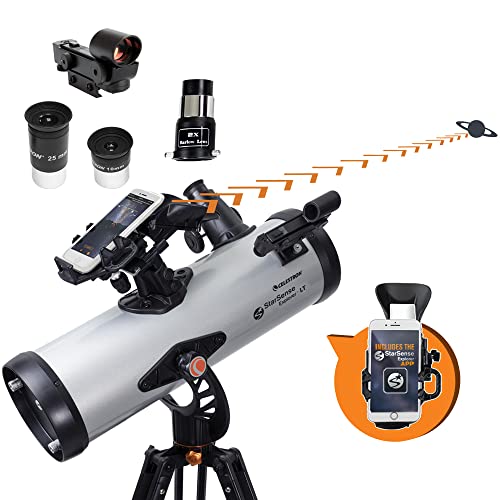
Celestron StarSense Explorer LT 114AZ Newtonian Smartphone Guided Telescope | Smartphone App Sky Navigation, Manual Reflector Telescope, Beginner Deep-Sky Telescope, Bright Celestial Views, Portable
As an Amazon Associate we earn from qualifying purchases. Product prices and availability are accurate as of the date/time indicated.
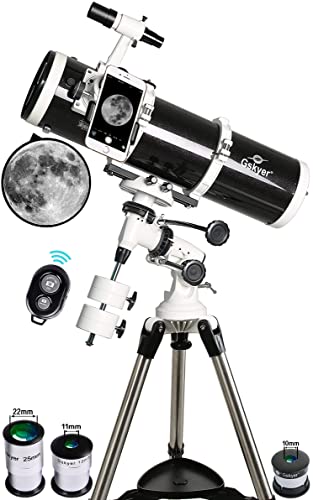
Gskyer 130EQ Professional Astronomical Reflector Telescope | 130mm Large Optic German Technology Scope, EQ130 Perfect Telescope for Beginners Adults Stargazing
As an Amazon Associate we earn from qualifying purchases. Product prices and availability are accurate as of the date/time indicated.

Gaterda Telescope, 90mm Aperture 900mm Refractor Telescope for Adults High Powered, Astronomical Telescopes for Adults Astronomy Beginners with Professional Eyepieces, Tripod, Phone Adapter&Carry Bag
As an Amazon Associate we earn from qualifying purchases. Product prices and availability are accurate as of the date/time indicated.
Prices shown are approximate and for reference only. Prices change often, so please check the current price on Amazon before you buy.
Best Budget Telescope for Deep Sky Beginners Reviewed for 2026
1. Celestron AstroMaster 130EQ Telescope: Best Overall Budget Telescope for Deep Sky Beginners
The Celestron AstroMaster 130EQ is our top pick for most deep sky beginners because it balances aperture, price, and ease of use. Its 130mm aperture gathers enough light to show bright galaxies, nebulae, and star clusters from a dark site, and its 650mm focal length gives you a wide field of view that makes it easier to find objects. It sits on an equatorial mount, which is useful for tracking objects as the Earth rotates, although it takes some practice to learn.
For deep sky observing, the AstroMaster 130EQ is practical because 130mm is large enough for deep sky, but the telescope is still light enough to carry outside. It comes with eyepieces in many listings, a finderscope, and a tripod, so you can start observing the same night you buy it. The main trade-off is the mount: an equatorial mount is more stable than a basic alt-azimuth mount, but it is also more complex to set up, and beginners may find it confusing at first.
At a typical price in the $250 to $300 range, it is a good value for a 130mm telescope. Choose it if you want the best aperture for the price, you have a dark site, and you are willing to learn an equatorial mount. Do not buy it if you need the simplest possible setup, because the Orion StarBlast 4.5 will be easier to use.
2. Orion StarBlast 4.5 Astro Reflector Telescope: Best Tabletop Telescope for Deep Sky Beginners
The Orion StarBlast 4.5 is a tabletop reflector with a 114mm aperture and a 450mm focal length, which gives you a very wide field of view for deep sky observing. Its short focal length makes it good for large nebulae and star clusters, such as the Orion Nebula and the Pleiades, which are too large to fit in the field of a long telescope. It sits on a simple Dobsonian-style tabletop mount, which is easy to use: you just point it and look.
For beginners, the StarBlast 4.5 is useful because it is simple, it is stable, and it is easy to set up on a table or a sturdy stool. You do not need to learn an equatorial mount, and you do not need to align it. The trade-off is that it is a tabletop telescope, so you need a table or a platform to put it on, and its 114mm aperture is smaller than the 130mm AstroMaster, so it gathers less light.
At a typical price in the $200 to $250 range, it is a good value for a beginner deep sky telescope. Choose it if you want the simplest setup, you observe from a backyard with a table, and you want a wide-field telescope for nebulae and clusters.
3. Celestron PowerSeeker 127EQ Telescope: Best Celestron Telescope for Deep Sky Beginners
The Celestron PowerSeeker 127EQ is a 127mm telescope with a 1000mm focal length, which gives you higher magnification than the AstroMaster 130EQ, but a narrower field of view. That makes it better for planets and the Moon, and less good for large deep sky objects, although it can still show bright galaxies and clusters from a dark site. It sits on an equatorial mount, like the AstroMaster, and it comes with eyepieces and a finderscope in many listings.
For deep sky beginners, the PowerSeeker 127EQ is a mixed choice. Its aperture is large enough for deep sky, but its long focal length makes it harder to find objects, because the field is narrow. It is a good choice if you also want to observe planets, because its higher magnification helps there. The trade-off is that its optics are not as good as the AstroMaster 130EQ for deep sky, and its mount is basic.
At a typical price in the $150 to $200 range, it is a low-cost way to get a large aperture. Choose it if you want a Celestron telescope for both deep sky and planets, you are on a budget, and you understand its limits for wide-field deep sky. If deep sky is your main interest, the AstroMaster 130EQ will be better.
4. Sky-Watcher Heritage 130 Telescope: Best Collapsible Telescope for Deep Sky Beginners
The Sky-Watcher Heritage 130 is a collapsible Dobsonian telescope with a 130mm aperture and a 650mm focal length, similar to the AstroMaster 130EQ, but with a simpler Dobsonian mount that is easy to use. Its collapsible tube makes it easy to carry and store, which is useful if you need to transport it to a dark site. Its wide field of view is good for deep sky, and its 130mm aperture gathers enough light for galaxies and nebulae.
For beginners, the Heritage 130 is practical because it is simple to set up, it is stable, and it is easy to point. You do not need to learn an equatorial mount, and you can start observing quickly. The trade-off is that it is a tabletop Dobsonian in many listings, so you need a table or a platform, and it does not track objects automatically.
At a typical price in the $200 to $250 range, it is a good value for a 130mm Dobsonian. Choose it if you want a collapsible telescope, you observe from a dark site, and you want a simple mount for deep sky. It is a strong alternative to the AstroMaster 130EQ if you prefer a Dobsonian mount.
5. Gskyer AZ70400 Telescope: Best Low-Cost Telescope for Deep Sky Beginners
The Gskyer AZ70400 is a low-cost refractor with a 70mm aperture and a 400mm focal length, priced in the $100 to $130 range. Its small aperture means it gathers less light than a 130mm telescope, so it will show fewer deep sky objects and fainter detail, but it can still show the Moon, bright planets, and the brightest deep sky objects such as the Orion Nebula and the Pleiades from a dark site.
For beginners on a tight budget, the AZ70400 is useful because it is inexpensive, it is easy to set up on an alt-azimuth mount, and it comes with eyepieces and a tripod in many listings. The trade-off is aperture: 70mm is small for deep sky, so you will not see faint galaxies as clearly as with a 130mm telescope. It is best as a first telescope to learn the sky, rather than as a dedicated deep sky telescope.
Choose it if you want the lowest-cost telescope in this guide, you are new to astronomy, and you want to learn before you spend more. It is not the best choice if deep sky is your main goal, because the AstroMaster 130EQ will show you much more.
6. Celestron Travel Scope 70 Telescope: Best Portable Budget Telescope for Beginners
The Celestron Travel Scope 70 is a portable refractor with a 70mm aperture and a 400mm focal length, priced in the $80 to $100 range. It is designed to be lightweight and easy to carry, with a backpack in many listings, so you can take it to a dark site, a campsite, or a holiday. Its short focal length gives you a wide field of view, which is good for large star clusters and for learning the sky.
For beginners who travel, the Travel Scope 70 is practical because it is the lightest and most portable telescope in this guide, and it is easy to set up. The trade-off is the same as the Gskyer: 70mm is small for deep sky, so it will not show faint galaxies as well as a 130mm telescope. It is best as a travel telescope and as a first telescope for learning.
Choose it if you want a portable, low-cost telescope for beginners, you travel to dark sites, and you do not need a large aperture yet. If deep sky is your main interest and you observe from home, the AstroMaster 130EQ will be better.
Buying Guide: How to Choose the Best Budget Telescope for Deep Sky Beginners
The best budget telescope for deep sky beginners for you depends on your sky, your budget, and how much you want to learn. Start with aperture and focal length, then compare mount, portability, and price. A telescope that gathers enough light, has a wide field, and is easy to use is better than a telescope with the highest magnification that is hard to point.
Aperture: 70mm vs 114mm vs 130mm for Deep Sky
Aperture is the most important specification for deep sky, because it determines how much light the telescope gathers. A 70mm telescope gathers less light than a 114mm telescope, and a 114mm telescope gathers less light than a 130mm telescope. For deep sky, larger is better, as long as the telescope is still portable and stable.
For most beginners, 130mm is the best balance between aperture and price. A 130mm telescope such as the AstroMaster 130EQ or Sky-Watcher Heritage 130 will show you bright galaxies, nebulae, and clusters from a dark site, while a 70mm telescope will show you fewer objects and less detail. Choose 70mm only if you need a very low-cost or very portable telescope, and choose 130mm if deep sky is your main goal.
Focal Length and Field of View: Wide Field for Nebulae and Clusters
Focal length determines magnification and field of view. A short focal length, such as 450mm in the Orion StarBlast 4.5 or 650mm in the AstroMaster 130EQ, gives you a wide field of view, which is good for large nebulae and star clusters. A long focal length, such as 1000mm in the PowerSeeker 127EQ, gives you higher magnification but a narrower field, which is better for planets and the Moon.
For deep sky, a short focal length is better, because most deep sky objects are large and faint. Use a low-power eyepiece for a wide field, and only increase magnification when you need more detail on a small object. A telescope with a focal ratio of f/5, such as the AstroMaster 130EQ, is a good deep sky choice.
Mount: Equatorial vs Dobsonian vs Alt-Azimuth for Beginners
Mount matters because it determines how easy the telescope is to use. An alt-azimuth mount, like the Gskyer and Travel Scope models, is the simplest: you move it up-down and left-right. A Dobsonian mount, like the Orion StarBlast and Sky-Watcher Heritage, is also simple and very stable, and it is good for deep sky. An equatorial mount, like the AstroMaster and PowerSeeker, is more complex but it can track objects as the Earth rotates, which is useful for longer observing sessions.
For most beginners, a Dobsonian or alt-azimuth mount is easier to learn than an equatorial mount. Choose an equatorial mount only if you want to learn tracking and you are willing to spend time aligning it. Always use a sturdy tripod or base, and do not use a telescope on a wobbly table.
Dark Skies, Safety, and What You Actually Need
Dark skies matter more than telescope size for deep sky. A 130mm telescope from a dark site will show you more than a larger telescope from a bright city. Find a dark site away from streetlights, let your eyes adapt for 20 minutes, and use a red flashlight to preserve night vision. Do not use white light, and do not look at your phone screen without a red filter.
For safety, never look at the Sun without a solar filter, inspect the filter for damage before every use, never use a damaged filter, and supervise kids. A spotting scope is best for the Moon and bright planets, a telescope is better for deep sky, and binoculars are best for wide-field views. Use a telescope for deep sky, and use binoculars to learn the sky first if you are new.
Price, Brand, and What You Actually Need
Price depends on aperture, mount, and brand. A telescope in the $80 to $130 range, like the Celestron Travel Scope 70 and Gskyer AZ70400, is a good starting point for learning the sky. A telescope in the $150 to $250 range, like the Celestron PowerSeeker 127EQ, Orion StarBlast 4.5, and Sky-Watcher Heritage 130, is a good balance if you want a larger aperture. A telescope in the $250 to $300 range, like the Celestron AstroMaster 130EQ, is best if you want the best aperture for the price.
Brand also matters. A telescope from a trusted brand in this guide, like Celestron, Orion, and Sky-Watcher, will be more reliable than an unbranded telescope with similar specifications on paper. For most deep sky beginners, the Celestron AstroMaster 130EQ is the best value for a 130mm telescope, the Orion StarBlast 4.5 is the best choice for a simple tabletop telescope, and the Sky-Watcher Heritage 130 is the best choice for a collapsible Dobsonian. Do not buy a telescope based on magnification alone. A telescope that gathers enough light, has a wide field, and is easy to use is worth the investment.
Best Budget Telescope for Deep Sky Beginners: FAQ
What is the best budget telescope for deep sky beginners?
For most deep sky beginners, the Celestron AstroMaster 130EQ Telescope is the best overall budget telescope because it offers a 130mm aperture, a 650mm focal length, and a wide field for deep sky at a typical price in the $250 to $300 range. If you want a simple tabletop telescope, the Orion StarBlast 4.5 is a good choice at $200 to $250. If you want a collapsible Dobsonian, the Sky-Watcher Heritage 130 is a practical option at $200 to $250. If you want a low-cost first telescope, the Celestron Travel Scope 70 is a good value at $80 to $100.
Can a budget telescope see galaxies and nebulae?
Yes, a budget telescope can see galaxies and nebulae from a dark site, especially with a 130mm aperture. Bright objects such as the Orion Nebula, the Andromeda Galaxy, and the Pleiades are visible in a budget telescope, although they will look like faint grey clouds, not like colour photos. For best results, observe from a dark site, let your eyes adapt, and use low magnification for a wide field.
What aperture do I need for deep sky beginners?
What aperture you need for deep sky beginners depends on your sky and budget, but in general, 130mm is a good starting point for deep sky, 114mm is enough for bright nebulae and clusters, and 70mm is enough for learning the sky but limited for faint galaxies. For best results, choose the largest aperture you can afford and carry, and observe from the darkest site you can reach.
How do I choose a budget telescope for deep sky beginners?
Choose a budget telescope for deep sky beginners by starting with aperture and focal length, then checking mount, portability, and price. Pick a 130mm telescope with a short focal length for a wide field, use a stable mount, and observe from a dark site. Always never look at the Sun without a solar filter, inspect the filter for damage, and supervise kids.
FAQ
What is the best budget telescope for deep sky beginners?
Can a budget telescope see galaxies and nebulae?
What aperture do I need for deep sky beginners?
How do I choose a budget telescope for deep sky beginners?
Related guides
- Best Hunting Binoculars with Chest Harness: 6 Best Hunting Binoculars with Chest Harness Picks in 2026
- Best Beginner Telescope With Phone Adapter in 2026: 7 Beginner Telescopes That Offer Clear Moon Views, Easy Setup, and Reliable Performance for New Stargazers
- Best Monoculars vs Telescopes for Hiking in 2026: Which Is Better for the Trail?
- Best First Binoculars for New Birders in 2026: How to Pick Your First Binoculars for Birding Without Overspending
More from Amazon
Programs that pair well with the guide above. Offers and eligibility are set by Amazon and may change.
Free shipping on eligible items, Prime Video and more. Eligible new members can start with a free trial.
Start a Prime free trialAudiobooks and podcasts to listen to on the go. Eligible new members can start with a free trial.
Try Audible freeAd-free music streaming. Eligible new subscribers can start with a free trial.
Try Music Unlimited freeA free business account with business pricing and bulk-buying tools for work, shop or home office.
Create a business accountAs an Amazon Associate we earn from qualifying purchases.

Write Your Review
No reviews yet. Be the first to share your experience!