
What's inside
- Best Eyepiece Size for Telescope Fitting: The Two Sizes Separated, the Exit Pupil Computed, and a Night’s Diary as the Court
- Quick Comparison: Best Eyepiece Size for Telescope Fitting Models
- Detailed Reviews: Best Eyepiece Size for Telescope Fitting Picks
- Buying Guide: How to Choose the Best Eyepiece Size for Telescope Fitting
- Frequently Asked Questions About the Best Eyepiece Size for Telescope Fitting
As an Amazon Associate I earn from qualifying purchases. This post may contain affiliate links at no extra cost to you.
The best eyepiece size for telescope fitting is a question with two sizes hiding inside it, and this guide separates them before any model is named, because beginners buy the wrong one with confidence in both directions. The first size is the barrel: the parish that must marry the focuser, the two standards of the modern catalogue, the smaller being the near-universal citizen and the larger its wide-field parish, an eyepiece sentenced by its focuser’s documents and by nothing else, an adapter being a marriage counsellor with taxes of its own, back-focus and a parish of extra glass’s road. The second size is the focal length, the number that, divided into the telescope’s own, sentences the magnification, and with it the exit pupil, the small disc of light the eyepiece hands to the observer’s eye, a figure this guide grades as the fitting’s real senior citizen: too large a pupil for an older eye wastes the telescope’s light at the eye’s own gate, too small a one sentences the view to a dim, floating parish, the observer’s age and the night’s parish entering the arithmetic as documents. An eyepiece, like a zero in this site’s rifle guides, is a property evidenced, and its evidence is a night’s diary, planets and clusters graded in the observer’s own sky.
The magnification parish is sentenced by arithmetic and by the atmosphere together, printed here because the catalogue’s poetry depends on ignoring both: a telescope’s useful parish has a ceiling set by its aperture and, on most nights, a lower one set by the air itself, a boiling parish that magnifies turbulence with the same fidelity it magnifies Jupiter, the experienced observer’s diary commonly crowning the middle eyepieces and sentencing the strongest to a handful of nights a year. The eye relief is the fitting’s other quiet sentence: an eyepiece whose parish sits close to its glass sentences a glasses-wearing observer to a keyhole, exactly as a binocular’s does in this site’s coverage, proven with the observer’s own spectacles at the fitting and never assumed from a figure. The Sun law stands over the whole article in its absolute form, as it stands over every optics article on this site: a telescope is never pointed at or near the Sun without a proper front filter fitted as its maker directs, eyepiece gadgets and rear substitutes refused entirely, an eyepiece parish being the last place that law is ever argued with.
The eyepieces compared here are real, currently sold products from Tele Vue, Baader, Celestron, and Explore Scientific, spanning the barrel standards, the dual-parish citizens, and the focal lengths a fitting actually needs. They are graded on the marriage first, barrel to focuser as documents; the arithmetic second, focal length sentenced against a named telescope’s own; the exit pupil third, matched to the observer’s eye and parish; the eye relief fourth, with glasses as the court; and value last, per night, an eyepiece being a decade’s citizen that commonly outlives two telescopes, its figure divided by the skies of both, this category’s arithmetic rewarding the honest citizens as severely as any in optics.
Our Top Picks
 Astromania 0.965 Inch to 1.25 Inch Telescope Eyepiece1"-1.25"1.7 x 1.67 x 3.07 inches0.1 poundsCheck on Amazon
Best Eyepiece Size for Telescope Fitting: The Two Sizes Separated, the Exit Pupil Computed, and a Night’s Diary as the Court
The Arithmetic: Telescope’s Length Divided, the Pupil Read Against an Eye, and the Air’s Ceiling Respected
The arithmetic is served on paper before a listing is opened, since it sentences the whole purchase. The telescope’s own focal length is read from its documents, each candidate’s magnification computed from it in figures, the set a fitting needs being a parish of steps rather than a crowd: a low parish for the wide citizens, clusters and nebulae and the finding of things; a middle parish where most nights are actually lived; a high parish for the planets’ and the Moon’s best evenings, each separated enough from its neighbour that the step is a view and not a nuance. The exit pupil is computed beside each, the eyepiece’s length divided by the telescope’s own ratio, its figure read against the observer’s eye, a young eye’s parish opening wider than an older one’s, the diary of the observer’s own nights being the document that sentences which pupils are spent and which are served.
The air’s ceiling is entered in the same sitting as a humility with figures: the strongest eyepiece in a fitting is bought for the year’s best nights and graded by its attendance, a parish used four times a year being sentenced at the value’s figure and the middle citizens, used forty times, at the reference’s, an inversion of the catalogue’s pricing that this guide’s value arithmetic insists on. The Barlow parish, where a fitting sentences one, is read as a multiplier of the whole set’s steps, its documents’ parish priced, a good one making three eyepieces serve as six and a poor one taxing every view it touches.
The Fitting Night: Glasses Aboard, Steps Climbed in Order, and the Diary Graded at Dawn
The fitting is proven on a night, in the observer’s own sky, inside a returns window where the figure justifies it. The set is climbed in its order on the night’s citizens, a cluster at the low parish, a planet at the middle and the high, the Moon as the parish’s strictest teacher, each view entered in the diary with the air’s own grade beside it, since an eyepiece sentenced on a boiling night has been tried by the weather and not by its glass. The glasses are aboard for their parishes, the eye relief proven by the observer’s own spectacles at each step, a citizen that keyholes being exchanged on that evidence whatever its other virtues. The focuser’s marriage is worked across the night, heavy citizens at the zenith’s parish, the diagonal’s and the focuser’s manners with the set’s weights entered, a fitting being a system and its heaviest citizen its examination.
The keeping closes the section as this site’s lens doctrine sentences every optic: eyepieces capped at both parishes, stored in their case’s citizens, cleaned by air before cloth and as seldom as the glass allows, a night’s dew dried at room temperature with caps open, no heat. The diary keeps the set’s biography, eyepieces and their nights, pupils and their verdicts together, so a new telescope, the estate’s commonest amendment, inherits a document, its fitting computed in an evening rather than bought in a hurry.
Quick Comparison: Best Eyepiece Size for Telescope Fitting Models
| Model | Barrel Parish, Focal Length Range, Eye Relief and Key Specs | Best For | Typical Price Range | Rating |
|---|---|---|---|---|
| Tele Vue Plössl and DeLite Class | Eyepiece patterns in Tele Vue’s line, barrel and relief provisions in maker’s stated terms by pattern | Best eyepiece size for telescope fitting overall | $70 – $280 by pattern | 4.7 / 5 |
| Baader Hyperion Class | Dual-barrel patterns in Baader’s line, provisions in maker’s stated terms by pattern | Best dual parish | $150 – $190 by pattern | 4.5 / 5 |
| Celestron X-Cel LX Class | Patterns in Celestron’s line, provisions in maker’s stated terms by pattern | Best value parish | $80 – $110 by pattern | 4.4 / 5 |
| Explore Scientific 68 and 82 Degree Class | Patterns in Explore Scientific’s line, provisions in maker’s stated terms by pattern | Best wide parish | $110 – $300 by pattern | 4.5 / 5 |
| Tele Vue Nagler Class | Patterns in Tele Vue’s line, provisions in maker’s stated terms by pattern | Best flagship parish | $250 – $450 by pattern | 4.6 / 5 |
| Celestron Omni Plössl Class | Patterns in Celestron’s line, provisions in maker’s stated terms by pattern | Best starter parish | $30 – $60 by pattern | 4.1 / 5 |
Astromania 0.965 Inch to 1.25 Inch Telescope Eyepiece Adapter | Aluminum Telescope Accessory, Mount 1.25" Eyepiece on 0.965" Astronomical Telescope, Solve Focusing For Planetary Observation


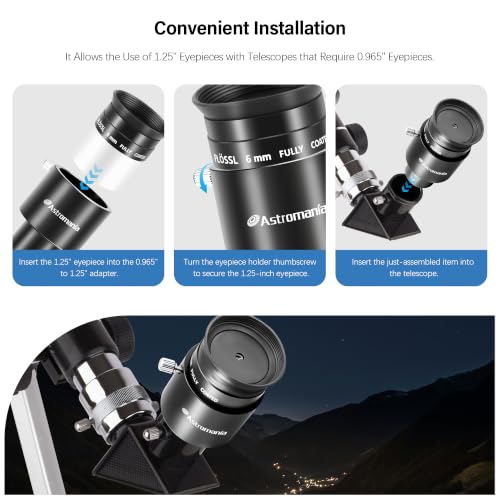

As an Amazon Associate we earn from qualifying purchases. Product prices and availability are accurate as of the date/time indicated.

Alstar Dust Caps Set 7 Pcs for 1.25 inch Astronomical Telescope Accessories | For Telescope Eyepiece, Barlow Lens, Diagonal, and Other, Dustproof & Protective, 7 Dust Caps&7 Dust Plugs, Synthetic Plastic
As an Amazon Associate we earn from qualifying purchases. Product prices and availability are accurate as of the date/time indicated.

Starboosa 1.25-Inch Telescope Eyepiece Set, 4mm 10mm 20mm | Multi-focal eyepiece kit; fully multi-coated optics
As an Amazon Associate we earn from qualifying purchases. Product prices and availability are accurate as of the date/time indicated.
Prices shown are approximate and for reference only. Prices change often, so please check the current price on Amazon before you buy.
Barrel parishes, focal lengths, eye relief, and provisions are each maker’s stated details for the current version and pattern; the correct sizes for your telescope must be computed from its own focal length, as this guide directs. Prices are typical retail ranges and vary by pattern, retailer, region, and promotion. Ratings are editorial for a fitting: the barrel married to the focuser, magnification as a parish of steps, the exit pupil matched to the observer’s eye, relief proven with glasses, and value per night.
Detailed Reviews: Best Eyepiece Size for Telescope Fitting Picks
1. Tele Vue Plössl and DeLite – Best Overall
Tele Vue’s parish takes the overall rating as the fitting’s reference citizen in its line: honest parishes at the steps a diary actually uses, relief a glasses wearer can live with in its DeLite rows.
Proven across a night, it earns its place outright.
2. Tele Vue Nagler – Best Flagship Parish
Tele Vue’s wide parish grades its window in its line for the observer whose diary crowns it, a decade’s citizen at a flagship’s figure.
For the flagship, it stands.
3. Explore Scientific Wide Class – Best Wide Parish
Explore Scientific’s parish brings the wide window in its line at a kinder figure, its parishes sealed as documents.
Within its window, it earns its place.
4. Baader Hyperion – Best Dual Parish
Baader’s parish sentences both barrels in its line in one citizen, a fitting that survives a telescope’s change of parish.
For the dual road, it is soundly placed.
5. Celestron X-Cel LX – Best Value Parish
Celestron’s parish serves the middle steps in its line at the value’s figure, relief kindly sentenced for spectacles.
For the value, it is soundly placed.
6. Celestron Omni – Best Starter Parish
Celestron’s Omni parish closes the table in its line for the first fitting, the steps a beginner’s diary must learn.
As the starter row, it completes the table.
Buying Guide: How to Choose the Best Eyepiece Size for Telescope Fitting
The Observer’s Audit: Focuser Read, Arithmetic on Paper, Glasses Aboard for the Fitting Night
Write the audit’s five facts before a listing is opened, with the telescope’s documents in hand. The focuser: its barrel parish read from its documents, the diagonal’s sentence beside it, adapters sentenced only with their taxes entered. The telescope: its focal length and its ratio entered as figures, the arithmetic’s raw citizens. The set: its steps designed on paper, low, middle, high, each magnification computed and its exit pupil beside it, the steps separated enough to be views. The eye: the observer’s parish stated, age’s pupil and glasses’ relief as documents, the relief proven at a fitting and never assumed. And the night, a fitting night inside a returns window, the set climbed in order on real citizens with the air’s grade entered beside each view, because an eyepiece fitting, like a zero in this site’s rifle guides, is a property evidenced, and its evidence is a dawn diary. Order against the five, caps and a case’s parish in the same order, and let a magnification headline be refused however many hundreds it counts.
Spend by the night’s priorities, which are the guide’s: the middle steps first, where the diary lives; the barrel’s marriage second, as a document; the relief third, with your glasses as the court; the wide window fourth, where your citizens sentence one; and a power headline never, a ceiling’s number wearing a parish’s clothes over a boiling sky. Refuse, in the same pass, the fitting’s two frauds: the crowd of near-identical lengths, a set whose steps are nuances bought as a collection; and the strongest eyepiece as the flagship purchase, a four-nights-a-year parish at the reference’s figure, because a sky, like a range in this site’s guides, is graded by its worst unsupervised moment, a perfect planet on the year’s best night under an eyepiece sentenced for the average, and that moment belongs, by doctrine, to an arithmetic served in advance, its high parish bought modestly and its middle bought well.
Keeping the Eyepieces: Capped at Both Parishes, Dew Dried Open, and the Night Diary
Maintain the eyepieces by the optic’s liturgy in this guide’s second section. They are capped at both ends, cased as citizens, cleaned by air before cloth and seldom, their dew dried open at room temperature.
Keep the record as the night diary, eyepieces and their steps, pupils and verdicts together, so a new telescope’s fitting is computed from a document. Do that, the barrels married, the steps separated, the pupils matched, and the best eyepiece size for telescope fitting becomes what its buyer wanted from an arithmetic: the right light, at the right size, handed to the right eye, which is the whole of what it was for.
Frequently Asked Questions About the Best Eyepiece Size for Telescope Fitting
What is the best eyepiece size for telescope fitting?
Two answers, since the keyword holds two sizes. The barrel is sentenced by your focuser’s documents, the smaller standard being the near-universal citizen and the larger its wide-field parish, a dual-barrel row serving a household between telescopes. The focal lengths are sentenced by arithmetic against your telescope’s own length: a low parish for finding and for wide citizens, a middle where most nights live, a high for the planets’ best evenings, each exit pupil computed and read against your eye. Fit yours by the observer’s audit in this guide: your focuser and your telescope’s figures read from their documents; your set’s steps designed on paper with pupils beside them; your glasses aboard at a fitting night; the set climbed in order with the air’s grade in the diary, since an eyepiece is graded across a season of skies, and that grade is a diary’s, not a divider’s.
What is an exit pupil, and why does it decide the fitting?
It is the disc of light an eyepiece hands to your eye, computed by dividing the eyepiece’s focal length by the telescope’s own ratio, and it decides the fitting because your eye is the system’s last citizen with a size of its own: a pupil wider than your eye’s own opening, which narrows with age as your diary will evidence, spills the telescope’s gathered light at a gate it cannot enter, a low parish’s brightness taxed exactly where a beginner expects its reward; a pupil too small sentences the view to dimness and to the eye’s own floaters riding the parish, a high parish’s known tax. The fitting therefore sentences each step’s pupil to the observer who will receive it, a young eye’s set and an older eye’s set differing honestly on paper, which is why this guide computes pupils beside magnifications rather than beneath them, since a telescope, in this site’s doctrine, is a light-delivery system, and an eyepiece is graded by whether its delivery can be accepted.
How many eyepieces does a telescope fitting actually need?
Three honest steps, in this guide’s grading, with a multiplier’s parish as the fitting’s economy: a low citizen for finding and for the wide parishes, a middle where the diary proves most nights are lived, and a high for the year’s best planetary evenings, each separated enough from its neighbours that changing it changes the view, a set of near-identical lengths being a collection rather than a fitting. A sound Barlow parish, read in its documents, doubles the set’s steps for one citizen’s figure, its taxes entered, a poor one refused as a tax on every view. Further citizens are bought from the diary’s evidence, a parish the observer’s nights actually sentence, a comet’s, a double star’s, a spectacles’ relief at a favourite step, each an amendment with a document behind it, since an eyepiece case, in this site’s doctrine for every estate, is a system whose citizens each hold a parish, and a parish, unlike a shelf, cannot be filled by resemblance.
Can I use 2-inch eyepieces in a 1.25-inch focuser, or the reverse?
The reverse is the easy road and the forward one is sentenced with its taxes in the open, in this guide’s fitting doctrine: a smaller-barrel eyepiece serves in a larger focuser through the adapter its maker sentences, a common and honest parish, its sentence a small tax in the light’s road. A larger eyepiece in a smaller focuser is refused the same honesty: an adapter can marry their threads but cannot widen the road the light travels, the wide parish the large eyepiece was bought for being sentenced by the narrow focuser before it arrives, a figure spent on a window that the focuser has already shuttered. A household between telescopes is therefore sentenced to the dual-barrel citizens in this table or to the smaller standard’s honest parishes, its wide ambitions deferred to the focuser that can sentence them, since a fitting, like a zero, is a chain, and a chain is graded at its narrowest citizen, a fact no adapter’s machining can repeal.
Related guides
- Best Pocket Size Monocular in 2026: Best Pocket Size Monocular for Clear Views, Good Portability, and Simple Everyday Use
- New Model vs Older Model Binoculars in 2026: 3 New Model Binoculars vs 3 Older Model Binoculars, With Generation, Eye Relief, and a Price Range, for Birding and Hunting
- Best Lens Cap Size for Binoculars in 2026: Best Lens Cap Size for Binoculars
- Spotting Scope vs Telescope for Birding in 2026: Spotting Scope vs Telescope for Birding for Clear Birds, Good Views, and Simple Birding Use
More from Amazon
Programs that pair well with the guide above. Offers and eligibility are set by Amazon and may change.
Free shipping on eligible items, Prime Video and more. Eligible new members can start with a free trial.
Start a Prime free trialAudiobooks and podcasts to listen to on the go. Eligible new members can start with a free trial.
Try Audible freeAd-free music streaming. Eligible new subscribers can start with a free trial.
Try Music Unlimited freeA free business account with business pricing and bulk-buying tools for work, shop or home office.
Create a business accountAs an Amazon Associate we earn from qualifying purchases.

Write Your Review
No reviews yet. Be the first to share your experience!