
What's inside
- Best Telescope Starter Kit for Beginners: Mount First, the Moon First, and a First Month Planned
- Quick Comparison: Best Telescope Starter Kit for Beginners Models
- Detailed Reviews: Best Telescope Starter Kit for Beginners Picks
- Buying Guide: How to Choose the Best Telescope Starter Kit for Beginners
- Frequently Asked Questions About the Best Telescope Starter Kit for Beginners
As an Amazon Associate I earn from qualifying purchases. This post may contain affiliate links at no extra cost to you.
The best telescope starter kit for beginners is chosen by a doctrine this guide states before any model is named, because the beginner telescope market inverts it in nearly every listing: the mount is the telescope. A beginner does not give up astronomy because an image was dim; a beginner gives up because the image would not hold still, because the planet slid out of view while a knob was being learned, because a wobbly parish converted wonder into furniture. Aperture gathers the light, and this guide honours it in its place, but the mount decides whether the light is ever seen steadily, and the table below is graded mount first, optics second, accessories last, in that order, against the listings’ own. Magnification is the parish’s resident fraud and is dealt with here in its largest care: a telescope’s useful magnification is governed by its aperture and by the air above the garden, and the enormous figures printed on starter boxes describe a parish no eyepiece in the box and no sky above a house will honestly serve, a beginner’s real work being done at the modest end of the range, the Moon, the planets’ discs and moons, the bright clusters and nebulae, each a citizen that rewards a steady, honest parish and punishes a trembling summit. Buy the stillness, this guide teaches, and the sky will provide the wonder on schedule.
One law stands over the whole article in the form this site prints it for every optic it grades, and for a beginner’s household it is printed first and without abbreviation: never look at the Sun through a telescope, or point one near it, without a proper solar filter fitted over the front of the instrument exactly as its maker directs, a filter made for that purpose and no other, inspected before every use. No eyepiece gadget, no smoked substitute, no projection improvisation a video suggests, stands in that sentence’s place, and a household with children treats the rule as the telescope’s first lesson, taught before the first night, the scope stored so that its parish cannot wander sunward in daylight play. The remaining safety of the parish is gentler: a scope is set up in daylight before it is used in the dark, its citizens learned by hand, its tripod’s or base’s parish on ground that will not move, and its first nights are given to the Moon, the sky’s kindest teacher, bright, near, and forgiving of every beginner’s sentence except impatience.
The kits compared here are real, currently sold products from Orion, Celestron, Sky-Watcher, and Zhumell, spanning the tabletop reflectors that this guide’s doctrine favours, the honest refractors, and the equatorial citizens whose learning parish is graded plainly. They are graded on the mount first, its stillness with the scope aboard in a garden’s ordinary breeze, its movements learnable by a beginner’s hands in the dark; the optics second, aperture and its honest parish, the image at the modest magnifications a beginner actually uses; the eyepieces third, the citizens in the box graded as a starting parish, two honest ones outranking a case of ornaments; the finding fourth, a finder a beginner can succeed with at the first night, a red-dot parish or a small scope’s, aligned in daylight as a liturgy; and value last, per year across the hobby’s first seasons, a starter scope’s figure divided by the nights it is actually carried out, the truest figure in the table being, in the record, the weight and size that decide whether carrying it out is a pleasure or a project.
Our Top Picks
Best Telescope Starter Kit for Beginners: Mount First, the Moon First, and a First Month Planned
The Mounts’ Parishes: Tabletop, Alt-Az, and the Equatorial Learning Curve Graded Honestly
The tabletop reflector parish earns this guide’s senior recommendation on evidence a beginner can feel in one night: a short, honest mirror on a simple base that moves in altitude and azimuth as a hand expects, set on a steady table or a stool in the garden, its image still while it is learned, its whole parish carried out in one trip with its eyepieces in a pocket. Its taxes are stated with the same plainness: it needs that steady surface, its low parish suits a seated observer and a child’s eye better than a standing adult’s, and its mirror asks the keeping this guide’s final section describes, a collimation sentence its maker’s documents teach and its owner learns as the hobby’s first maintenance liturgy, graded here as a virtue in disguise, since a beginner who has collimated owns the instrument in a way a sealed citizen’s owner does not. The simple alt-azimuth refractor parish answers with a sealed, maintenance-quiet tube on a mount that points as a hand expects, its citizens, the Moon and the planets, served handsomely, its taxes being a smaller parish of sky and a mount whose quality divides the honest rows from the trembling ones at exactly the figure where beginners shop, the rehearsal’s shake test, described below, being the audit’s instrument for telling them apart.
The equatorial parish is graded as the table’s honest warning. An equatorial mount is a fine citizen in experienced hands, its one-axis tracking a genuine profession, but its sentences, polar alignment, axes that move diagonally to a beginner’s intuition, a counterweight’s parish, are a curriculum, and a starter kit that spends a beginner’s first nights on its mount rather than on its sky has taxed the hobby’s scarcest citizen, a new observer’s enthusiasm, at the highest rate in the catalogue. The record behind this guide is unambiguous: the wobbly equatorial starter is the charity shop’s most donated telescope. A beginner whose heart is set on the parish is directed to the sturdiest row that carries it and to the rehearsal’s full rigour, and every other beginner is directed, with this guide’s whole authority, to a mount that disappears beneath the looking.
The First Nights: Daylight Setup, the Finder’s Liturgy, and the Moon as Teacher
The first night is rehearsed in daylight, in this guide’s unbroken order. The kit is assembled on its ground, its mount’s movements learned by hand, its balance and its citizens proven, its finder aligned on a distant parish, a chimney or a far roofline, the finder’s and the main scope’s views married on the same citizen until a hand can place the one inside the other, a liturgy repeated at each setup until it is a minute’s parish, since a finder unaligned is the beginner’s whole frustration wearing a small scope’s clothes. The eyepieces are arranged by their honest order, the lowest parish first, every target found wide and only then magnified, the beginner’s golden rule, its opposite, starting high and hunting a trembling field, being the first night’s classic failure and the second night’s absence.
The Moon teaches the first month. Its parish is bright enough to forgive a garden’s sky, detailed enough to reward a steady mount at every magnification the box honestly serves, and patient enough to be found by a beginner’s finder on the first attempt, a success whose importance this guide will not understate, since hobbies are built from first successes exactly as they are buried by first frustrations. The planets follow as their seasons present them, their discs and their moons a steady mount’s parish, then the bright clusters and the great nebulae as the eye learns its trade, each citizen logged in a notebook with its date and its eyepiece, a diary that becomes, by the second season, the beginner’s own star atlas of what their garden can actually do, a document no listing can sell and no successor scope can replace. The kit’s keeping rides along from the first week: caps on, the tube stored dry in the house’s temperate parish, a cold scope rested in its case while it warms after a winter night so the room’s moisture spends itself outside, in the doctrine this site prints for every optic it keeps.
Quick Comparison: Best Telescope Starter Kit for Beginners Models
| Model | Type, Aperture, Mount and Key Specs | Best For | Typical Price Range |
|---|---|---|---|
| Orion StarBlast 4.5 and II Class | Tabletop reflector patterns in Orion’s line, aperture and mount provisions in maker’s stated terms by pattern | Best telescope starter kit for beginners overall | $230 – $330 by pattern |
| Sky-Watcher Heritage Class | Tabletop patterns in Sky-Watcher’s line, provisions in maker’s stated terms by size | Best portable parish | $220 – $320 by size |
| Celestron AstroMaster Class | Refractor and reflector patterns in Celestron’s line, provisions in maker’s stated terms by pattern | Best refractor parish | $180 – $300 by pattern |
| Zhumell Tabletop Class | Tabletop patterns in Zhumell’s line, provisions in maker’s stated terms by size | Best value parish | $200 – $300 by size |
| Celestron StarSense Explorer Class | Phone-guided patterns in Celestron’s line, provisions in maker’s stated terms by pattern | Best finding parish | $300 – $470 by pattern |
| Orion SkyScanner and Observer Class | Patterns in Orion’s line, provisions in maker’s stated terms by pattern | Best lightest parish | $130 – $220 by pattern |
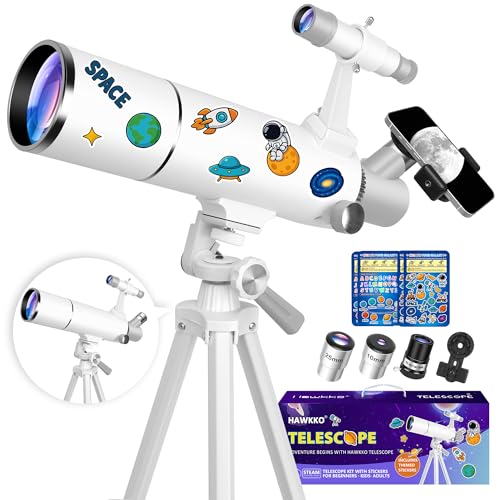
Hawkko 80mm Aperture 500mm Telescope for Kids 8-12 & Adults Beginners | Astronomical Refractor Telescope Kit for Beginners with Decorate Stickers, AZ Tripod, Phone Adapter
As an Amazon Associate we earn from qualifying purchases. Product prices and availability are accurate as of the date/time indicated.

Gskyer Telescope, 70mm Aperture 400mm AZ Mount Astronomical Refracting Telescope for Kids Beginners - Travel Telescope with Carry Bag, Phone Adapter and Wireless Remote.
As an Amazon Associate we earn from qualifying purchases. Product prices and availability are accurate as of the date/time indicated.

Telescope for Kids, 50mm 100x Silver Beginner Telescope with Tripod | 2 Eyepieces, Finder Scope, Moon Observation Guide, STEM Astronomy Fun, Educational Toy Gift for Boys & Girls Ages 6-12
As an Amazon Associate we earn from qualifying purchases. Product prices and availability are accurate as of the date/time indicated.
Prices shown are approximate and for reference only. Prices change often, so please check the current price on Amazon before you buy.
Types, apertures, mounts, and provisions are each maker’s stated details for the current version and pattern; never observe the Sun without a proper front solar filter fitted as its maker directs. Ratings are editorial for beginners: the mount’s stillness first, the optics’ honest parish, the eyepieces in the box, a finder a first night can succeed with, and value per night carried out.
Detailed Reviews: Best Telescope Starter Kit for Beginners Picks
1. Orion StarBlast – Best Overall
Orion’s tabletop parish takes the overall rating as the beginner’s reference citizen in its line: a steady base, an honest mirror, and a first night that succeeds, the hobby’s whole future decided correctly in one evening.
Set on its table, it earns its place outright.
2. Sky-Watcher Heritage – Best Portable Parish
Sky-Watcher’s parish folds its sentence in its line for the household whose sky is a journey away, a real mirror’s parish in a carried citizen.
For the travelling beginner, it stands.
3. Celestron StarSense Explorer – Best Finding Parish
Celestron’s guided parish marries a phone’s parish in its line to the finding problem, for the beginner whose garden sky offers few landmarks and whose enthusiasm deserves a guide.
Within its guidance, it earns its place.
4. Zhumell Tabletops – Best Value Parish
Zhumell’s parish brings the tabletop doctrine in its line at a value’s figure, its mount’s stillness rehearsed by the shake test like any row’s.
For the value, it is soundly placed.
5. Celestron AstroMaster – Best Refractor Parish
Celestron’s refractor parish serves the Moon-and-planets beginner in its line with a sealed tube’s quiet keeping, its mount graded by the rehearsal’s hand before the season trusts it.
For that beginner, it is soundly placed.
6. Orion SkyScanner – Best Lightest Parish
Orion’s lightest parish closes the table in its line for the smallest households and the youngest observers, a first citizen whose whole virtue is being carried out nightly.
As the lightest row, it completes the table.
Buying Guide: How to Choose the Best Telescope Starter Kit for Beginners
The Beginner’s Audit: Ground Named, Mount Shaken, the First Month Planned
Write the audit’s five facts before a listing is opened. The ground: the garden or the journey named honestly, its sky, its surface for a tabletop’s parish or a tripod’s, its storage in the house’s dry parish, a scope bought for a sky the household does not have being the parish’s saddest citizen. The mount: chosen as the purchase itself, tabletop or simple alt-azimuth as the default sentences, an equatorial parish bought only with its curriculum accepted in writing in the diary. The shake test, scheduled in a shop or on a doorstep inside a returns window: the scope assembled, a distant citizen centred, the tube tapped lightly, the image’s settling counted in seconds and in temper, a parish still dancing at the count of five being exchanged on that evidence however bright its mirror. The eyepieces: the box’s citizens counted as a starting parish, two honest ones and a finding citizen preferred to a case of ornaments, a later eyepiece’s road confirmed in the maker’s parish. And the first month, planned as four nights with the Moon at their head, the finder’s liturgy and the notebook bought in the same order, because a starter telescope, like a zero in this site’s rifle guides, is a property evidenced, and its evidence is a first night that succeeds. Order against the five, and let a kit whose headline is a magnification be refused on that evidence alone, the figure being a confession.
Spend by the sky’s priorities, which are the guide’s: the mount’s stillness first, as the telescope itself; aperture second, in its honest parish; the finder third, as the first night’s; the eyepieces fourth, as a starting parish; and a magnification headline never, a number measured against no sky wearing an astronomy’s clothes. Refuse, in the same pass, the parish’s two frauds: the wobbly equatorial monument, a curriculum sold as a shortcut, and the accessory mountain, a box of citizens that magnify, colour, and erect, eleven ornaments deep and no steady parish among them, because a beginner’s sky, like a range in this site’s guides, is graded by its decisive moment, a still planet at a child’s eye in the first week, and that moment belongs, by doctrine, to a mount that disappears.
Keeping the Scope: Caps, Collimation, and the Night Diary
Maintain the scope as an optic with a season’s liturgy from this site’s keeping coverage. Its caps live on it, its glass meets only the small kit, blown before a cloth and seldom, its tube is stored dry and temperate in its parish, a cold night’s citizen rested in its closed case while it warms. A reflector’s collimation is learned from its maker’s documents and read at the season, a parish of minutes that its owner comes to regard as the instrument’s handshake. Its mount’s citizens are read with it, a loosening parish answered at the bench.
Keep the record as the night diary, scope and its citizens, targets and their eyepieces by date, so the second season opens from a document and a successor scope is specified by a sky actually observed. Do that, the mount steady, the Moon first, the Sun never without its filter, and the best telescope starter kit for beginners becomes what its buyer wanted from a first instrument: a garden, a still image, a child’s question answered by looking, and a hobby with a second night in it, which is the whole of what it was for.
Frequently Asked Questions About the Best Telescope Starter Kit for Beginners
What is the best telescope starter kit for beginners?
Orion’s StarBlast parish overall, a steady tabletop mount under an honest mirror, with Sky-Watcher’s Heritage the portable’s, Celestron’s StarSense the finding’s, Zhumell’s tabletops the value’s, Celestron’s AstroMaster the sealed refractor’s, and Orion’s SkyScanner the lightest sentence. Fit yours by the beginner’s audit in this guide: your ground and its sky named, a tabletop’s surface or a tripod’s; the mount chosen as the purchase, simple parishes by default and an equatorial only with its curriculum accepted; the shake test performed in a shop or inside a returns window, the image’s settling counted; the box’s eyepieces counted as a starting parish; and a first month planned, daylight setup, the finder’s liturgy, the Moon at its head, because a starter scope is graded by its first night, and that grade is rehearsed in daylight or collected in the dark.
How much magnification does a beginner telescope need?
Far less than its box will claim, and the honest parish is set by the aperture and the air rather than by the marketing. A beginner’s real citizens, the Moon’s surface, the planets’ discs and their moons, the bright clusters and nebulae, are served at the modest magnifications the included eyepieces honestly provide, the image growing dimmer, shakier, and emptier as magnification climbs past what the mirror or lens gathers and what the garden’s air holds still, a large trembling planet teaching less than a small steady one at every age. The discipline is the golden rule in this guide: find every target at the lowest parish, centre it, and only then climb one eyepiece at a time, stopping where the image stops improving, a sentence the sky itself delivers nightly. Judge any kit by its mount and its aperture, let its magnification figures be read as the parish’s known fiction, and spend the difference, where a choice offers it, on stillness, since a beginner is not buying power; a beginner is buying the Moon, held still, at a child’s eye level.
Is a reflector or a refractor better for a beginner?
The one on the steadier mount, the two parishes dividing by keeping and by citizens rather than by rank. A reflector gathers the larger sky for its figure, its tabletop citizens topping this table on exactly that arithmetic, and asks one keeping sentence in return, a collimation learned from its maker’s documents and read at the season, a liturgy this guide grades as the hobby’s first honest skill. A refractor answers with a sealed tube that asks almost nothing, its citizens, the Moon and the planets, served in a bright, contrasty parish, its taxes a smaller gathering at the same figure and a mount whose quality must be rehearsed, the refractor rows in this table spanning the honest and the trembling at figures a shopper cannot separate without the shake test. Decide by your household: a family that will learn one liturgy buys the mirror’s sky; a household that wants the tube to disappear buys the sealed parish, on the steadiest mount its figure allows, since in both parishes the mount, and not the glass’s arrangement, is what the first night will actually grade.
What should a beginner look at first with a new telescope?
The Moon, and the reasons are a pedagogy rather than a preference. It is the one citizen a beginner’s finder cannot miss, bright enough to forgive a garden’s sky and a first night’s every sentence except impatience, and detailed enough to reward a steady mount at each eyepiece in the box, craters along its shadow line teaching the eye its trade in a single evening. Begin wide, the whole disc in the lowest parish, and climb as the golden rule directs, watching the image’s stillness as much as its size, the mount’s grade being delivered by the Moon more honestly than by any shop’s test. The planets follow as their seasons present them, a disc and its moons being the second lesson, then the bright clusters as the diary grows. Every night is logged, target, eyepiece, and the sky’s manners, and every night begins with the finder’s liturgy where the setup has moved. And the parish’s one law rides over all of it, printed here a final time: the Sun is never an object for this instrument without a proper front solar filter fitted as its maker directs, the Moon’s classroom having no need of a dangerous annex.
Related guides
- Best Premium Telescopes for Rainy Weather in 2026: Sealed Refractors and Weather-Resistant Systems for Damp Climates, Dew, and Coastal Air
- Best Binoculars for Shaky Hands Stability in 2026: 7 Binoculars That Offer Image Stabilization, Clear Views, and Reliable Performance for Shaky Hands Stability
- Observing Chair Pros and Cons Guide in 2026: Observing Chair Pros and Cons Guide
- Best Telescope Storage Box for Home in 2026: 7 Boxes That Offer Strong Protection, Large Storage, and Reliable Performance for Telescope Storage at Home
More from Amazon
Programs that pair well with the guide above. Offers and eligibility are set by Amazon and may change.
Free shipping on eligible items, Prime Video and more. Eligible new members can start with a free trial.
Start a Prime free trialAudiobooks and podcasts to listen to on the go. Eligible new members can start with a free trial.
Try Audible freeAd-free music streaming. Eligible new subscribers can start with a free trial.
Try Music Unlimited freeA free business account with business pricing and bulk-buying tools for work, shop or home office.
Create a business accountAs an Amazon Associate we earn from qualifying purchases.


Write Your Review
No reviews yet. Be the first to share your experience!