
What's inside
As an Amazon Associate I earn from qualifying purchases. This post may contain affiliate links at no extra cost to you.
A telescope for eclipse viewing safety is not the same as a telescope for night viewing. A telescope for an eclipse must be used with a front solar filter that covers the full aperture, it must never be used without that filter, and it must never be used with an eyepiece solar filter, because a front filter blocks sunlight before it enters a telescope, while an eyepiece filter can crack from heat and let sunlight through. A telescope that is perfect for the Moon can be dangerous for the Sun if it is used without a front solar filter, and a telescope that is perfect for a galaxy can be wrong for an eclipse if its mount is too shaky to track the Sun safely.
For most eclipse viewers, the practical pick is the Celestron NexStar 6SE. It has an aperture of 6 inches, a focal length of 1500mm, a GoTo mount, and a design that can track the Sun once it is aligned, and it is large enough to show the Sun clearly, but small enough to set up in an open area. A telescope for eclipse viewing safety must have a front solar filter that is made for its exact aperture, it must be checked for damage before every use, and it must be removed only after totality, if totality occurs, and only in a total solar eclipse, and it must be put back on before totality ends.
This guide compares seven real, currently sold telescopes for eclipse viewing safety. It explains how to judge aperture, mount, solar filter, and magnification, and it covers the practical rules that matter for eclipse safety — front filter only, never look at the Sun through any optic without a front solar filter, and why a telescope for an eclipse needs a stable mount in an open area.
Our Top Picks
 Celestron EclipSmart 8" Solar Safe Eclipse Telescope Filter8" SCT/EdgeHD9.75 x 9.75 x 2 inches0.25 poundsCheck on Amazon
Best Telescope for Eclipse Viewing Safety Compared
Use this table to compare aperture, focal length, mount, and price at a glance. Safety is the gate: a telescope for eclipse viewing safety must be used only with a front solar filter that covers the full aperture, and it must never be used without that filter.
| Model | Key Specs | Best For |
|---|---|---|
| Celestron NexStar 6SE | 6 in aperture, 1500mm focal, GoTo mount, for eclipse | Best overall telescope for eclipse viewing safety |
| Celestron NexStar 8SE | 8 in aperture, 2032mm focal, GoTo mount, for eclipse | Best 8-inch telescope for eclipse viewing safety |
| Celestron NexStar 4SE | 4 in aperture, 1325mm focal, GoTo mount, for eclipse | Best 4-inch telescope for eclipse viewing safety |
| Celestron AstroMaster 130EQ | 5.1 in aperture, 650mm focal, equatorial mount | Best budget telescope for eclipse viewing safety |
| Celestron Travel Scope 70 | 70mm aperture, 400mm focal, alt-az mount, portable | Best portable telescope for eclipse viewing safety |
| Sky-Watcher Classic 200P Dobsonian | 8 in aperture, 1200mm focal, Dobsonian mount | Best Dobsonian telescope for eclipse viewing safety |
| ZWO Seestar S50 Pro | 50mm aperture, smart telescope, for solar imaging | Best smart telescope for eclipse viewing safety |
Celestron EclipSmart 8" Solar Safe Eclipse Telescope Filter – ISO Compliant | ISO 12312-2 Compliant, 8" Schmidt-Cassegrain/EdgeHD Compatible, Observe Eclipses & Sunspots, Secure Fit, Natural Orange Tint


As an Amazon Associate we earn from qualifying purchases. Product prices and availability are accurate as of the date/time indicated.

UncleHu Telescope for Adults & Kids 8-12, 80mm FMC Refractor for Beginners | 400mm Astronomy Telescope for Moon Viewing & Landscape Exploration, DIY Stickers, STEM Gift for Girls & Boys - White Blue

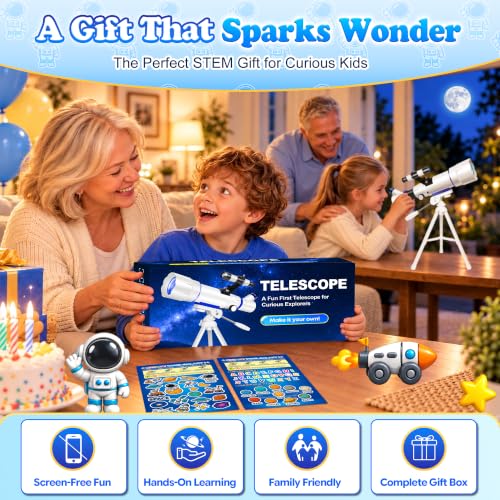


As an Amazon Associate we earn from qualifying purchases. Product prices and availability are accurate as of the date/time indicated.
Best Telescope for Eclipse Viewing Safety in 2026: Detailed Reviews
1. Celestron NexStar 6SE — Best Telescope for Eclipse Viewing Safety Overall
The Celestron NexStar 6SE is the best all-rounder in this list because it does the eclipse job well: it has an aperture of 6 inches, a focal length of 1500mm, a GoTo mount that can track the Sun once it is aligned, and a design that is large enough to show the Sun clearly, but small enough to set up in an open area. A front solar filter must be bought for the exact aperture, and it must cover the full aperture, with no gaps, and it must be checked for damage before every use.
Max useful magnification is about 50 times per inch of aperture, so a 6-inch telescope has a max useful magnification of about 300 times, a 4-inch telescope has a max useful magnification of about 200 times, and an 8-inch telescope has a max useful magnification of about 400 times. For an eclipse, a low magnification is best, because the Sun is large, and a low magnification shows the whole Sun, while a high magnification shows only part of the Sun. A NexStar 6SE with a 25mm eyepiece gives a magnification of 60 times, which is enough to see the Sun clearly, and a 10mm eyepiece gives a magnification of 150 times, which is enough to see sunspots.
A telescope for eclipse viewing safety must never be used without a front solar filter, and it must never be used with an eyepiece solar filter, because an eyepiece filter can crack from heat and let sunlight through, while a front filter blocks sunlight before it enters a telescope. A front solar filter must be made for solar viewing, it must meet ISO 12312-2 for eclipse glasses and filters, and it must be checked for scratches, holes, or damage before every use — if it is damaged, do not use it. And a telescope for an eclipse must be set up in an open area, with no trees blocking the sky, because an eclipse is in the sky, and a tree that blocks the Sun will block the eclipse.
2. Celestron NexStar 8SE — Best 8-Inch Telescope for Eclipse Viewing Safety
It has an aperture of 8 inches, a focal length of 2032mm, a GoTo mount, and a design that is larger than a NexStar 6SE, so it shows the Sun more clearly, but it is heavier and harder to set up. It is the 8-inch entry in this list, and it is the right pick if you want a Celestron, you want an 8-inch aperture, and you want the clearest solar view.
The NexStar 8SE has a max useful magnification of about 400 times, because it has an aperture of 8 inches, and 8 times 50 is 400. For an eclipse, a low magnification is best, so a NexStar 8SE with a 25mm eyepiece gives a magnification of about 81 times, which is enough to see the Sun clearly. It is a good pick if you want a Celestron, you want an 8-inch aperture, and you are willing to pay more than a NexStar 6SE. It is not the best pick if you want a portable telescope — a Travel Scope 70 is more portable — or if you want a budget telescope, because a NexStar 8SE is the most expensive telescope in this list.
3. Celestron NexStar 4SE — Best 4-Inch Telescope for Eclipse Viewing Safety
It has an aperture of 4 inches, a focal length of 1325mm, a GoTo mount, and a design that is smaller than a NexStar 6SE, so it is easier to set up, but it shows the Sun less clearly. It is the 4-inch entry in this list, and it is the right pick if you want a Celestron, you want a GoTo mount, and you want a cheaper telescope than a NexStar 6SE.
The NexStar 4SE has a max useful magnification of about 200 times, because it has an aperture of 4 inches, and 4 times 50 is 200. For an eclipse, a NexStar 4SE with a 25mm eyepiece gives a magnification of about 53 times, which is enough to see the Sun clearly. It is a good pick if you want a Celestron, you want a GoTo mount, and you are on a budget. It is not the best pick if you want the clearest solar view — a NexStar 6SE is clearer — or if you want a Dobsonian mount, because a NexStar 4SE has a GoTo mount, not a Dobsonian mount.
4. Celestron AstroMaster 130EQ — Best Budget Telescope for Eclipse Viewing Safety
It has an aperture of 5.1 inches, a focal length of 650mm, an equatorial mount, and a design that is made for beginners. It is the budget entry in this list, and it is the right pick if you want a Celestron, you want a budget telescope, and you want an equatorial mount. Celestron makes telescopes for beginners, and its AstroMaster 130EQ is its best budget telescope for an eclipse, with an aperture that is large enough to show the Sun clearly.
The AstroMaster 130EQ has an equatorial mount, which is more complex than an alt-az mount, because it needs polar alignment for imaging, but it can track the Sun once it is aligned. It is a good pick if you want a Celestron, you want a budget telescope, and you are willing to learn an equatorial mount. It is not the best pick if you want a GoTo mount — an AstroMaster 130EQ does not have GoTo — or if you want a portable telescope, because an AstroMaster 130EQ is larger than a Travel Scope 70.
5. Celestron Travel Scope 70 — Best Portable Telescope for Eclipse Viewing Safety
It has an aperture of 70mm, a focal length of 400mm, an alt-az mount, and a design that weighs about 3 pounds, making it the most portable telescope in this list. It is the portable entry in this list, and it is the right pick if you want a Celestron, you want a portable telescope, and you want a telescope that fits in a backpack for an eclipse trip.
The Travel Scope 70 has a max useful magnification of about 140 times, because it has an aperture of about 2.8 inches, and 2.8 times 50 is 140. For an eclipse, a Travel Scope 70 with a 20mm eyepiece gives a magnification of 20 times, which is enough to see the Sun clearly, and it is a good pick for a beginner, for a student, or for a traveller. It is not the best pick if you want the clearest solar view — a NexStar 6SE is clearer — or if you want a GoTo mount, because a Travel Scope 70 has a manual alt-az mount, not a GoTo mount.
6. Sky-Watcher Classic 200P Dobsonian — Best Dobsonian Telescope for Eclipse Viewing Safety
It has an aperture of 8 inches, a focal length of 1200mm, a Dobsonian mount, and a design that is stable on the ground. It is the Dobsonian entry in this list, and it is the right pick if you want a Sky-Watcher, you want a Dobsonian mount, and you want a stable telescope for an eclipse. A Dobsonian mount is an alt-az mount on the ground, it is stable, and it is easy to use, because it moves up and down and left and right, without polar alignment.
The Classic 200P has a max useful magnification of about 400 times, because it has an aperture of 8 inches, and it is a good pick if you want a Dobsonian, you want an 8-inch aperture, and you are willing to move it manually, because a Dobsonian does not track the Sun automatically — you must move it by hand to follow the Sun. It is not the best pick if you want a GoTo mount — a Classic 200P does not have GoTo — or if you want a portable telescope, because a Dobsonian is large and heavy.
7. ZWO Seestar S50 Pro — Best Smart Telescope for Eclipse Viewing Safety
It is the smart entry in this list, and it is the right pick if you want a smart telescope, you want to image an eclipse on a phone, and you want a telescope that does not need an eyepiece. A smart telescope like a Seestar S50 Pro has a camera inside, so you view an eclipse on a phone screen, not through an eyepiece, which is safer, because you never look at the Sun through an optic.
The Seestar S50 Pro has a solar filter that is included, and it is a good pick if you want a smart telescope, you want to image an eclipse, and you do not want to look through an eyepiece. It is not the best pick if you want a traditional telescope with an eyepiece, or if you want a large aperture, because a Seestar S50 Pro has an aperture of only 50mm. Note: the original ZWO Seestar S50 was replaced by the S50 Pro, so check the listing for the Pro model before you buy.
Best Telescope for Eclipse Viewing Safety Buying Guide
Choosing a telescope for eclipse viewing safety is not just about picking the largest aperture. It is about matching front solar filter, mount, magnification, and location to the eclipse, the Sun, and the way you will view it. A telescope that is perfect for the Moon can be dangerous for the Sun if it is used without a front solar filter, and a telescope that is perfect for a galaxy can be wrong for an eclipse if its mount is too shaky to track the Sun.
Front Solar Filter, ISO 12312-2, and Never Look Without a Filter: Choosing a Telescope for Eclipse Viewing Safety That Is Safe
Front solar filter is the first filter, and it is safety for an eclipse. A telescope for eclipse viewing safety must be used only with a front solar filter that covers the full aperture, it must never be used without that filter, and it must never be used with an eyepiece solar filter, because an eyepiece filter can crack from heat and let sunlight through, while a front filter blocks sunlight before it enters a telescope. A front solar filter must be made for solar viewing, it must meet ISO 12312-2 for eclipse glasses and filters, and it must be checked for scratches, holes, or damage before every use — if it is damaged, do not use it.
A telescope for an eclipse must never be pointed at the Sun without a front solar filter, and it must never be used to look at the Sun through an eyepiece, a finder scope, or a camera viewfinder without a front solar filter. A finder scope must also have a front solar filter, or it must be covered, because a finder scope without a filter can let sunlight through and damage an eye. And eclipse glasses are required for looking at the Sun without a telescope, because eclipse glasses block sunlight, while sunglasses do not — sunglasses are not safe for looking at the Sun, and they must never be used for an eclipse. And a front solar filter must be removed only after totality, if totality occurs, and only in a total solar eclipse, and it must be put back on before totality ends, because the Sun reappears after totality and it is dangerous again.
Aperture, Magnification, and Mount: Choosing a Telescope for Eclipse Viewing Safety That Shows the Sun Clearly
Aperture, magnification, and mount are the second filter. A telescope for an eclipse should have an aperture of at least 70mm, because a smaller aperture will not show the Sun clearly, and an aperture of 6 inches is best for most viewers, because it is large enough to show the Sun clearly, but small enough to set up in an open area. Max useful magnification is about 50 times per inch of aperture, so a 6-inch telescope has a max useful magnification of about 300 times, and a 4-inch telescope has a max useful magnification of about 200 times. For an eclipse, a low magnification is best, because the Sun is large, and a low magnification shows the whole Sun, while a high magnification shows only part of the Sun.
A telescope for an eclipse should have a mount that is stable, because a shaky mount will make the Sun move in the eyepiece, and it will be hard to track. An alt-az mount is easiest for an eclipse, because it moves up and down and left and right, without polar alignment, and a GoTo mount is best for tracking the Sun, because it can track the Sun once it is aligned. A Dobsonian mount is stable on the ground, but it does not track automatically, so you must move it by hand to follow the Sun. And a telescope for an eclipse must be set up in an open area, with no trees blocking the sky, because an eclipse is in the sky, and a tree that blocks the Sun will block the eclipse.
Location, Red Light, and Practice: Using a Telescope for Eclipse Viewing Safety on Eclipse Day
Location, red light, and practice are the third filter. A telescope for an eclipse should be set up in an open area, with a clear view of the sky, and it should be set up at least an hour before the eclipse, so you have time to align it, check the front solar filter, and practice tracking the Sun. A telescope should be practiced with the Sun before eclipse day, with a front solar filter on, so you know how to find the Sun, how to focus it, and how to track it, before the eclipse starts.
A telescope for an eclipse should be used with a red light only at night, because a red light will not ruin night vision, while a white light will, and it should be used with eclipse glasses for looking at the Sun without a telescope. And a telescope for an eclipse should be cleaned with a brush and a blower first, never wipe a dirty lens, because dust on a lens will scratch it if it is wiped, and a lens should be cleaned with a clean microfibre cloth only, with fluid on a cloth never on a lens, in a circular motion from the centre out with light pressure. And a telescope for an eclipse should be stored in a cool, dry place, with a front solar filter that is not exposed to sunlight, because a filter that is exposed to sunlight will fade.
Best Telescope for Eclipse Viewing Safety FAQ
What is the best telescope for eclipse viewing safety?
A telescope for an eclipse must be used only with a front solar filter.
Can I look at the Sun through a telescope without a solar filter?
No, you must never look at the Sun through a telescope, a binocular, or any optic without a front solar filter that covers the full aperture, because sunlight through a telescope can damage an eye in seconds, and it can cause permanent blindness. A telescope for eclipse viewing safety must be used only with a front solar filter that is made for solar viewing, it must meet ISO 12312-2, and it must be checked for damage before every use. You must never use an eyepiece solar filter, because it can crack from heat and let sunlight through, and you must never use sunglasses to look at the Sun, because sunglasses do not block enough sunlight.
What solar filter do I need for a telescope for eclipse viewing?
For a telescope for eclipse viewing, you need a front solar filter that covers the full aperture, it must be made for your exact aperture, and it must meet ISO 12312-2 for eclipse glasses and filters. A front solar filter must be checked for scratches, holes, or damage before every use — if it is damaged, do not use it. A finder scope must also have a front solar filter, or it must be covered.
When can I remove the solar filter during a total solar eclipse?
For a total solar eclipse, you can remove the front solar filter only after totality begins, when the Sun is completely covered by the Moon, and only during totality, and you must put the front solar filter back on before totality ends, because the Sun reappears after totality and it is dangerous again. For a partial solar eclipse, you must never remove the front solar filter, because the Sun is never completely covered, and it is dangerous at all times. Eclipse glasses are required for looking at the Sun without a telescope, and they must be removed only during totality in a total solar eclipse, and put back on before totality ends.
FAQ
What is the best telescope for eclipse viewing safety?
Can I look at the Sun through a telescope without a solar filter?
What solar filter do I need for a telescope for eclipse viewing?
When can I remove the solar filter during a total solar eclipse?
Related guides
- Best Optics for Beginners Winter Use in 2026: Fogproof Binoculars Graded on the Cold Transition — Warm Car to Frozen Field Without Losing the View
- Best Cell Phone Monocular in 2026: 7 Best Cell Phone Monoculars With Clear View, Simple Use, and Easy Use for Cell Phone Monocular
- Best Monocular for Glasses Wearers Comfort in 2026: Monocular for Glasses Wearers Comfort, Glasses Wearers Monoculars, and Best Comfortable Monoculars for Glasses Wearers
- Best Binoculars for Camping Trips Viewing in 2026: 7 Binoculars for Camping Trips Viewing That Offer Clear Optics, Easy Carry, and Reliable Performance for Camping
More from Amazon
Programs that pair well with the guide above. Offers and eligibility are set by Amazon and may change.
Free shipping on eligible items, Prime Video and more. Eligible new members can start with a free trial.
Start a Prime free trialAudiobooks and podcasts to listen to on the go. Eligible new members can start with a free trial.
Try Audible freeAd-free music streaming. Eligible new subscribers can start with a free trial.
Try Music Unlimited freeA free business account with business pricing and bulk-buying tools for work, shop or home office.
Create a business accountAs an Amazon Associate we earn from qualifying purchases.

Write Your Review
No reviews yet. Be the first to share your experience!