
What's inside
- What Makes the Best Binoculars for Birding with Glasses Different
- Quick Comparison: Best Binoculars for Birding with Glasses Models
- Detailed Reviews: Best Binoculars for Birding with Glasses Picks
- Buying Guide: How to Choose the Best Binoculars for Birding with Glasses
- Frequently Asked Questions About Best Binoculars for Birding with Glasses
As an Amazon Associate I earn from qualifying purchases. This post may contain affiliate links at no extra cost to you.
The best binoculars for birding with glasses are decided by a specification most buyers never learn until it has already ruined a morning: eye relief. A binocular forms its image at a precise distance behind the eyepiece, a point in space where the eye’s pupil must sit to see the whole field of view, edge to edge, without black shadows crowding in. A naked eye can press close and find that point easily. An eye behind glasses sits the thickness of a frame and the depth of a lens further back, and if the binocular’s eye relief — the distance it can project that point, quoted in millimetres in every maker’s specification — is shorter than the glasses demand, the wearer sees a tunnel: a bright centre, a vignetted edge, and the warbler that was in the field’s corner, theoretically, in a part of the view the glasses never let them reach. Lifting the glasses to the forehead for every bird is the amateur’s penance, slow, fogging, and fatal to the fast identifications birding is made of. Keeping them on, with a binocular whose eye relief is generous and whose eyecups retract to honour it, is the professional’s arrangement, and it is available at every price in this table. The glasses-wearing birder does not need a special binocular. They need a correct one, and correctness, in this category, is a number plus a mechanism, both of which this guide teaches you to verify before money moves.
This guide compares real, currently sold binoculars from Vortex, Nikon, Zeiss, Swarovski, and Celestron across the prices birding actually pays, in the 8×42 class that is the discipline’s centre — 8 magnification for a steady, wide view, 42mm objectives for the dawn and woodland light birds keep — with the 10x and compact edges noted where they matter. Each model is graded for the glasses wearer first: its stated eye relief, the design of its eyecups, because a generous figure is only delivered by an eyecup that twists down fully and stays where it is put, and the field of view that remains visible when it does. Around that core stand birding’s ordinary virtues, graded as usual: optical clarity and colour honesty for identification, close focus for the butterfly and the near warbler, weight and handling for a day in the field, and weather sealing for the climate birds prefer. The method matters more than the models, and the buying guide gives it in full: bring your own glasses, the pair you bird in, to the test; retract the eyecups completely; and judge the field’s edge with your own eyes, because eye relief interacts with your frames, your face, and your eyes’ own geometry in ways no specification fully predicts. Identify birds, never the sun — a binocular must never be pointed at or near the sun, with or without glasses, as this site states in every optics guide it publishes. Buy the binocular your glasses vote for, and the vote, once cast, holds for a decade of mornings.
Our Top Picks
What Makes the Best Binoculars for Birding with Glasses Different
Eye Relief: The Number, the Mechanism, and the Test
Eye relief is quoted in millimetres, measured from the eyepiece’s last surface to the point where the full field is visible, and the glasses wearer’s working rule is simple to state: look for the high teens and upward, because a spectacle lens holds the eye roughly that far behind where a naked eye would rest, and a binocular whose relief meets or exceeds the demand delivers the whole field with the eyecups retracted. Figures in the 17 to 20mm region in this table are the comfortable classes; figures toward 15mm serve some wearers, with some frames, and disappoint others, which is why the number is a filter and not a verdict. The mechanism is the number’s delivery system. Twist-up eyecups, the standard across this table’s serious rows, retract in stages to set the eye at the relief the maker designed: fully down for glasses, extended for the naked eye, with intermediate stops that some faces and some sunglasses prefer. An eyecup that retracts only partway spends the relief it advertises; one that will not stay retracted under a brow’s pressure spends it hourly; and the old rubber fold-down cups of the budget’s older school spend it in a fortnight, as the rubber perishes into a permanent half-measure. Dioptre adjustment completes the glasses wearer’s fitting: the ring, usually on the right eyepiece, that compensates for the difference between the wearer’s eyes, set once with the glasses on, by the method the buying guide gives, so that both eyes arrive at the same focus and the centre wheel serves the pair. Test all of it as one act, in the shop, with your birding glasses: eyecups fully down, binocular raised, and the field’s edge inspected for the black crescent that confesses a shortage — then the same test at the eyecups’ first stop, because some wearers and some deep-set frames find their point one click up, and a binocular that offers the choice is a binocular that fits more faces than its figure promises.
The 8×42 Centre and the Glasses Wearer’s Other Specifications
Beyond relief, the glasses wearer’s binocular is a birder’s binocular, and its specifications follow the discipline’s settled logic with two adjustments for the eyepiece’s audience. Magnification stays at 8 for most: the wider field of view forgives the glasses wearer’s slightly slower acquisition, the image stays steadier across a long day, and the exit pupil — the objective divided by the magnification, 5.25mm in an 8×42 — is generous in the dawn light where birds and birders both start work. The 10×42 serves the open-country and shorebird birder whose distances are longer, at the cost of field and steadiness, and its eye relief must be checked with extra care because higher-power designs historically spend relief more grudgingly. Field of view itself is the glasses wearer’s second number: a wide stated field is only a gift if the relief lets you see its edges, so the two figures are read together, and a slightly narrower field fully visible beats a panoramic one whose corners live behind a vignette. Close focus, in the makers’ stated terms toward two metres in the better rows, matters to the naturalist whole rather than the birder narrowly, and costs the glasses wearer nothing. Weight and eyecup diameter close the fitting: a heavy binocular presses glasses into the face across a day in a way a naked-eye user never learns, which argues for the table’s lighter classes or a harness that takes the weight to the shoulders; and small-diameter eyecups suit small frames and small faces, a fit detail the shop test settles in seconds. Waterproofing and fogproofing, in the makers’ stated sealing and nitrogen terms, are the field’s standing requirement, with the glasses wearer’s footnote that a fogged spectacle lens, not a fogged binocular, is their usual morning enemy, answered by the cloth in the pocket and the binocular held away from a warm face in cold air for the first minutes out.
Sunglasses, Prescription Variety, and the Honest Alternatives
The glasses in the title are a family, not a pair, and the guide should speak to its members. Ordinary prescription glasses are the standard case the whole table serves. Sunglasses, prescription and otherwise, add depth and frame between eye and eyepiece and ask the same relief with a little more suspicion, and the birding answer is the same test performed in the shades you actually wear in the field, because a frame’s geometry is a specification no chart carries. Progressive and bifocal wearers meet a subtler problem: the binocular meets the lens at whatever zone the head’s angle chooses, and most progressives users bird through their distance zone with the binocular set by the dioptre for that zone, a fitting the shop test reveals immediately and a knowledgeable optician can discuss with the prescription in hand. Contact lens wearers are, optically, naked-eye users, and the eyecups go up and the relief requirement relaxes to the table’s ordinary figures. The honest alternatives deserve their paragraph for the wearer no binocular quite serves: some birders prefer to bird without glasses where their prescription allows the binocular’s own focus range and dioptre to correct their vision, an arrangement that works within limits the maker’s focus travel sets and fails where astigmatism, which binoculars cannot correct, is the prescription’s main author; others keep glasses on a cord, down for the binocular and up for the notebook, a rhythm older than the twist-up eyecup. All are respectable. The mainstream answer, and this guide’s, is the relief and the retracted eyecup, because it asks the birder to change nothing about how they see the world except the quality of the instrument they see the birds through.
Quick Comparison: Best Binoculars for Birding with Glasses Models
| Model | Format, Eye Relief and Key Specs | Best For |
|---|---|---|
| Vortex Viper HD 8×42 class | 8×42, eye relief toward 18mm class in maker’s terms, twist-up eyecups, HD optical system in maker’s terms, waterproof | Best binoculars for birding with glasses overall |
| Nikon Monarch M7 8×42 class | 8×42, eye relief toward 17mm plus class in maker’s terms, wide field positioning, ED glass in maker’s terms, locking dioptre in class | Best wide field for glasses wearers |
| Zeiss Conquest HD 8×42 class | 8×42, eye relief toward 18mm class in maker’s terms, premium glass, robust eyecup design in maker’s terms | Best premium step |
| Swarovski NL Pure 8×42 class | 8×42, eye relief toward 18mm class in maker’s terms, very wide field in maker’s terms, flagship optics | Best no-compromise flagship |
| Vortex Diamondback HD 8×42 class | 8×42, eye relief toward 17mm class in maker’s terms, twist-up eyecups, strong value, waterproof | Best value for glasses wearers |
| Celestron Nature DX ED 8×42 class | 8×42, eye relief in maker’s terms, ED glass positioning, budget pricing | Best budget entry |

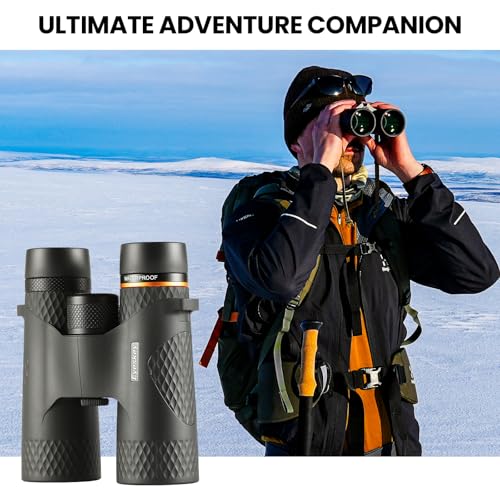
Eyeskey Whisper 10x42 Binoculars for Adults - ED Glass Birding Binoculars with Phone Adapter, Lightweight & Waterproof for Backyard Birding, Migration Watching



As an Amazon Associate we earn from qualifying purchases. Product prices and availability are accurate as of the date/time indicated.

Sogries 12x50 Binoculars for Adults High Power Premium ED Glass Waterproof | Bird Watching Binoculars for Alaska Cruise Ship Travel Birding Whale Watching Clear Low Light Stargazing Long Range Powerful
As an Amazon Associate we earn from qualifying purchases. Product prices and availability are accurate as of the date/time indicated.

8x42 ED Binoculars with BAK4 Prism - IPX7 Waterproof for Adults Birding | ED Glass Binoculars for Bird Watching - 23mm Eyepiece, 17.2mm Eye Relief for Glasses, IPX7 Waterproof with Phone Adapter
As an Amazon Associate we earn from qualifying purchases. Product prices and availability are accurate as of the date/time indicated.
Eye relief figures, fields of view, close focus distances, eyecup designs, dioptre arrangements, weights, and waterproof constructions are each maker’s stated details for the current version; eye relief interacts with the wearer’s own glasses, frames, and facial geometry, and must be verified by the in-hand test this guide describes, with the wearer’s own birding glasses, before purchase. Ratings are editorial for birding with glasses: delivered eye relief and eyecup quality, visible field with glasses, optical clarity and colour for identification, close focus, handling across a field day, weather build, and value in class.
Detailed Reviews: Best Binoculars for Birding with Glasses Picks
1. Vortex Viper HD 8×42 Class – Best Overall
The Viper HD is the glasses wearer’s reference at the serious-amateur price: eye relief in the comfortable class in its maker’s terms, eyecups that twist down fully and hold their stations like they were machined by someone who wears glasses, a field that arrives entire at the retracted setting, and glass whose clarity and colour serve identification at the dawn hour. Its warranty culture, the strongest in the table’s middle, insures a decade of field mornings. For the birder buying once and birding for years, with glasses, it is the answer this guide gives first and defends in the shop, with the test, against all comers.
2. Nikon Monarch M7 8×42 Class – Best Wide Field
The Monarch M7’s pitch is the view: a wide field in its maker’s positioning that, married to relief in the comfortable class, gives the glasses wearer the fullest picture in the table’s middle — the warbler found at the edge, the flock taken in whole — with ED glass in its terms for the colour fringing that identification hates, and a locking dioptre in its class that ends the pocket’s slow sabotage of a careful setting. Its handling is the modern Nikon’s, light and quick. For the wearer whose complaint has always been the tunnel, this is the tunnel’s opposite, at a price that respects the mortgage.
3. Zeiss Conquest HD 8×42 Class – Best Premium Step
The Conquest HD is the step into the flagship continent at its lowest pass: Zeiss glass with the contrast and colour authority the house is named for, relief in the comfortable class, and eyecups built with a solidity that makes the daily twist a pleasure rather than a negotiation. Its weight is the premium’s, felt across a day and answered by the harness this guide recommends to every glasses wearer whose binocular presses. For the birder whose eyes have begun to grade lesser glass and find it wanting, this is where the grading stops for a decade.
4. Swarovski NL Pure 8×42 Class – Best Flagship
The NL Pure is the field of view’s current outer limit in its maker’s terms, in a binocular whose relief serves the glasses wearer completely and whose ergonomics were drawn around a human hand and face with unusual honesty. Its price is the category’s ceiling and its performance is the reason the ceiling is there: a picture so wide and so clear that the glasses wearer, for the first time, may own more field than their naked-eye friends. It is bought by the birder for whom birding is a life’s central pleasure, and it repays them every morning, in the currency of birds seen whole.
5. Vortex Diamondback HD 8×42 Class – Best Value
The Diamondback HD is the value row that respects the glasses wearer rather than tolerating them: relief in the workable-to-comfortable class in its maker’s terms, proper twist-up eyecups, glass that embarrasses its price at the centre, and the house’s warranty behind a first serious binocular. Its edges soften where the Viper’s hold, as the money says they should. For the new birder with glasses, equipping completely — binocular, harness, field guide, the club membership that teaches the birds — within one budget, this is the row where the budget survives and the birding does not suffer.
6. Celestron Nature DX ED 8×42 Class – Best Budget
Tested and passed, it birds honestly for years. Tested and failed, the Diamondback above it is the shortest step up in the table, and the test, not the price, should cast that vote.
Buying Guide: How to Choose the Best Binoculars for Birding with Glasses
The Shop Test: Your Glasses, Your Face, the Field’s Edge
Buy this binocular in person, or on a returns policy you have read, because the decisive specification is an interaction and interactions are tested, not read. Take the glasses you bird in — and the sunglasses, if they are part of the field kit — and work the test as a routine. Eyecups fully retracted: raise the binocular, settle it against the glasses as you naturally would, and look not at the centre but at the field’s edges, left, right, top, bottom, hunting the black crescents and the kidney-bean shadows that confess the eye is too far back or off the axis. Work the eyecups up one stop and repeat, because your point may live there. Check the dioptre’s setting method and set it, glasses on, by the standard ritual: centre-focus the left eye alone with the right closed, then the right eye alone with the dioptre ring and the left closed, open both, and confirm the pair arrives together — then note whether the dioptre locks or drifts, because a setting that survives the pocket is a setting you make once. Handle the focus wheel with the gloves of your season if your birding has one, weigh the binocular against your neck across an imagined day, and price the harness that moves that weight to your shoulders in the same purchase. A binocular that passes your face’s test at a row above your budget is a better buy than a bargain that fails it, because the tunnel is paid for at every bird, forever, in the currency the whole purchase was for.
Set It Up Once, Then Bird for a Decade
Commission the binocular as an instrument fitted to one wearer. Set the interpupillary distance, the hinge, until the two fields merge into one circle without shadow, and note the scale’s reading where it is marked, because a borrowed-and-returned binocular can be reset in seconds from a number. Set the dioptre as above and, where it does not lock, check it in the morning routine as a pilot checks a gauge. Fit the eyecups to your glasses’ station and leave them there; fit the strap or, better, the harness, so the binocular rides at the chest’s height where a day’s weight is forgotten; keep the lens cloth in the pocket that your hand finds without looking, because glasses and objectives fog and smudge on the same mornings. In the field, hold the binocular to the glasses with a light, consistent contact rather than a press, let the brow and the frames share the steadiness, and clean both the spectacles and the eyepieces with the blower and the cloth, never a sleeve’s grit. Store the binocular dry, cased, with its caps, away from the car’s heat and the house’s dust, and never, on any morning, point it at or near the sun. Do all of that, and the best binoculars for birding with glasses become what their owners, glasses firmly on, report from a decade of dawn patrols: not an accommodation, not a compromise, just the binocular — the whole field, edge to edge, the bird in the corner found as fast as the bird in the centre, and the glasses, at last, treated by an instrument as what they are. Part of the birder, not a problem to be solved before the birding can start.
Frequently Asked Questions About Best Binoculars for Birding with Glasses
What are the best binoculars for birding with glasses?
The Vortex Viper HD 8×42 class is the best overall, the Nikon Monarch M7 the widest field, the Zeiss Conquest HD the premium step, the Swarovski NL Pure the flagship, the Vortex Diamondback HD the best value, and the Celestron Nature DX ED the budget door. The best for you is decided by delivered eye relief with your own glasses: look for stated relief in the high teens of millimetres and upward, eyecups that twist down fully and hold their position, and then prove the combination in hand, eyecups retracted, checking the field’s edges for black crescents with the glasses you actually bird in. A binocular that passes that test, in the 8×42 class for most birders, will serve for a decade. One that fails it, at any price or reputation, will tax every bird you ever look at through it.
How much eye relief do I need if I wear glasses?
As a working rule, look for stated eye relief in the region of 17mm and above, with the high teens and the figures toward 20mm being the comfortable classes for most spectacle wearers, because the glasses hold your eye roughly that far behind the point a naked eye would occupy. Treat the figure as a filter rather than a guarantee: frames vary in depth, faces vary in geometry, and some wearers see a full field at 16mm while others vignette at 18, which is why this guide’s shop test — your glasses, eyecups fully retracted, the field’s edges inspected — is the verdict and the specification is the shortlist. Eyecup design matters as much as the number: a twist-up cup that retracts completely delivers the relief its maker claims, while a partial or perishing fold-down design spends it. Buy the delivered relief, tested, not the printed figure, assumed.
Should glasses wearers choose 8x or 10x binoculars for birding?
Eight, for most, and the glasses strengthen the usual argument. An 8×42 offers the wider field, the steadier image across a long day, and the more generous exit pupil for dawn light, and its acquisition — finding the bird in the view — is kinder to a wearer whose eye sits behind a frame. A 10×42 serves the shore, the reservoir, and the open country where distances stretch, and its relief and field should be tested with extra care, because higher-power designs historically offer less of both. Whichever you choose, the test is the same and the glasses are present for it. Many glasses-wearing birders who own both find the 8x on their harness for nine mornings in ten, which is the discipline’s settled wisdom expressing itself one birder at a time.
Can I just take my glasses off and adjust the binocular instead?
Sometimes, within limits worth knowing. A binocular’s centre focus and dioptre can compensate for a good deal of ordinary short or long sight, so a wearer whose prescription is mainly spherical may focus the instrument to their naked eyes and bird comfortably, glasses parked on a cord. What a binocular cannot correct is astigmatism, which lives in the eye’s shape rather than its focus, so a prescription with a significant astigmatic component will never be fully sharp without the glasses, however the dials are set. The arrangement also costs the world between birds — the notebook, the companion’s pointed finger, the path — which the glasses-on birder never surrenders. Try it in the shop if you are curious, with the dioptre ritual performed naked-eye, and let your own vision grade it. For most wearers, the relief-and-eyecup answer in this guide is the better one, because it changes nothing about how you see everything else.
Related guides
- Best Optics for Beginners Winter Use in 2026: Fogproof Binoculars Graded on the Cold Transition — Warm Car to Frozen Field Without Losing the View
- Best Cell Phone Monocular in 2026: 7 Best Cell Phone Monoculars With Clear View, Simple Use, and Easy Use for Cell Phone Monocular
- Best Monocular for Glasses Wearers Comfort in 2026: Monocular for Glasses Wearers Comfort, Glasses Wearers Monoculars, and Best Comfortable Monoculars for Glasses Wearers
- Best Binoculars for Camping Trips Viewing in 2026: 7 Binoculars for Camping Trips Viewing That Offer Clear Optics, Easy Carry, and Reliable Performance for Camping
More from Amazon
Programs that pair well with the guide above. Offers and eligibility are set by Amazon and may change.
Free shipping on eligible items, Prime Video and more. Eligible new members can start with a free trial.
Start a Prime free trialAudiobooks and podcasts to listen to on the go. Eligible new members can start with a free trial.
Try Audible freeAd-free music streaming. Eligible new subscribers can start with a free trial.
Try Music Unlimited freeA free business account with business pricing and bulk-buying tools for work, shop or home office.
Create a business accountAs an Amazon Associate we earn from qualifying purchases.

Write Your Review
No reviews yet. Be the first to share your experience!