
What's inside
As an Amazon Associate I earn from qualifying purchases. This post may contain affiliate links at no extra cost to you.
A budget telescope for beginners astronomy is not the same as a telescope for an experienced astronomer. A beginner needs a telescope that is easy to set up, easy to point, and bright enough to show the Moon, Jupiter, Saturn, and a bright deep-sky object like the Orion Nebula, without needing polar alignment, a computer, or a degree in astronomy. A telescope that is too complicated will not be used, a telescope that is too small will not show enough, and a telescope that is too cheap will have a wobbly mount that makes it hard to see anything.
For most beginners, the practical pick is the Celestron AstroMaster 70AZ. It has a 70mm aperture, a 900mm focal length, an alt-az mount, and a maximum useful magnification of about 140x. Maximum useful magnification is about 50x per inch of aperture — a 70mm telescope is about 2.75 inches, so 50 times 2.75 is about 137x, or about 140x. A telescope that claims 675x magnification for a 70mm aperture is not useful, because the image will be dim and blurry at that magnification, and you should ignore the claimed magnification on the box.
This guide compares seven real, currently sold budget telescopes for beginners astronomy. It explains how to judge aperture, mount, magnification, and price, and it covers the practical rules that matter for a beginner — aperture gathers light, low power is best for galaxies, and why an alt-az mount is easier than an equatorial mount for a first telescope.
Our Top Picks
Best Budget Telescope for Beginners Astronomy Compared
Use this table to compare aperture, focal length, mount, and price at a glance. Aperture is the gate: a budget telescope for beginners astronomy should have an aperture of at least 70mm, because a smaller aperture will not gather enough light to show a planet clearly, and a larger aperture will gather more light and show more detail.
| Model | Key Specs | Best For |
|---|---|---|
| Celestron AstroMaster 70AZ | 70mm, 900mm, alt-az, for Moon + planets | Best overall budget telescope for beginners astronomy |
| Celestron Travel Scope 70 | 70mm, 400mm, alt-az, portable, 3 lb | Best portable budget telescope for beginners astronomy |
| Sky-Watcher Heritage 130P | 130mm, 650mm, tabletop Dob, for deep sky | Best Dobsonian budget telescope for beginners astronomy |
| Celestron PowerSeeker 127EQ | 127mm, 1000mm, equatorial, for Moon + planets | Best equatorial budget telescope for beginners astronomy |
| Gskyer Telescope 70mm AZ | 70mm, 400mm, alt-az, for beginners, budget | Best Gskyer budget telescope for beginners astronomy |
| Zhumell Z130 Portable Dobsonian | 130mm, 650mm, tabletop Dob, for deep sky | Best Zhumell budget telescope for beginners astronomy |
| Celestron AstroMaster 130EQ | 130mm, 650mm, equatorial, for Moon + planets | Best 130mm budget telescope for beginners astronomy |

Telescope, 90MM Telescope for Adults High Powered, 180X Magnification | Portable Professional Astronomy Refractor Telescopes for Beginners, with Adjustable Tripod & Phone Adapter, 3X Barlow Lens
As an Amazon Associate we earn from qualifying purchases. Product prices and availability are accurate as of the date/time indicated.
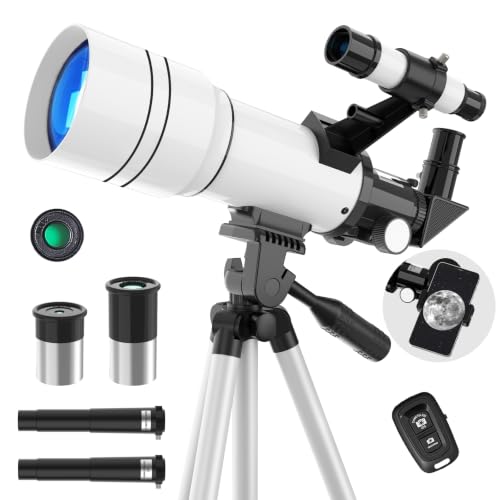
Telescope for Kids and Adults, Astronomical Telescopes (15X-150X) with Fully Multi-Coated Optics, 70MM Aperture 300MM Refracting Telescope for Moon, Astronomy Beginners Gifts with Phone Adapter
As an Amazon Associate we earn from qualifying purchases. Product prices and availability are accurate as of the date/time indicated.

Hawkko 90mm Aperture 900mm Telescope for Adults High Powered - Professional Multi-Coated Refractor Telescope for Astronomy Beginners (36X-270X) with AZ Mount, Phone Adapter and Carry Bag
As an Amazon Associate we earn from qualifying purchases. Product prices and availability are accurate as of the date/time indicated.
Best Budget Telescope for Beginners Astronomy in 2026: Detailed Reviews
1. Celestron AstroMaster 70AZ — Best Budget Telescope for Beginners Astronomy Overall
The Celestron AstroMaster 70AZ is the best all-rounder in this list because it does the beginner job well: it has a 70mm aperture, a 900mm focal length, an alt-az mount, and a maximum useful magnification of about 140x. An alt-az mount moves up and down and left and right, which is the easiest mount for a beginner, because you point it like you point a camera — you do not need to polar align it, and you do not need to learn equatorial coordinates.
Aperture gathers light, and a 70mm aperture gathers enough light to show the Moon in detail, to show Jupiter’s four Galilean moons, and to show Saturn’s rings. A smaller aperture, like a 50mm, will not gather enough light to show Saturn’s rings clearly, and a larger aperture, like a 130mm, will gather more light and show more detail, but it will cost more and it will be heavier. For a beginner, a 70mm is the right starting point, because it is affordable, it is portable, and it is enough to show the best objects in the sky.
Maximum useful magnification is about 50x per inch of aperture, and a 70mm telescope is about 2.75 inches, so 50 times 2.75 is about 137x, or about 140x. A telescope that claims 675x for a 70mm aperture is not useful, because the image will be dim and blurry at that magnification. Use low power for most viewing: use 50 to 100x for galaxies, use 100 to 150x for the Moon and planets, and use a low-power eyepiece to find an object, then switch to a higher-power eyepiece to see detail. And use red light only at night, because white light will ruin your night vision, and it takes 20 to 30 minutes for your eyes to adapt to the dark.
2. Celestron Travel Scope 70 — Best Portable Budget Telescope for Beginners Astronomy
It is the most portable telescope in this list, and it is the right pick if you want a telescope that fits in a backpack, you travel, or you have a small balcony. A tabletop Dobsonian fits on a balcony table, and a Travel Scope 70 fits in a backpack, so it is the most portable choice for a beginner who wants to take a telescope to a dark site.
The Travel Scope 70 has a shorter focal length than the AstroMaster 70AZ — 400mm versus 900mm — so it has a wider field of view and it is easier to find an object, but it has less magnification for planets. It is a good pick for a beginner who wants a wide-field telescope for the Moon and for star clusters, and for a traveller who wants a light telescope. It is not the best pick if you want the highest magnification for planets — the AstroMaster 70AZ with a 900mm focal length is better for planets — or if you want a Dobsonian for deep sky, because the Travel Scope 70 is too small for faint galaxies.
3. Sky-Watcher Heritage 130P — Best Dobsonian Budget Telescope for Beginners Astronomy
It is the best Dobsonian in this list, because a Dobsonian is a stable alt-az mount on a ground or table base, it is easy to point, and it holds a larger aperture for the price. A 130mm aperture gathers more light than a 70mm aperture, so it will show more detail on the Moon and planets, and it will show deep-sky objects like the Orion Nebula and the Andromeda Galaxy more clearly.
A Dobsonian mount is an alt-az mount on a stable base, and it is the easiest mount for a large telescope, because you push it by hand to point it, and it stays where you put it. A tabletop Dobsonian fits on a balcony table, on a picnic table, or on a sturdy stool, and it is the right pick if you have a table and you want a larger aperture without a tripod. The Heritage 130P has a maximum useful magnification of about 260x, because 130mm is about 5.1 inches, and 50 times 5.1 is about 255x. Use low power, 50 to 100x, for galaxies, because a galaxy is large and faint, and a high magnification will make it dimmer and harder to see. And use a dark site, a moonless night, and red light only for deep sky, because light pollution will wash out a faint galaxy.
4. Celestron PowerSeeker 127EQ — Best Equatorial Budget Telescope for Beginners Astronomy
It is the equatorial entry in this list, and it is the right pick if you want an equatorial mount, you want to learn equatorial coordinates, and you want a larger aperture than a 70mm. An equatorial mount is polar-aligned, which means you point its axis at the North Star, and then you can track a star by turning one knob, instead of moving the telescope in two directions.
An equatorial mount is more complex than an alt-az mount, and it needs polar alignment for imaging, and it is harder for a beginner to set up. A GoTo mount is motorised and it needs batteries and alignment, and it is even more complex. For a beginner, an alt-az mount is easier, and an equatorial mount is a second telescope, not a first. The PowerSeeker 127EQ is a good pick if you want an equatorial mount, you are willing to learn polar alignment, and you want a 127mm aperture. It is not the best pick if you want the easiest telescope — the AstroMaster 70AZ with an alt-az mount is easier.
5. Gskyer Telescope 70mm AZ — Best Gskyer Budget Telescope for Beginners Astronomy
The Gskyer 70mm has a shorter focal length than the AstroMaster 70AZ, so it has a wider field of view, but it has less magnification for planets. It is a good pick for a beginner who wants a wide-field telescope for the Moon and for star clusters. It is not the best pick if you want the best mount — the AstroMaster’s mount is more stable — or if you want the best optics, because the Gskyer’s optics are less sharp at the edges. For a first telescope on a tight budget, the Gskyer is enough.
6. Zhumell Z130 Portable Dobsonian — Best Zhumell Budget Telescope for Beginners Astronomy
It is similar to the Sky-Watcher Heritage 130P, with a slightly different design and a slightly different mount, but it has the same aperture and the same focal length. It is the Zhumell entry in this list, and it is the right pick if you want a Zhumell, you want a tabletop Dobsonian, and you want a larger aperture for deep sky.
The Z130 has a maximum useful magnification of about 260x, like the Heritage 130P, and it is best for deep sky at low power, 50 to 100x. It is a good pick if you want a Zhumell, you want a Dobsonian, and you want a telescope that fits on a table.
7. Celestron AstroMaster 130EQ — Best 130mm Budget Telescope for Beginners Astronomy
It is the larger AstroMaster in this list, and it is the right pick if you want a Celestron, you want a 130mm aperture, and you want an equatorial mount. The AstroMaster 130EQ has a larger aperture than the AstroMaster 70AZ, so it will show more detail, but it has an equatorial mount, which is more complex than an alt-az mount.
The AstroMaster 130EQ is a good pick if you want a Celestron, you want a larger aperture, and you are willing to learn an equatorial mount. It is not the best pick if you want the easiest telescope — the AstroMaster 70AZ with an alt-az mount is easier — or if you want a Dobsonian, because the 130EQ is on a tripod, not a Dobsonian base. For a beginner who wants a larger aperture and an equatorial mount, the 130EQ is the right buy.
Best Budget Telescope for Beginners Astronomy Buying Guide
Choosing a budget telescope for beginners astronomy is not just about picking the cheapest telescope. It is about matching aperture, mount, magnification, and price to the beginner, the sky, and the way you observe. A telescope that is perfect for the Moon can be wrong for galaxies if it does not have enough aperture, and a telescope that is perfect for galaxies can be wrong for a beginner if its mount is too complicated.
Aperture, Light, and Galaxies: Choosing a Budget Telescope for Beginners Astronomy That Shows Deep Sky
Aperture is the first filter. Aperture gathers light, and a larger aperture gathers more light and shows more detail. A 70mm aperture is enough for the Moon, Jupiter, and Saturn, a 130mm aperture is better for deep sky, because it gathers more light and it will show the Orion Nebula and the Andromeda Galaxy more clearly. Andromeda is about 2.5 million light-years away, the Whirlpool Galaxy is about 23 million light-years away, and both are faint, so they need a dark site, a moonless night, and red light only to see them well.
Low power is best for galaxies: use 50 to 100x for galaxies, because a galaxy is large and faint, and a high magnification will make it dimmer and harder to see. Use a low-power eyepiece to find a galaxy, then switch to a slightly higher power to see detail, but do not use the maximum magnification for a galaxy, because the image will be too dim. And use a dark site: a telescope in a city with light pollution will not show a faint galaxy, no matter how large its aperture, while a telescope at a dark site will show a galaxy even with a 70mm aperture.
Mount, Alt-Az vs Equatorial vs Dobsonian, and Load: Choosing a Budget Telescope for Beginners Astronomy That Is Easy to Point
Mount is the second filter. An alt-az mount moves up and down and left and right, and it is the easiest mount for a beginner, because you point it like you point a camera. A Dobsonian is a stable alt-az mount on a ground or table base, and it is the easiest mount for a large telescope, because you push it by hand and it stays where you put it. An equatorial mount is polar-aligned, it needs polar alignment for imaging, and it is more complex than an alt-az mount. A GoTo mount is motorised, it needs batteries and alignment, and it is even more complex.
Mount load should be at least 2 times the telescope weight for visual use, and at least 3 times for astrophotography, because a mount that is overloaded will wobble and it will be hard to see anything. A tabletop Dobsonian fits on a balcony table, on a picnic table, or on a sturdy stool, and it is the right pick if you have a table. A tripod telescope needs a stable tripod, and a tripod that is too light will wobble in wind. And check your balcony or building rules: some buildings prohibit a telescope on a balcony, and some balconies have a weight limit.
Magnification, Moon, and Red Light: Using a Budget Telescope for Beginners Astronomy at Night
Magnification and Moon are the third filter. Maximum useful magnification is about 50x per inch of aperture, and a 70mm telescope is about 2.75 inches, so its maximum is about 140x. A telescope that claims 675x for a 70mm aperture is not useful, and you should ignore the claimed magnification on the box. Use low power to find an object, then switch to higher power to see detail, and use a low-power eyepiece for galaxies and a higher-power eyepiece for the Moon and planets.
The best Moon to view is at quarter Moon, not full Moon, because at quarter Moon, the terminator — the line between light and dark — creates shadows that show craters and mountains in detail, while at full Moon, the light is flat and craters are hard to see. Never look at the Sun through a telescope, and never look at the Sun without a front solar filter, because looking at the Sun through an optic can damage your eyes. And use red light only at night, because white light will ruin your night vision, and it takes 20 to 30 minutes for your eyes to adapt to the dark. A red flashlight is the right tool for astronomy, and a white flashlight should not be used at a dark site.
Best Budget Telescope for Beginners Astronomy FAQ
What is the best budget telescope for beginners astronomy?
What aperture do I need for a beginner telescope for astronomy?
For a beginner telescope for astronomy, you need an aperture of at least 70mm, because a 70mm aperture gathers enough light to show the Moon, Jupiter, and Saturn clearly. A 130mm aperture is better for deep sky, because it gathers more light and it will show the Orion Nebula and the Andromeda Galaxy more clearly. A smaller aperture, like a 50mm, will not gather enough light to show Saturn’s rings clearly, and a larger aperture will cost more and be heavier. For a first telescope, a 70mm is enough, and a 130mm is better if you can afford it.
Should I choose an alt-az or equatorial mount for a beginner telescope?
For a beginner telescope, you should choose an alt-az mount, because an alt-az mount moves up and down and left and right, and it is the easiest mount to point, like a camera. A Dobsonian is a stable alt-az mount on a ground or table base, and it is the easiest mount for a large telescope. An equatorial mount is polar-aligned, it needs polar alignment for imaging, and it is more complex than an alt-az mount. A GoTo mount is motorised, it needs batteries and alignment, and it is even more complex. For a first telescope, an alt-az or Dobsonian is the right choice.
What is the best Moon phase to view with a beginner telescope?
For a beginner telescope, the best Moon phase to view is a quarter Moon, not a full Moon, because at quarter Moon, the terminator — the line between light and dark — creates shadows that show craters and mountains in detail, while at full Moon, the light is flat and craters are hard to see. Use red light only at night, because white light will ruin your night vision, and it takes 20 to 30 minutes for your eyes to adapt to the dark. Never look at the Sun through a telescope, and never look at the Sun without a front solar filter.
FAQ
What aperture do I need for a beginner telescope for astronomy?
Should I choose an alt-az or equatorial mount for a beginner telescope?
What is the best Moon phase to view with a beginner telescope?
Related guides
- Best Optics for Beginners Winter Use in 2026: Fogproof Binoculars Graded on the Cold Transition — Warm Car to Frozen Field Without Losing the View
- Best Cell Phone Monocular in 2026: 7 Best Cell Phone Monoculars With Clear View, Simple Use, and Easy Use for Cell Phone Monocular
- Best Monocular for Glasses Wearers Comfort in 2026: Monocular for Glasses Wearers Comfort, Glasses Wearers Monoculars, and Best Comfortable Monoculars for Glasses Wearers
- Best Binoculars for Camping Trips Viewing in 2026: 7 Binoculars for Camping Trips Viewing That Offer Clear Optics, Easy Carry, and Reliable Performance for Camping
More from Amazon
Programs that pair well with the guide above. Offers and eligibility are set by Amazon and may change.
Free shipping on eligible items, Prime Video and more. Eligible new members can start with a free trial.
Start a Prime free trialAudiobooks and podcasts to listen to on the go. Eligible new members can start with a free trial.
Try Audible freeAd-free music streaming. Eligible new subscribers can start with a free trial.
Try Music Unlimited freeA free business account with business pricing and bulk-buying tools for work, shop or home office.
Create a business accountAs an Amazon Associate we earn from qualifying purchases.

Write Your Review
No reviews yet. Be the first to share your experience!