
What's inside
As an Amazon Associate I earn from qualifying purchases. This post may contain affiliate links at no extra cost to you.
Galaxy viewing distance is not about how far a telescope can see in miles. It is about aperture, dark sky, and low magnification. A galaxy like Andromeda is about 2.5 million light-years away, and it is visible in a small telescope from a dark site, because it is large and relatively bright. A fainter galaxy like the Whirlpool, about 23 million light-years away, needs a larger aperture and a darker sky to show detail. A telescope does not magnify distance, it gathers light, and the more light it gathers, the fainter and more distant the galaxy it can show.
For most galaxy viewers, the practical pick is an 8-inch telescope. An 8-inch Dobsonian gathers enough light to show Andromeda, the Whirlpool, the Sombrero, and dozens of other galaxies from a dark site, without the cost and weight of a 10-inch or 12-inch scope.
This guide compares seven real, currently sold telescopes for galaxy viewing. It explains how aperture, focal ratio, mount, and dark sky decide what galaxies you can see, why low magnification is better than high magnification for galaxies, and how to choose between a Dobsonian and a GoTo scope. It is written for a beginner who wants to see galaxies for the first time, and for a viewer who already has a small telescope and wants to step up.
Our Top Picks
 Hemrsey 90mm Aperture 800mm Refractor Telescopes for Adults25.59 x 5.31 x 8.27 inchesCheck on Amazon
Best Telescope for Galaxy Viewing Distance Compared
Use this table to compare the best telescope for galaxy viewing distance at a glance. Aperture is listed in inches and millimetres, because both are used in shops. Ratings are editorial scores out of five based on aperture, mount, ease of finding galaxies, and value for galaxy viewing.
| Model | Key Specs | Best For |
|---|---|---|
| Celestron NexStar 8SE | 8 in / 203mm, f/10, GoTo, 40,000 objects, 11.9 kg | Best overall telescope for galaxy viewing distance |
| Sky-Watcher Skyliner-200P Dobsonian | 8 in / 203mm, f/6, manual Dob, 2 in focuser, 13.5 kg | Best value telescope for galaxy viewing distance |
| Sky-Watcher Skyliner-250PX Dobsonian | 10 in / 254mm, f/4.7, manual Dob, 2 in focuser, 18 kg | Best large-aperture telescope for galaxy viewing distance |
| Celestron NexStar 6SE | 6 in / 150mm, f/10, GoTo, 40,000 objects, 9.5 kg | Best compact GoTo telescope for galaxy viewing |
| Explore Scientific ED102 Apo Refractor | 102mm, f/7, refractor, 2.5 in focuser, needs mount | Best refractor telescope for galaxy viewing wide field |
| ZWO Seestar S50 Pro | 50mm, smart telescope, app, stacking, 2.5 kg | Best smart telescope for galaxy viewing distance |
| Celestron Advanced VX 8 in SCT | 8 in / 203mm, f/10, equatorial GoTo, 24 kg total | Best equatorial telescope for galaxy viewing and imaging |

Celestron StarSense Explorer DX 130AZ Smartphone Guided Newtonian Telescope | Smartphone App Sky Navigation, Parabolic Reflector Telescope & Premium Mount, DeepSky Viewing, Perfect for Backyard Astronomy
As an Amazon Associate we earn from qualifying purchases. Product prices and availability are accurate as of the date/time indicated.

UncleHu Telescope for Adults & Kids 8-12, 80mm FMC Refractor for Beginners | 400mm Astronomy Telescope for Moon Viewing & Landscape Exploration, DIY Stickers, STEM Gift for Girls & Boys - White Blue

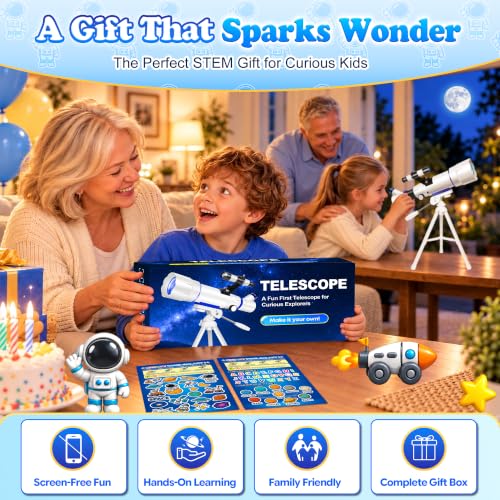


As an Amazon Associate we earn from qualifying purchases. Product prices and availability are accurate as of the date/time indicated.
Hemrsey 90mm Aperture 800mm Refractor Telescopes for Adults High Powered | FMC Optics, Moon Viewing, Stargazing, Bird Watching, Daytime Scenery, 240X Magnification, Aluminum Tripod, Easy Setup


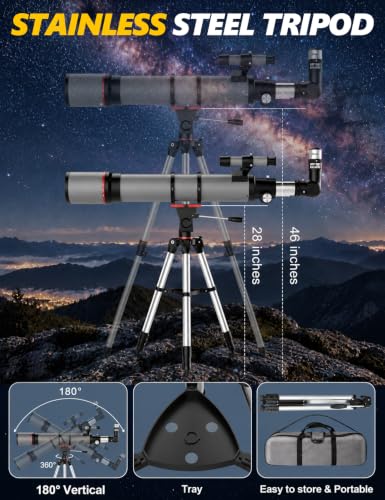


As an Amazon Associate we earn from qualifying purchases. Product prices and availability are accurate as of the date/time indicated.
Best Telescope for Galaxy Viewing Distance in 2026: Detailed Reviews
1. Celestron NexStar 8SE — Best Telescope for Galaxy Viewing Distance Overall
The Celestron NexStar 8SE is an 8-inch Schmidt-Cassegrain telescope on a GoTo alt-azimuth mount, with a focal ratio of f/10, a database of about 40,000 objects, and a total weight of about 11.9 kilograms for the optical tube and mount. It has a single fork arm, a hand controller, and a design that is made for a beginner who wants to find galaxies without star-hopping.
For galaxy viewing, the NexStar 8SE is a good choice because its 8-inch aperture gathers enough light to show Andromeda as a large oval with a bright core, the Whirlpool as a faint pair with a hint of spiral structure from a dark site, and the Sombrero as a small oval with a dark lane on a good night. Its GoTo mount is the reason it leads this list: a beginner can align on two or three bright stars, select a galaxy from the database, and the scope will slew to it, which saves time and frustration compared with star-hopping to a faint galaxy that is hard to find in a finderscope. Its f/10 focal ratio gives a longer focal length, so it is better for smaller galaxies at higher magnification, though it is less good for very wide-field views of large galaxies like Andromeda, which can fill the field at low power.
Its limitation is aperture per dollar. An 8-inch Dobsonian costs less than half as much for the same aperture, so a viewer on a budget will get more light for less money with a Dobsonian. The NexStar 8SE is best for a viewer who values GoTo finding, who has a small car or a small storage space, and who wants a compact scope that can be set up quickly on a patio.
2. Sky-Watcher Skyliner-200P Dobsonian — Best Value Telescope for Galaxy Viewing Distance
The Sky-Watcher Skyliner-200P is an 8-inch Newtonian reflector on a manual Dobsonian mount, with a focal ratio of f/6, a 2-inch focuser, and a weight of about 13.5 kilograms for the tube and base. It has no GoTo, no motors, and no database. It is a simple, large mirror on a simple, stable base, and that simplicity is its strength for galaxy viewing.
At f/6, it gives a wider field than the NexStar 8SE at f/10, so Andromeda fits more easily in the field at low power, and it shows a brighter image at the same magnification, because a faster focal ratio gives a brighter image for extended objects like galaxies. Its 2-inch focuser lets a viewer use a wide-field 2-inch eyepiece, which is useful for large galaxies. Its Dobsonian base is stable, easy to move by hand, and easy to set up: place the base on flat ground, put the tube in the cradle, and it is ready. A viewer must find galaxies by star-hopping, using a star chart or an app, which takes practice, but it teaches the sky in a way GoTo does not.
For a viewer who wants the most aperture for the least money, the Skyliner-200P is the best buy in this list. It is heavier and larger than the NexStar 8SE, so it needs a car with a large boot or a garage, but it shows the same galaxies for less than half the price.
3. Sky-Watcher Skyliner-250PX Dobsonian — Best Large-Aperture Telescope for Galaxy Viewing Distance
The Sky-Watcher Skyliner-250PX is a 10-inch Newtonian reflector on a manual Dobsonian mount, with a focal ratio of f/4.7, a 2-inch focuser, and a weight of about 18 kilograms. It has a larger aperture than the 8-inch scopes above, so it gathers more light and shows fainter galaxies with more detail.
A 10-inch aperture gathers about 56 percent more light than an 8-inch aperture, because light gathering depends on area, not diameter alone. That difference is visible on faint galaxies: a galaxy that is a faint smudge in an 8-inch scope can show a core and a hint of structure in a 10-inch scope from the same dark site. Its f/4.7 focal ratio is fast, so it gives a bright, wide-field view, though it needs more careful collimation than a slower scope, and it is heavier and larger than an 8-inch Dobsonian, so it needs a larger car and a stronger back to move.
For a viewer who has a dark site, a large car, and a desire to see fainter galaxies, the Skyliner-250PX is a good step up from 8 inches. For a viewer with a small car or a small flat, the 8-inch Dobsonian is easier to live with.
4. Celestron NexStar 6SE — Best Compact GoTo Telescope for Galaxy Viewing
The Celestron NexStar 6SE is a 6-inch Schmidt-Cassegrain telescope on a GoTo alt-azimuth mount, with a focal ratio of f/10, a database of about 40,000 objects, and a total weight of about 9.5 kilograms. It is smaller and lighter than the NexStar 8SE, so it is easier to carry and store, though its 6-inch aperture gathers less light than an 8-inch scope.
For galaxy viewing, the NexStar 6SE will show Andromeda, the Whirlpool, and other bright galaxies, but they will be fainter and smaller than in an 8-inch scope. A 6-inch aperture gathers about 44 percent less light than an 8-inch aperture, so faint galaxies that are visible in an 8-inch scope from a dark site may be invisible in a 6-inch scope from the same site. Its GoTo mount is the same as the 8SE, so it is easy to find galaxies, and its compact size is useful for a viewer with a small car or a balcony, though a balcony has light pollution and a limited view, so a dark site is still better for galaxies.
It is best for a viewer who values portability and GoTo over aperture, and who mainly wants to see bright galaxies, not the faintest ones. A viewer who wants the faintest galaxies should choose an 8-inch or 10-inch scope.
5. Explore Scientific ED102 Apo Refractor — Best Refractor Telescope for Galaxy Viewing Wide Field
The Explore Scientific ED102 is a 102mm apochromatic refractor, with a focal ratio of f/7, a 2.5-inch focuser, and a tube that needs a separate mount. It is a refractor, not a reflector, so it has no central obstruction, and it gives a sharp, high-contrast image.
For galaxy viewing, a 102mm refractor is smaller in aperture than an 8-inch reflector, so it gathers less light and shows fainter galaxies less well. Its strength is wide-field views: at f/7, with a wide-field eyepiece, it can show Andromeda with its companion galaxies in the same field, and it can show large star clusters and nebulae with a wide, sharp view. It is best as a wide-field telescope for large, bright galaxies, not as a primary telescope for faint galaxies. A viewer who already has an 8-inch Dobsonian for faint galaxies can add the ED102 for wide-field views, but a beginner who buys only the ED102 will see fewer faint galaxies than with an 8-inch Dobsonian.
6. ZWO Seestar S50 Pro — Best Smart Telescope for Galaxy Viewing Distance
The ZWO Seestar S50 Pro is a 50mm smart telescope, with an app, live stacking, and a weight of about 2.5 kilograms. It is not a visual telescope in the usual sense: it takes many short exposures and stacks them in the app, so a galaxy that is invisible to the eye through a 50mm lens can appear on a phone screen after a minute of stacking. The original Seestar S50 was replaced by the S50 Pro, so the Pro is the current model to buy.
For galaxy viewing, the Seestar S50 Pro is different from the other scopes here. It does not show a galaxy to the eye, it shows it on a screen, with colour and detail that the eye cannot see in a small telescope. That makes it useful for a viewer in a light-polluted city, where a visual telescope shows little, and for a beginner who wants to see a galaxy image quickly without star-hopping. Its 50mm aperture is small, so it relies on stacking, not on light gathering alone, and it needs a charged battery, a phone, and a clear view of the sky. It is best as a complement to a visual telescope, or as a first telescope for a viewer who prefers a screen to an eyepiece.
7. Celestron Advanced VX 8 in SCT — Best Equatorial Telescope for Galaxy Viewing and Imaging
The Celestron Advanced VX 8-inch Schmidt-Cassegrain is an 8-inch telescope on an equatorial GoTo mount, with a focal ratio of f/10 and a total weight of about 24 kilograms for the tube, mount, and tripod. It has a German equatorial mount, which tracks the sky by rotating on one axis, so it can track a galaxy for a long time without field rotation, which is useful for imaging.
For visual galaxy viewing, the Advanced VX 8-inch shows the same galaxies as the NexStar 8SE, because it has the same 8-inch aperture. Its advantage is for imaging: an equatorial mount is better than an alt-azimuth mount for long exposures, because it tracks in the right direction. Its disadvantage is weight and setup time: at 24 kilograms total, it is heavier than the NexStar 8SE, and it needs polar alignment, which takes time and practice. It is best for a viewer who wants to do both visual galaxy viewing and astrophotography, not for a beginner who wants a quick visual setup.
Best Telescope for Galaxy Viewing Distance Buying Guide
Choosing a telescope for galaxy viewing is not just about picking the largest aperture. It is about matching aperture, mount, and dark sky to the galaxies you want to see, and to the time and transport you have. A telescope that is perfect for a dark site can be wrong for a city balcony, and a telescope that is perfect for visual viewing can be wrong for imaging.
Aperture, Light Gathering, and Faint Galaxies: How Much Aperture Do You Need
Aperture is the first filter, and it is the most important for galaxy viewing. A larger aperture gathers more light, so it shows fainter galaxies and more detail in bright galaxies. An 8-inch telescope gathers about 56 percent more light than a 6-inch telescope, and a 10-inch telescope gathers about 56 percent more light than an 8-inch telescope, because light gathering depends on the area of the mirror, which grows with the square of the diameter. That is why an 8-inch scope is a practical sweet spot for most viewers: it shows many galaxies from a dark site, without the cost and weight of a 10-inch or 12-inch scope.
For bright galaxies, a smaller telescope can work. Andromeda is large and relatively bright, so it is visible in a 6-inch scope and even in binoculars from a dark site, as a large oval with a bright core. For fainter galaxies like the Whirlpool, the Sombrero, and the many galaxies in the Virgo Cluster, a larger aperture helps, because those galaxies are fainter and smaller. A viewer who wants to see the faintest galaxies should choose the largest aperture they can transport and store, while a viewer who mainly wants bright galaxies can choose a smaller, more portable scope.
Maximum useful magnification is about 50 times per inch of aperture, so an 8-inch scope has a maximum of about 400x, and a 10-inch scope has a maximum of about 500x, though galaxies are best viewed at low magnification, not at maximum, because low magnification gives a brighter image and a wider field, which is better for an extended object like a galaxy. Use low power, 50x to 100x, for most galaxies, and only increase magnification on a small, bright galaxy on a good night.
Dark Sky, Light Pollution, and Low Magnification: Why Location Matters More Than Magnification
Dark sky is the second filter, and it matters more than magnification for galaxy viewing. A galaxy that is easy to see from a dark site can be invisible from a city, even in a large telescope, because light pollution washes out faint light. A viewer should travel to a dark site, away from city lights, with a clear horizon and no Moon, because the Moon also washes out faint galaxies. The best time to view galaxies is on a moonless night, with no clouds, and with eyes adapted to the dark for about 20 minutes.
For night vision, use a red light only, because a red light preserves night vision, while a white light will ruin it. A red flashlight, a red headlamp, or a phone screen on red mode is useful for reading a star chart without losing dark adaptation. For a telescope, use low magnification for galaxies, because low magnification gives a brighter image, and a galaxy is an extended object, not a point, so it needs a bright, wide-field view, not a high-power, narrow view. A high magnification will make a galaxy dimmer and harder to see, so start low and only increase power if the galaxy is bright and small.
For a telescope, never look at the Sun through any optic, and never look at the Sun without a front solar filter, because looking at the Sun through a telescope can cause permanent eye damage. A solar filter must be on the front of the telescope, not on the eyepiece, and it must be checked for damage before use.
Mount Type, GoTo vs Dobsonian, and Transport: Choosing a Mount You Will Actually Use
Mount type is the third filter. A Dobsonian mount is a simple, stable, manual mount that is easy to use and cheap, because it has no motors or electronics, and it lets a viewer move the telescope by hand to follow a galaxy. A GoTo mount is a motorised mount that finds galaxies automatically, after alignment on two or three bright stars, which saves time and helps a beginner find faint galaxies that are hard to star-hop to. An equatorial mount is a GoTo mount that tracks the sky by rotating on one axis, which is better for imaging, but it needs polar alignment and is heavier.
For a beginner, a GoTo mount is helpful, because it removes the hardest part of galaxy viewing, which is finding a faint galaxy in a finderscope. For a viewer on a budget, a Dobsonian is better value, because the same money buys a larger aperture, and star-hopping teaches the sky. For a viewer who wants to do imaging, an equatorial mount is better, because it tracks without field rotation.
For transport, check weight and size before buying. An 8-inch Dobsonian weighs about 13.5 kilograms and fits in a large car boot, while a 10-inch Dobsonian weighs about 18 kilograms and needs a larger car. A NexStar 8SE weighs about 11.9 kilograms and is more compact, so it fits in a smaller car. A mount should be stable, with a load that is enough for the optical tube, and a tripod or base that is on level ground, because a shaky mount will make a galaxy image shake and will ruin the view.
Best Telescope for Galaxy Viewing Distance FAQ
What is the best telescope for galaxy viewing distance?
The Sky-Watcher Skyliner-200P Dobsonian is the best value alternative with the same 8-inch aperture for less money, while the Sky-Watcher Skyliner-250PX is the best large-aperture alternative for fainter galaxies.
How far away are the galaxies I can see with a telescope?
With a telescope from a dark site, you can see Andromeda, about 2.5 million light-years away, as a large oval, the Whirlpool, about 23 million light-years away, as a faint pair, and many other galaxies in the Virgo Cluster, about 50 million light-years away, as small smudges. Distance alone does not decide visibility, because a large, bright galaxy at a greater distance can be easier to see than a small, faint galaxy closer to us, so aperture, dark sky, and low magnification matter more than distance.
What magnification is best for viewing galaxies?
For viewing galaxies, low magnification is best, typically 50x to 100x, because low magnification gives a brighter image and a wider field, which is better for an extended object like a galaxy. High magnification makes a galaxy dimmer and harder to see, so start low and only increase power on a small, bright galaxy on a good night. Maximum useful magnification is about 50 times per inch of aperture, so an 8-inch scope has a maximum of about 400x, but that maximum is not useful for most galaxies.
Do I need a dark sky to see galaxies with a telescope?
Yes, you need a dark sky to see most galaxies with a telescope, because light pollution washes out faint light, and a galaxy that is easy to see from a dark site can be invisible from a city, even in a large telescope. Travel to a dark site, away from city lights, on a moonless night, with eyes adapted to the dark for about 20 minutes, and use a red light only, because a red light preserves night vision, while a white light will ruin it.
FAQ
What is the best telescope for galaxy viewing distance?
How far away are the galaxies I can see with a telescope?
What magnification is best for viewing galaxies?
Do I need a dark sky to see galaxies with a telescope?
Related guides
- Best Optics for Beginners Winter Use in 2026: Fogproof Binoculars Graded on the Cold Transition — Warm Car to Frozen Field Without Losing the View
- Best Cell Phone Monocular in 2026: 7 Best Cell Phone Monoculars With Clear View, Simple Use, and Easy Use for Cell Phone Monocular
- Best Monocular for Glasses Wearers Comfort in 2026: Monocular for Glasses Wearers Comfort, Glasses Wearers Monoculars, and Best Comfortable Monoculars for Glasses Wearers
- Best Binoculars for Camping Trips Viewing in 2026: 7 Binoculars for Camping Trips Viewing That Offer Clear Optics, Easy Carry, and Reliable Performance for Camping
More from Amazon
Programs that pair well with the guide above. Offers and eligibility are set by Amazon and may change.
Free shipping on eligible items, Prime Video and more. Eligible new members can start with a free trial.
Start a Prime free trialAudiobooks and podcasts to listen to on the go. Eligible new members can start with a free trial.
Try Audible freeAd-free music streaming. Eligible new subscribers can start with a free trial.
Try Music Unlimited freeA free business account with business pricing and bulk-buying tools for work, shop or home office.
Create a business accountAs an Amazon Associate we earn from qualifying purchases.

Write Your Review
No reviews yet. Be the first to share your experience!